



Our Investor Report delves into the extent of commitments made to private credit by different institutions.
In last month’s column, we considered some of the findings of our latest Investor Report – including that 63 percent of institutions canvassed describe themselves as under-allocated to the asset class.
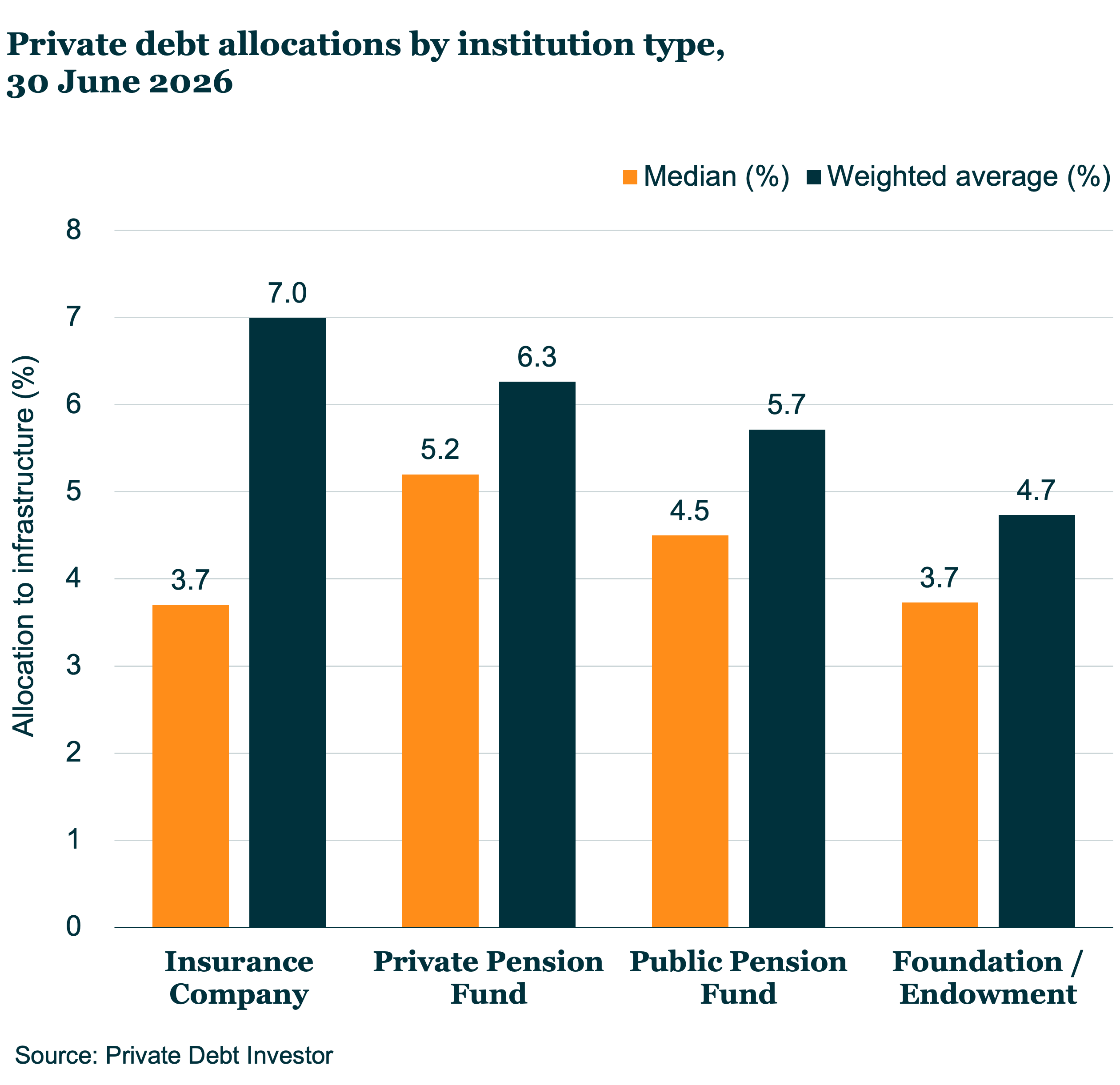
Also contained within the report is interesting information around the commitment percentages of different types of organisation – measured on both a median and weighted average basis (see chart).
While the median is the middle value when all allocations are sorted by size, the weighted average is gleaned from the total capital size of each commitment – giving greater influence to larger funds and institutions.
On a median basis, it transpires from our sample that private pension funds are the most committed to private credit with a 5.2 percent median allocation. But on a weighted average basis, insurance companies come out on top with 7.0 percent.
Indeed insurance companies demonstrate the biggest margin between the median and the weighted average (insurers’ median allocation standing at only 3.7 percent). This suggests that large insurers, with big capital bases, are engaging with the asset class – but smaller to medium sized insurers are not making anything like the same impact.
The report also charts the biggest commitments made to the asset class in the first six months of the year. The largest individual check of $1 billion was written by New York State Common Retirement for Kennedy Lewis Investment Management’s KLIM Delta Excelsior Fund.
When it came to the largest volume of commitments made to private credit in H1, Kern County Employees Retirement Association tops the list with seven commitments followed by New Jersey Division of Investment with six.





Latest news

Rate hike expectations ease as term SOFR curve flattens
The CME six-month Term SOFR rate reached a recent high of 3.979% on July 28 before retreating to 3.837% as…
3Q26: New loan assets rise to 44% of total lending, a 3-year high
New loan assets as a proportion of total US loan volume make up 44% of the 3Q26 pipeline to date,…

North American GPs dominant as fundraising accelerates
Our PEI Private Credit 200 ranking also shows capital raising increasing overall – and accelerating especially fast for the largest…