



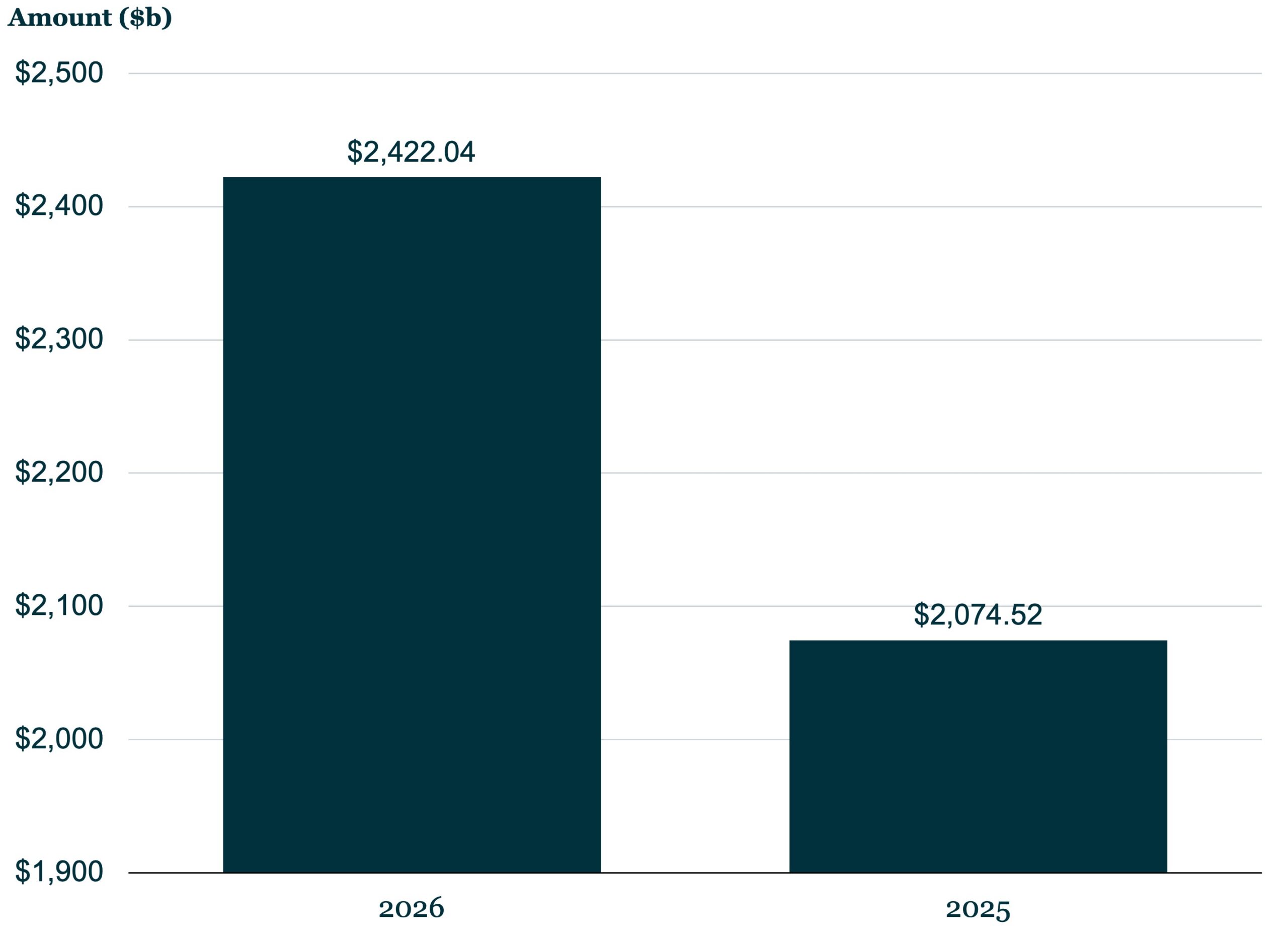
Our PEI Private Credit 200 ranking also shows capital raising increasing overall – and accelerating especially fast for the largest fund managers.
Every year PEI Private Credit compiles a list of the asset class’s most prolific fundraisers, based on fresh capital accumulated over a rolling five-year period. So, what does this year’s ranking tell us about the current dynamics in private credit fundraising? Here are a few of the key observations:
1. Fundraising on the up: Counting back five years from 2026, capital raised by private credit’s 200 most prolific fundraisers totalled $2,422 billion – a significant increase on the $2,074 billion raised by the same cohort when measured on a rolling five-year basis in 2025. This shows increasing fundraising momentum for private credit firms overall, as indicated by our H1 2026 fundraising report, which indicated that this year could be a record-breaker.
2. The big get bigger: One of the anecdotal observations often made about private credit is the growing dominance of the largest GPs – bigger teams, more assets under management, widening product suites and increasingly powerful fundraising machines. This is borne out very strongly by our ranking, which shows the top ten fundraisers accounting for more than a third (34.6 percent) of total funds raised over the five-year period – compared with 65.4 percent for the other 190 firms.
3. North America rules the roost: The five-year period confirms the dominance of North America-headquartered fund managers when it comes to capital-raising efforts. Of the total $2,422 billion raised globally, the region accounted for a huge $1,795 billion. Western Europe trails behind on just over $550 billion, with Asia-Pacific the only other significant fundraising region with slightly more than $71 billion.



Latest news

US Leveraged Loans Return 3.36% to Investors YTD
The Bloomberg US Leveraged Loan Index (Ticker: LOAN) returned 0.96% in August and has gained an additional 0.28% through September…

PE dry powder
The capital that is being raised is flowing overwhelmingly to the largest, most established managers.

Middle market debt held by BDCs vs High yield vs Treasury yields
The blue line represents the current dividend yield of the VanEck BDC Income ETF (BIZD), which stood at 11.7% as…