



Overall Optimistic, Investors See Choppiness Ahead
Private equity firms typically target companies that are in trouble. It’s the heart of the traditional buyout model, which, although shifting as the industry matures, remains the core of PE dealmaking. However, the relative health of target companies can shift considerably depending on overall deal trends—nowadays is no exception. Since 3Q 2013, the percentage of PE firms stating their target acquisitions had positive revenue increases in the 12 months prior to the deal has stayed firmly above 70%. In and of itself, this doesn’t mean PE firms have been purchasing healthy companies, as many other factors play into a company’s wellbeing. But it does indicate that up until a few quarters ago, PE firms had to resort to acquiring companies that are better off, relatively speaking, than the typical picture of the struggling firm courting PE bids.

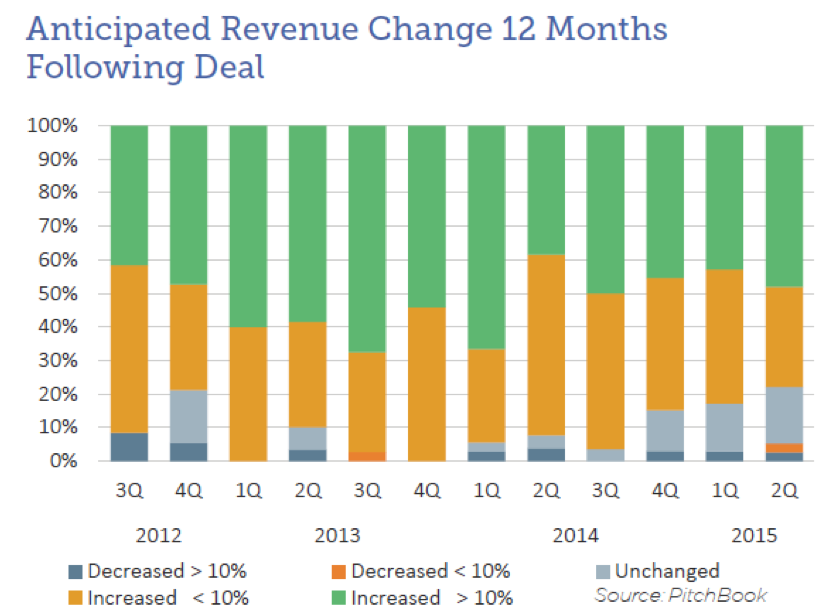
Things have been shifting as of late, however, with the percentage of acquired companies having had flat or decreasing revenues closing in on 30% in 2Q 2015. Coupling that with a small but significant uptick in the proportion of dealmakers who state that they anticipate no change, or even a decrease in acquired company revenues, it’s clear investors are sanguine on the whole but expect some turbulence going forward. Choppy prospects in sectors hit hard by plunging commodity prices, as well as the strength of the U.S. dollar and uncertain global growth, are doubtless contributing on the macro level. From a micro perspective, since PE firms have been dialing back activity overall, the companies actually being bought are likely more troubled—worthwhile opportunities for general partners to flex their operational expertise. But honing a company’s operations takes time—investors are planning accordingly.
To Download PitchBook’s 3Q 2015 Global PE Deal Multiples & Trends Report, please click here.

Contact: Garrett Black
garrett.black@pitchbook.com




Latest news

Fitch Ratings Completes Peer Review of 13 US BDCs
Fitch Ratings has completed a peer review of 13 U.S. business development companies (BDCs). We have affirmed the Long-Term Issuer Default Ratings (IDRs) on 12 issuers and completed one Review No Action. The Rating Outlooks are Negative for three BDCs and Stable for 10 BDCs in this peer group.
Sponsored middle market leverage falls to its lowest level since 1Q23
Total leverage on sponsored middle market transactions declined to 4.40x in 2Q26 from 4.51x in 1Q26, reaching its lowest level…

Deals and refinancing offset market shocks as LevFin issuance tops 2025 levels
Leveraged finance issuance has remained resilient despite technology-sector volatility and geopolitical turmoil. Combined leveraged loan and high-yield bond volume reached…