



Median Hold Period for U.S. Middle Market Companies Drops for First Time in Years
Private equity’s ‘hangover’ from the buyout boom era, with steadily aging investments skewing median holding periods for portfolios ever upwards, has been well-documented. PE holdings in the U.S. middle market—which has become increasingly popular among PE investors, its proportion of all U.S. buyout activity hitting close to 72% last year—is no exception, with the median hold time of a U.S. middle-market company jumping by 1.3 years between 2010 and 2014. But as quarterly data has rolled in throughout the year, for the first time in years, the median holding time has dropped, even if only by six months through the end of Q3. First and foremost, this shows just how successful PE sellers have been in exiting their holdings over the past couple years. The M&A boom is largely to thank for that, with secondary buyouts a well-utilized if still distant second exit ramp as well.
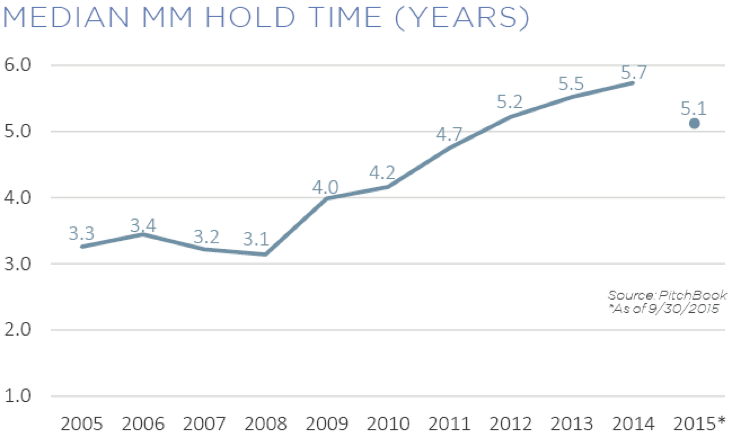
The potentially disquieting number, however, is that six months. Even in a heightened sellers’ market, the median hold time has only dropped to 5.1 years, which is still a considerable length of time. If M&A and sponsor-to-sponsor transactions continue apace, given the trend for acquisitive growth nowadays—not to mention the dry powder and cash & equivalents PE firms and corporate buyers respectively have on hand—many PE firms could still realize some of these aging investments. Selling off middle-market holdings in particular may prove easier than, say, selling companies valued at over $1 billion, but at this point, the quality of the companies that have been held for over five years must also be a consideration. Granted, some companies have taken a long time to recover from the Great Recession, but for those still being nursed back to health, exit prospects in the short-term are dim, and the long-term isn’t that long anymore when it comes to typical PE fund lifetimes. It really comes down to just how hungry corporate buyers will be for top-line expansion, as secondary buyouts aren’t likely to become a significant enough source of liquidity.





Latest news

Rate hike expectations ease as term SOFR curve flattens
The CME six-month Term SOFR rate reached a recent high of 3.979% on July 28 before retreating to 3.837% as…
3Q26: New loan assets rise to 44% of total lending, a 3-year high
New loan assets as a proportion of total US loan volume make up 44% of the 3Q26 pipeline to date,…

North American GPs dominant as fundraising accelerates
Our PEI Private Credit 200 ranking also shows capital raising increasing overall – and accelerating especially fast for the largest…