


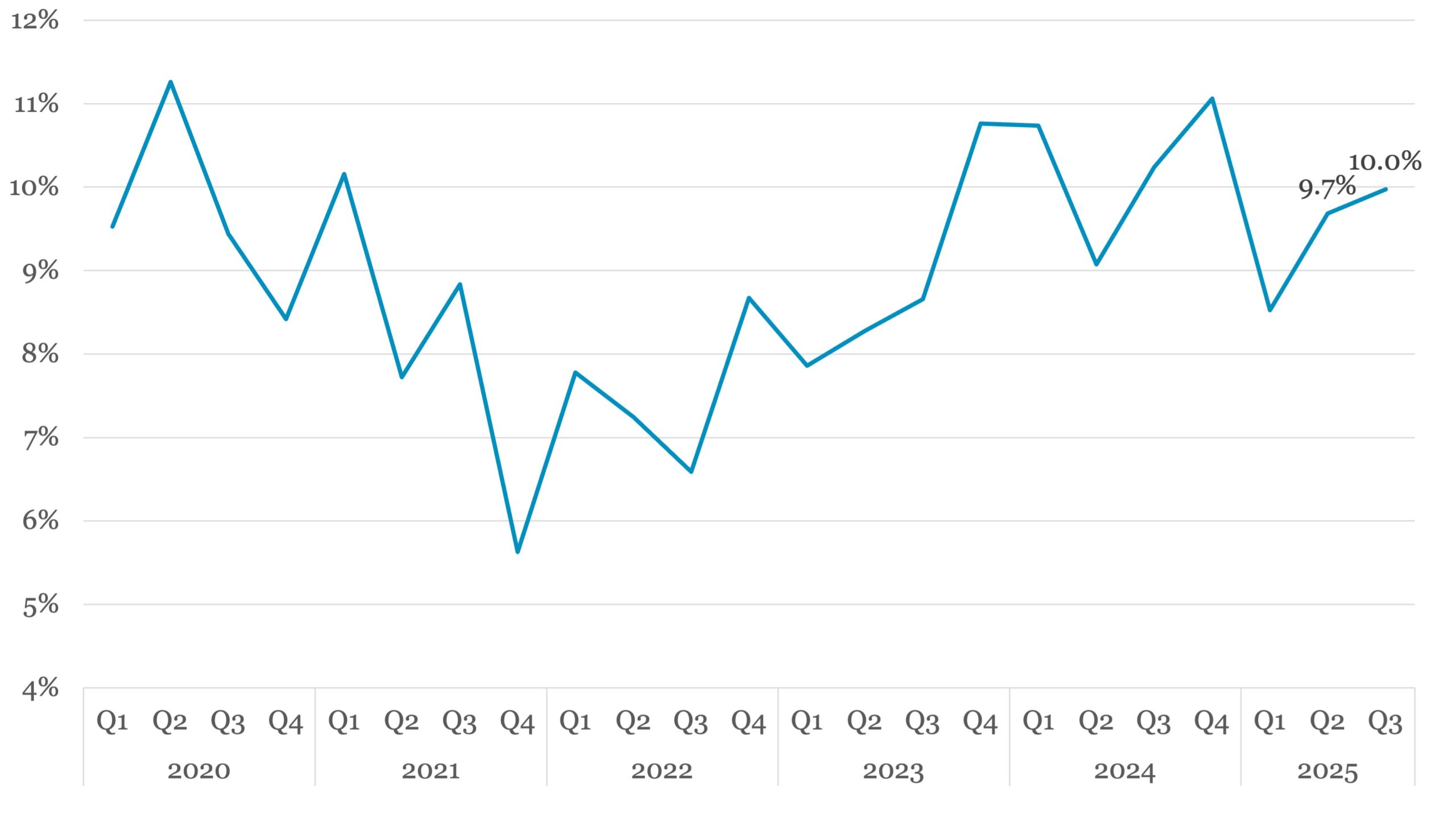
Carveout/divestiture count as a share of all PE middle-market deals by quarter

Carveout/divestiture count as a share of all PE middle-market deals by quarter
Download PitchBook’s Report here.
While quarterly figures can fluctuate, annual trends provide a clearer benchmark, showcasing that carveouts are a core deal type for sponsors. Industry participants note that many large companies continue to sell noncore assets, especially as market conditions improve and stabilize further, allowing corporates to focus on core areas and accelerate growth, all while providing a more compelling story to investors.
Carveouts provide advantages for both buyers and sellers. For sellers, proceeds can be used to address maturing debt obligations or reinvest in higher-growth initiatives. For buyers, carveouts often involve established assets with robust financial histories, enabling more reliable due diligence.This transparency tends to attract a wider pool of bidders, reinforcing the appeal of carveouts in today’s dealmaking environment. Additionally, these divested assets can often be underperforming in nature, whether due to a lack of time or resources invested in them by their corporate owners. These “albatross” assets, similar to founder-owned businesses, can provide sponsors with several levers that can be pulled to scale growth. Notable carveout transactions in Q3 included Sonoco’s sale of ThermoSafe, a provider of temperature-controlled packaging solutions, to Arsenal Capital Partners for $650 million in September. This deal allows Sonoco to streamline its operations into two core global business segments. Also in September, GE Vernova—one of GE’s three standalone public companies, with Vernova being the energy division—agreed to sell Proficy, its industrial software unit, to TPG for $600 million. GE Vernova will use the proceeds of the sale to reinvest in its grid software business.
(Past performance is no guarantee of future results.)





Latest news

Rate hike expectations ease as term SOFR curve flattens
The CME six-month Term SOFR rate reached a recent high of 3.979% on July 28 before retreating to 3.837% as…
3Q26: New loan assets rise to 44% of total lending, a 3-year high
New loan assets as a proportion of total US loan volume make up 44% of the 3Q26 pipeline to date,…

North American GPs dominant as fundraising accelerates
Our PEI Private Credit 200 ranking also shows capital raising increasing overall – and accelerating especially fast for the largest…