



Stronger primary issuance and rising bids mask fragility in leveraged loan market sentiment – DebtDynamics NorthAm
Secondary loan prices rallied in May, reopening the refinancing window and causing a spike in primary activity. Despite these highly positive markers, signs remain that the recovery may prove short-lived.
Recent loan trading levels suggest a gradual improvement after the softness seen earlier this year. As of 1 June, more than 36% of loans were trading above par, rebounding from a low of 13% on 2 March and peaking at 40% on 6 May, based on Markit data compiled by Debtwire.
The improvement in the secondary market led to a rise in bid prices across the board and in turn gave issuers more scope to reduce borrowing costs on existing debt through repricing. The result was a sharp increase in primary market activity, led overwhelmingly by refinancing transactions.
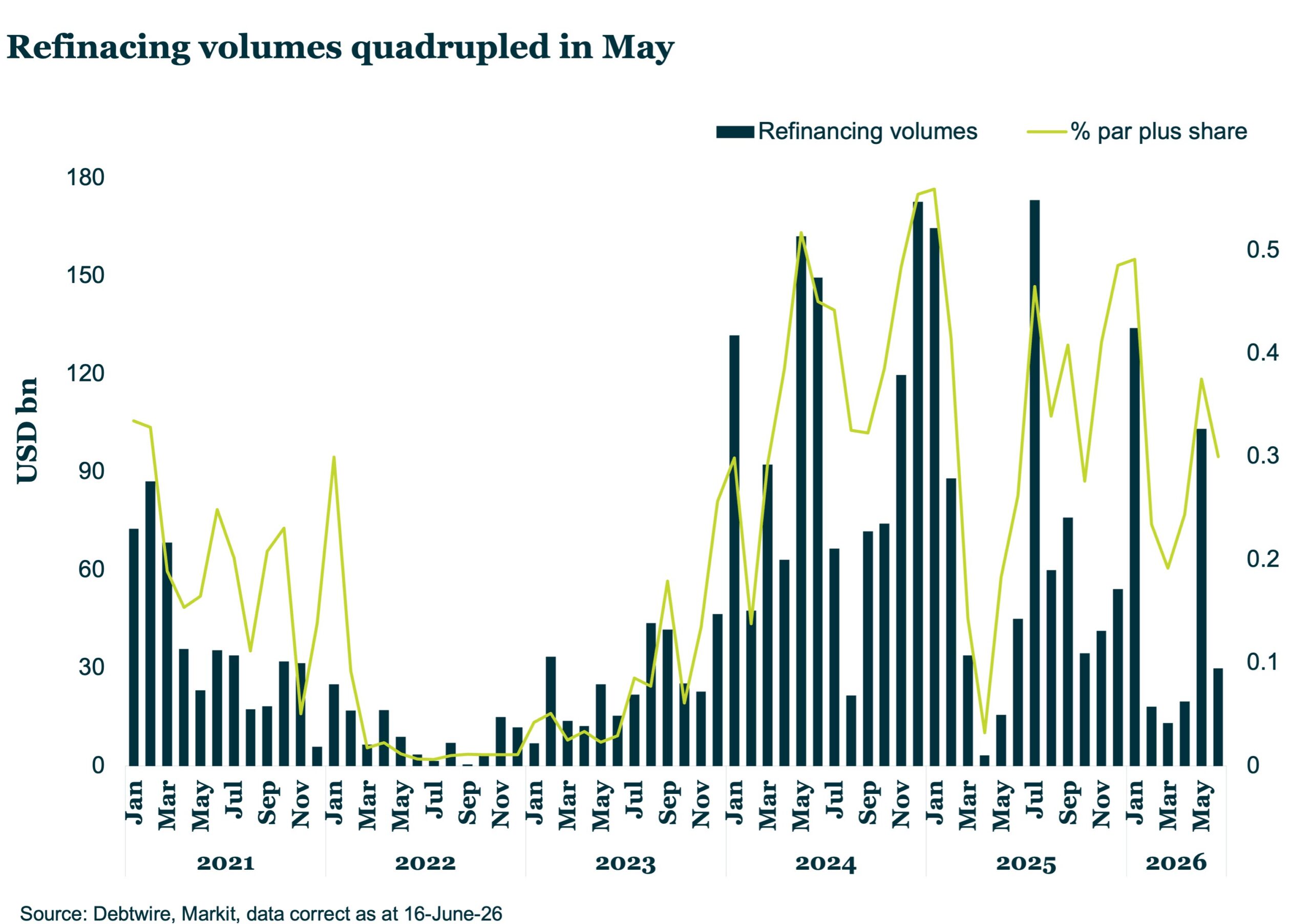
Refinancing deals accounted for 91% of total activity in May, as institutional leveraged loan issuance surged 264% month-on-month to USD 121bn, from USD 33.2bn in April, with refinancing volumes rebounding to USD 110bn. Refinancing comfortably overshadowed new money volumes, which declined from USD 13.6bn in April, to USD 10.8bn in May.
Tech recovers from selloff
The technology sector was a major contributor to the rebound, staging a recovery after the AI-impacted software sell-off that weighted on issuance earlier in the year. Technology dominated refinancing activity in May, accounting for USD 19.7bn, or 18% of the total refinancing volume, as it rebounded from muted issuance early this year.
Along with new money activity, tech-related loan issuance surged to USD 23.1bn in May, compared with just USD 550m in April, which was the lowest monthly volume for the sector in the past five years, according to Debtwire data.
Some of the jumbo refinancing tech-related deals included experience management software provider Qualtrics’ USD 5.4bn loan package to extend its existing facilities and support the acquisition of Press Ganey Forsta, as well as Clarios’ cross-border repricing transaction to reprice its USD 3.5bn and EUR 1.875bn TLB facilities.
Secondary sentiment improves
Improving sentiment in the loan market was also reflected in the overall rise in the weighted average bid price for institutional loans. Bids rose one percentage point to 95.1 on 1 June from a low of 94.2 on 31 March. Tech loan average bids also recovered, rising from a low of 89.5 on 31 March to 90.1 as of 16 June.
Eye of the storm
Despite these encouraging signals, some market participants caution that the recovery may not fully reflect underlying conditions.
The chart above shows that secondary prices have already slipped again in the first half of June, falling back to 94.8, a sign that volatility remains elevated and that the market has not yet returned to more benign conditions.
One buysider argued that the recent rise in refinancing figures might be artificially propped up by aggressive CLO warehouse buying fueled by captive equity, temporarily boosting pricing. Considering the market’s continued pressures and extremes, a recovery might not be so straightforward.
Outlook
Despite strong refinancing activity last month, momentum has since begun to ease. As of mid-June, institutional leveraged loan volumes stood at USD 39bn, with refinancing accounting for USD 30bn of that total. At the same time, the percentage of loans trading above par slid from 36% on 1 June, to 30% by 15 June.
In another sign that risk appetite remains low is in dividend recap activity, year-to-date dividend recap volume is running at its lowest level in the past three years despite ongoing pressure to DPI, suggesting the market is still far from supporting a broader return to sponsor-led opportunistic issuance.
May’s issuance rebound was a welcome sign that the market had reopened, but it was dominated by refinancing. If sentiment were materially improving, new money would be expected to recover at a similar pace. Instead, new money demand is only beginning to return, with volume so far in June at USD 9bn, leaving sentiment still sensitive and uneven.
The rebound in activity is evident, but it does not yet amount to a full return to broad-based risk-on conditions. The softness seen so far in June suggests that market sentiment remains fragile, making it premature to call a return to normal conditions and leaving future issuance levels far from certain.
For access to our comprehensive news, analysis and data on the global loan and bond markets, please subscribe to Debtwire.
(Past performance is no guarantee of future results.)





Latest news

Rate hike expectations ease as term SOFR curve flattens
The CME six-month Term SOFR rate reached a recent high of 3.979% on July 28 before retreating to 3.837% as…
3Q26: New loan assets rise to 44% of total lending, a 3-year high
New loan assets as a proportion of total US loan volume make up 44% of the 3Q26 pipeline to date,…

North American GPs dominant as fundraising accelerates
Our PEI Private Credit 200 ranking also shows capital raising increasing overall – and accelerating especially fast for the largest…