
News reached us from Harvard’s Astrophysics Center of an interstellar object of unknown origin spotted passing through our solar system. Named Oumuamua (Hawaiian for “scout”), the cigar-shaped “stadium-size” UFO demonstrated “excess acceleration” on its trek past the Sun and back out into space.
Given the unusual trajectory, scientists theorized it could be “a fully operational probe sent intentionally to Earth vicinity by an alien civilization.” Cautioned one researcher, “It’s impossible to guess the purpose behind Oumuamua without more data.” Just so.
After checking our calendars didn’t read April 1, we reflected on how similar the search for extraterrestrial life is to terrestrial analysts scrutinizing data on loan recoveries.
As we covered in our first instalment of this special series, there’s a macro drag on the ability of investors to recover par on leverage loans. Leverage as a multiple of debt-to-ebitda is on the rise. And structural features (e.g. cov-lite) are weakening.
But there are other considerations as well. As our Chart of the Week depicts, recoveries vary depending on where you are in the capital structure. Being a revolver lender, for example, is somewhat a better proposition than being a term lender.
It is also a good thing to be a senior lender with some kind of debt cushion below you:
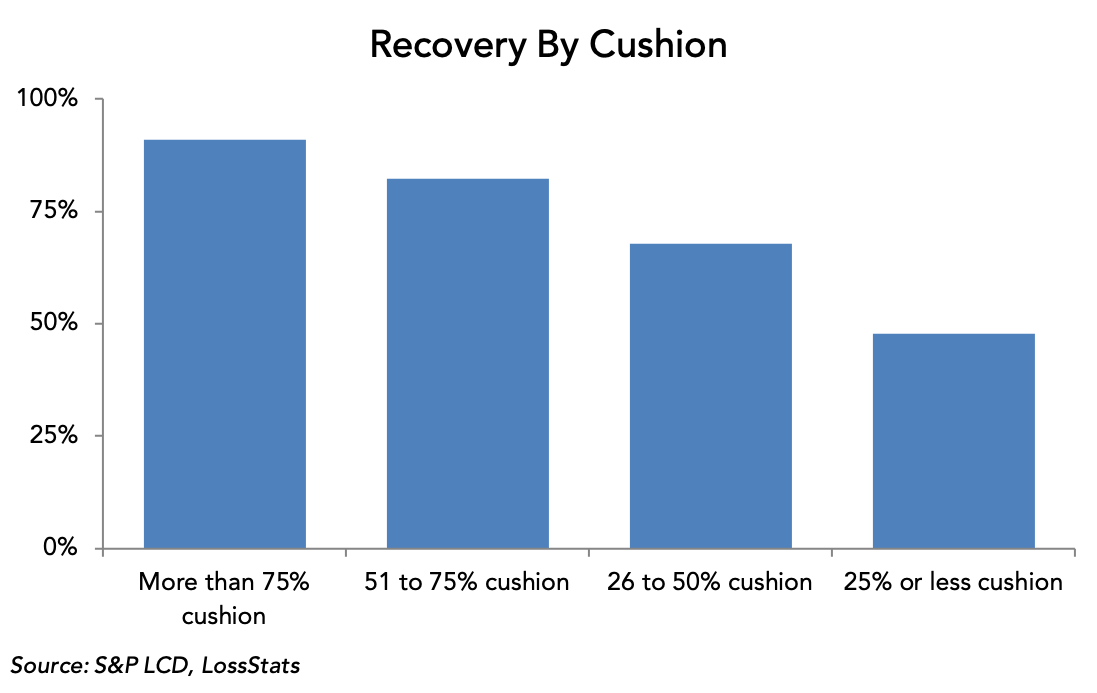
Based on data provided by S&P, the average discounted recovery shrinks as the amount of cushion declines. It’s clear that having more subordinated capital in your deal can make a dramatic difference. Recoveries are cut to less than 50% if your debt has a 25% or less cushion.
Unsurprisingly sector also matters. For example, utilities demonstrate twice the recovery (on event level for bankruptcies) as do companies in the telecom space (per S&P).
Next week we continue scanning the skies for other ways to track enhanced loan values.





Latest news

Multiples on PE buyouts
This quarter marks our integration of SPI by StepStone as the primary source for US buyout valuation metrics for the PE Breakdown.
US Leveraged Loan Issuance Slows to $76.5b in July
The US leveraged loan market has continued to slow from the May level of $104.7b, with approximately $76.5b priced in…