



Cyclicality of PE industry coming to bear?
View PitchBook’s 2017 Global PE & VC Fund Benchmarking Report: Part II Here
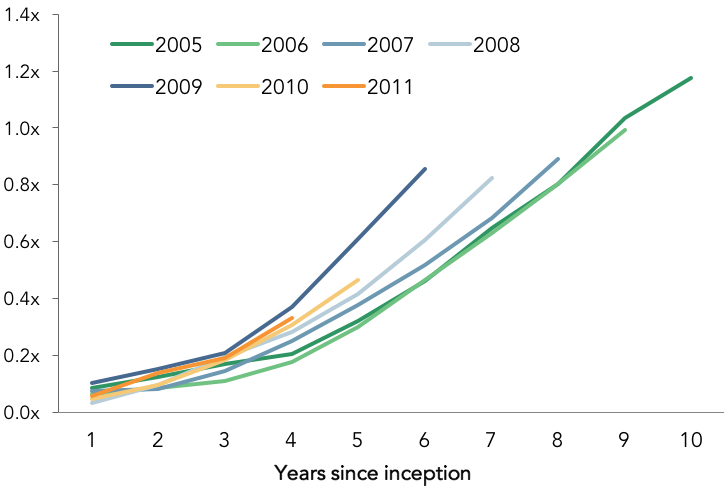
From the rhythmic ebb and flow of the tide to the mysterious circadian patterns within each human, the world is governed by cycles. When it comes to private equity investment and fundraising, multiple separate cycles overlap to produce headline trends, ranging from the longer-term credit cycle to the typical business cycle within a given region. The rate at which general partners return capital to their investors over time (distributed-to-paid-in or DPI multiples is the typical metric) is one of the more interesting trends to tease out, as it is illustrative of liquidity, hold periods, the investing cycle and the broader economic environment, all in concert. The greater the slope of a given line in the chart above, the more swiftly the average PE fund from that vintage is returning capital to its limited partners. For example, the soaring curve of the 2005 figure indicates how funds from that era cashed in on the buyout boom prior to the financial crisis, in addition to the simple reality that so much time has elapsed since their inception the mean vehicle could recoup any losses and return over time.
More recent vintages, however, hint at more intriguing findings. The average 2009 vintage has clearly outpaced its immediate predecessors of 2007 and 2008 in terms of returning capital to its investors, likely due to funds from that year benefiting from the timing of slow-paced economic recovery, as well as the early period of the M&A bull market and once-thriving IPO environment. However, more recent if not exactly youthful vintages, such as 2010 and 2011, are not quite matching the performance of vehicles from 2009. The spread is slight enough one could ascribe some of it to sluggish reporting by LPs, but what it also portends is the inevitable cyclicality of the PE industry. Fund managers took full advantage of the sellers’ market over the past few years, exiting investments they bought at more reasonable valuations in the immediate aftermath of the financial crisis, thus boosting typical returns and returning cash to investors quickly. Now, however, exit avenues aren’t as packed due to a variety of factors, chief among them refilling PE portfolios, timing and relatively high valuations. Especially as more youthful funds also weren’t able to snag such favorably priced assets, their momentum and eventual time taken to post DPI figures similar to those of 2009 look set to be slower and longer, respectively.
Contact: Garrett Black
garrett.black@pitchbook.com





Latest news

Rate hike expectations ease as term SOFR curve flattens
The CME six-month Term SOFR rate reached a recent high of 3.979% on July 28 before retreating to 3.837% as…

3Q26: New loan assets rise to 44% of total lending, a 3-year high
New loan assets as a proportion of total US loan volume make up 44% of the 3Q26 pipeline to date,…

North American GPs dominant as fundraising accelerates
Our PEI Private Credit 200 ranking also shows capital raising increasing overall – and accelerating especially fast for the largest…