


Private Debt Intelligence – 9/9/2019

Private Debt Cash Flows
Chart
Download Data
[wpdm_package id=’28057′]
Investors commonly cite that they look to private debt to offer three advantages: portfolio diversification, a reliable income stream and high risk-adjusted returns. This strikes a balance between the perceived regularity and predictability of real assets, and the alpha generation of private equity investments.
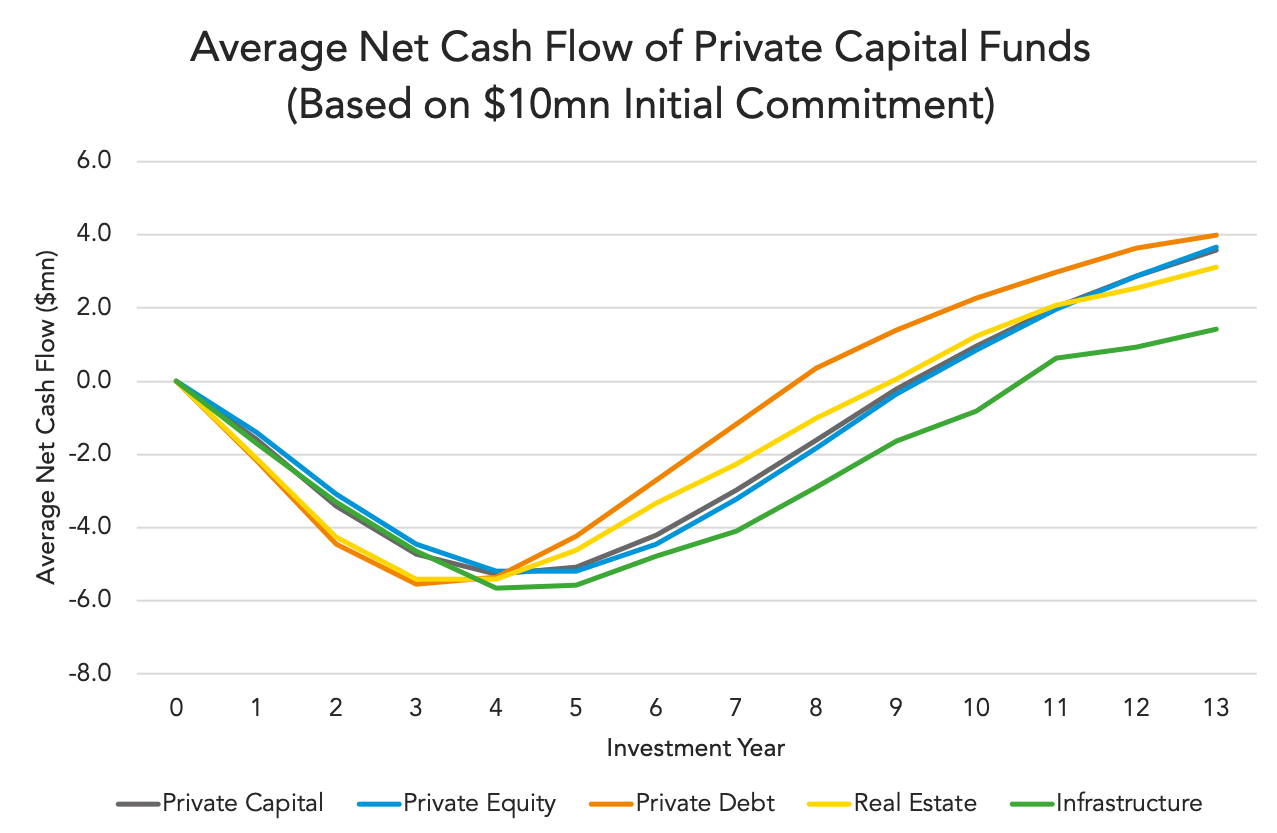
This is a challenging set of expectations, but the industry seems to be rising to the challenge. When looking at the average cash flow available to investors in each alternative asset class, private debt is remarkable for allowing investors to put money to work quickly, break even early, and make returns at a consistent rate.
On average, a private debt firm calls around two-thirds of its capital within the first three years of the fund’s lifespan, putting the bulk of capital to work earlier than a private equity fund might. However, the nature of the asset class means that many funds are making loans, and so repayments will start within a short time-frame. Loan repayments are more consistent and regular than the disbursement of assets, so the distributions from a private debt fund annually remain similar from the fourth to the tenth year of a fund’s lifespan (at which point many funds are wound up and liquidated).
Cumulatively, this gives the average private debt fund a very favourable J-curve when compared to other asset classes. The early part of the fund’s cash flow mirrors that of a real estate fund, which has less need of keeping capital for add-on acquisitions or further investment. However, the strong and consistent rate of distributions after the initial investment phase has ended means that private debt is the first asset class to break even on average, and pushes the ultimate returns to investors above that seen from any other asset class.
Of course, no fund is entirely typical, and the cash flow model takes no account of variance or risk. But it does show the strength of the asset class, and suggests that until the model materially changes, its appeal to investors will be undiminished.
Contact: William Clarke
william.clarke@preqin.com





Latest news

Rate hike expectations ease as term SOFR curve flattens
The CME six-month Term SOFR rate reached a recent high of 3.979% on July 28 before retreating to 3.837% as…

3Q26: New loan assets rise to 44% of total lending, a 3-year high
New loan assets as a proportion of total US loan volume make up 44% of the 3Q26 pipeline to date,…

North American GPs dominant as fundraising accelerates
Our PEI Private Credit 200 ranking also shows capital raising increasing overall – and accelerating especially fast for the largest…