Private Debt Intelligence – 3/13/2017

Private Debt Industry Assets Approach $600bn
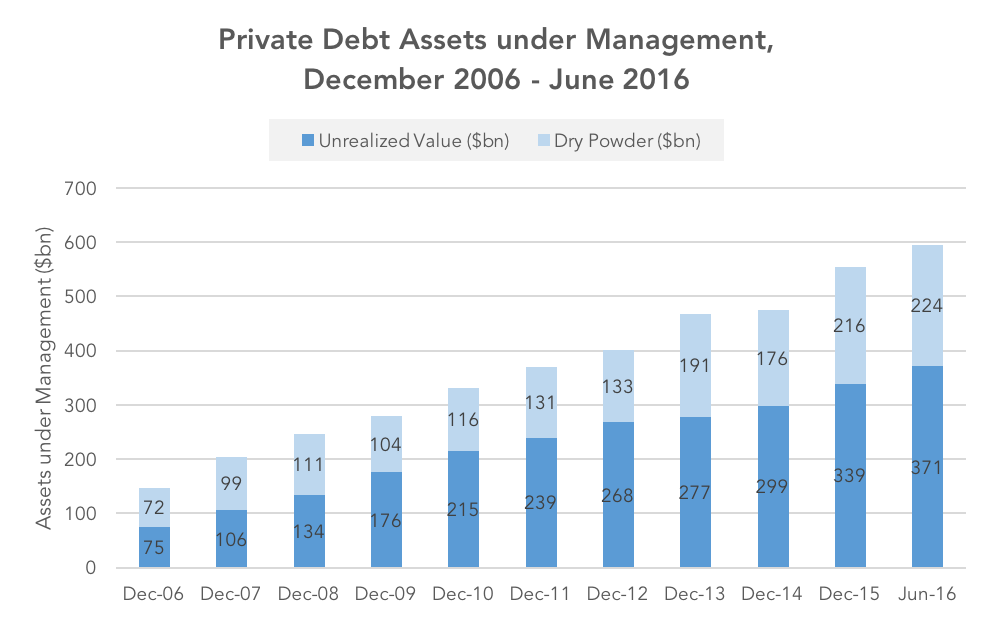
The private debt industry has continued to grow in recent years, and as of the end of H1 2016 reached a record $595bn in assets under management. This comprises $224bn in capital available to fund managers (‘dry powder’) and $371bn in unrealized investments held by private debt vehicles. Both of these components have increased over the first half of the year, up from $216bn and $339bn respectively as of the end of 2015. Overall, the total assets held by the industry rose by $40bn in H1 2016, an increase of 7.1%. In fact, the private debt asset class has seen a decade of successive annual increases in AUM, and has quadrupled in size since 2006.
It is perhaps unsurprising that distressed debt funds account for the largest proportion of industry assets. With a total AUM of $223bn, these funds represent 38% of the private debt asset class. However, the rapid growth of the direct lending sector has seen the assets held by vehicles of this type swell to $153bn as of the end of June 2016, making direct lending the second-largest part of the market. Mezzanine funds hold approximately the same level of assets, with a total AUM of $135bn, while special situations and venture debt funds are considerably smaller.
The growth in the size of the asset class comes despite the fact that private debt funds distributed a record $95bn to investors in 2015, and a further $58bn in H1 2016. At that pace, the industry looks set to return over $100bn to investors in the full-year 2016 for the first time ever, a sign of the strong performance many funds are enjoying. This level of capital returning to investors has spurred satisfaction in the asset class, and in turn may help private debt funds to record a landmark year in 2017.




Latest news

US leveraged loans returns turn negative in October
The Bloomberg US Leveraged Loan Index (Ticker: LOAN) has returned -0.26% this month through October 21, reducing its year-to-date return…

M&A activity begins to tick upward
In the third quarter of 2026, acquisition-linked loan volume across North America and Europe reached about $47 billion, up from $30.6 billion in Q2 and $29.5 billion a year ago.