



Investors are mulling opportunities beyond direct lending but moving up the risk curve doesn’t guarantee better results.
Direct lending dominated private debt fundraising last year – accounting for 65 percent of the total – prompting us to investigate in a recent Private Debt Investor cover story whether investors are as committed to diversification as you might assume.
Some LPs we spoke with for the feature said they were keen to shift some of their capital to potentially higher risk, higher reward areas of the asset class including distressed debt, special situations and opportunistic credit.
Among those in favour was Ben Levenstein, head of private markets at UK pension fund USS. “We are active in opportunistic credit strategies that seek to capitalise on the volatility we note in markets right now,” he said.
But there was a counterpoint. “The thing that investors need to ask themselves is – given a core allocation of fully invested, compounding, yield-producing, cashflow-generating loans in a direct lending portfolio where you have very good visibility – is the cash-on-cash return going to be substantially greater by going up the risk curve?” asked John Bohill, a partner and private debt specialist at StepStone Group, the private markets investment and advisory firm.
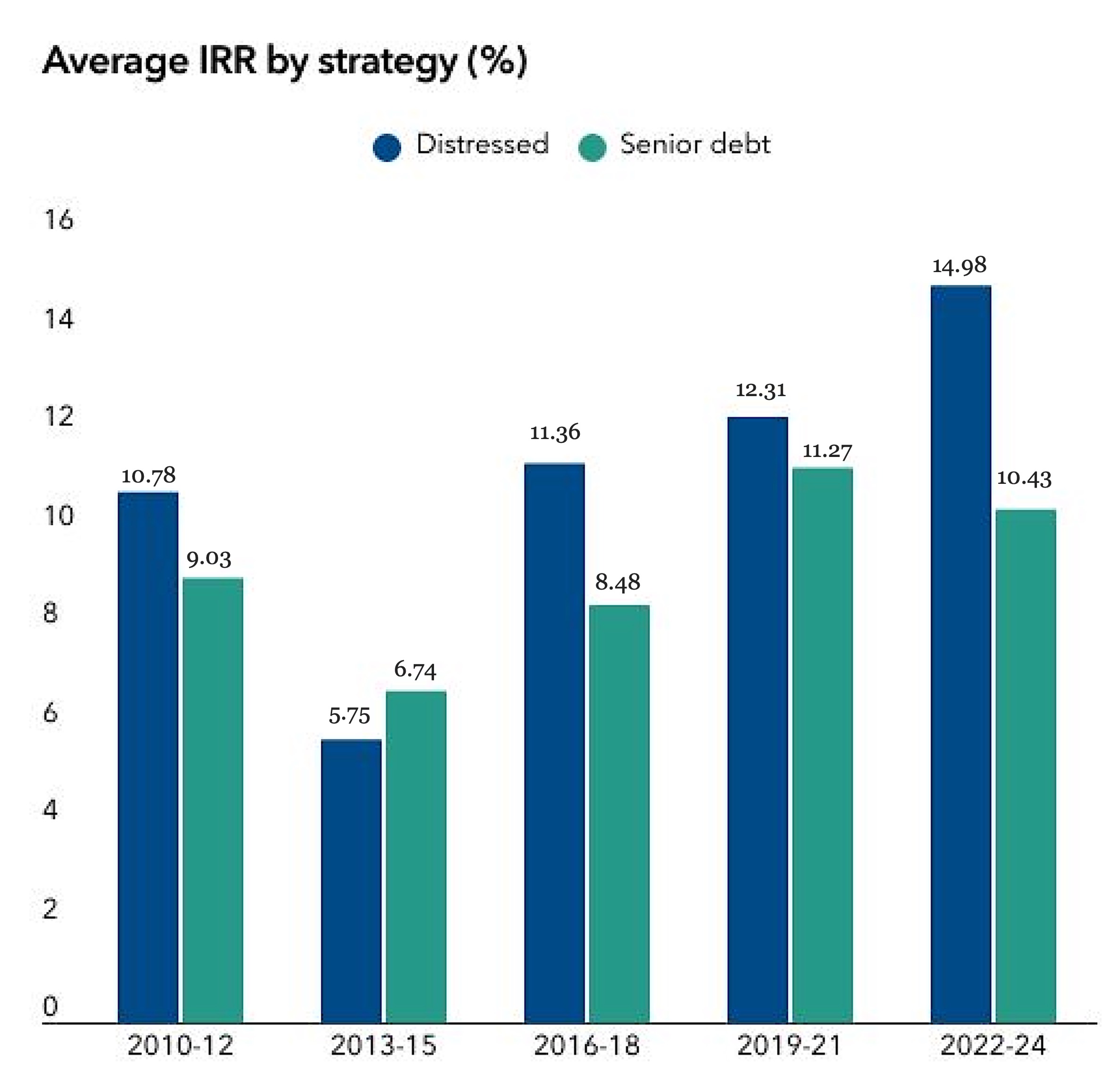
The answer, according to our proprietary performance data (see chart), is ‘mostly, but not necessarily’. Across a range of performance metrics and vintages, distressed debt does indeed frequently offer a premium over senior debt in exchange for the increased risk profile.
However, our data found exceptions to this. For example, in the vintage period 2013-15, senior debt delivered a 6.74 percent IRR versus 5.75 percent for distressed debt. Likewise, in 2019-21, senior debt outperformed distressed debt on a TPVI basis; and on a DPI basis in both 2013-15 and 2019-21. Going up the risk curve is not always a guarantee of better performance.





Latest news

Lack of new issues clouds CLO market
It’s been boom time in the leveraged loan market but now that market has eased off, what are the implications…

Multiples on PE buyouts
This quarter marks our integration of SPI by StepStone as the primary source for US buyout valuation metrics for the PE Breakdown.

US Leveraged Loan Issuance Slows to $76.5b in July
The US leveraged loan market has continued to slow from the May level of $104.7b, with approximately $76.5b priced in…