



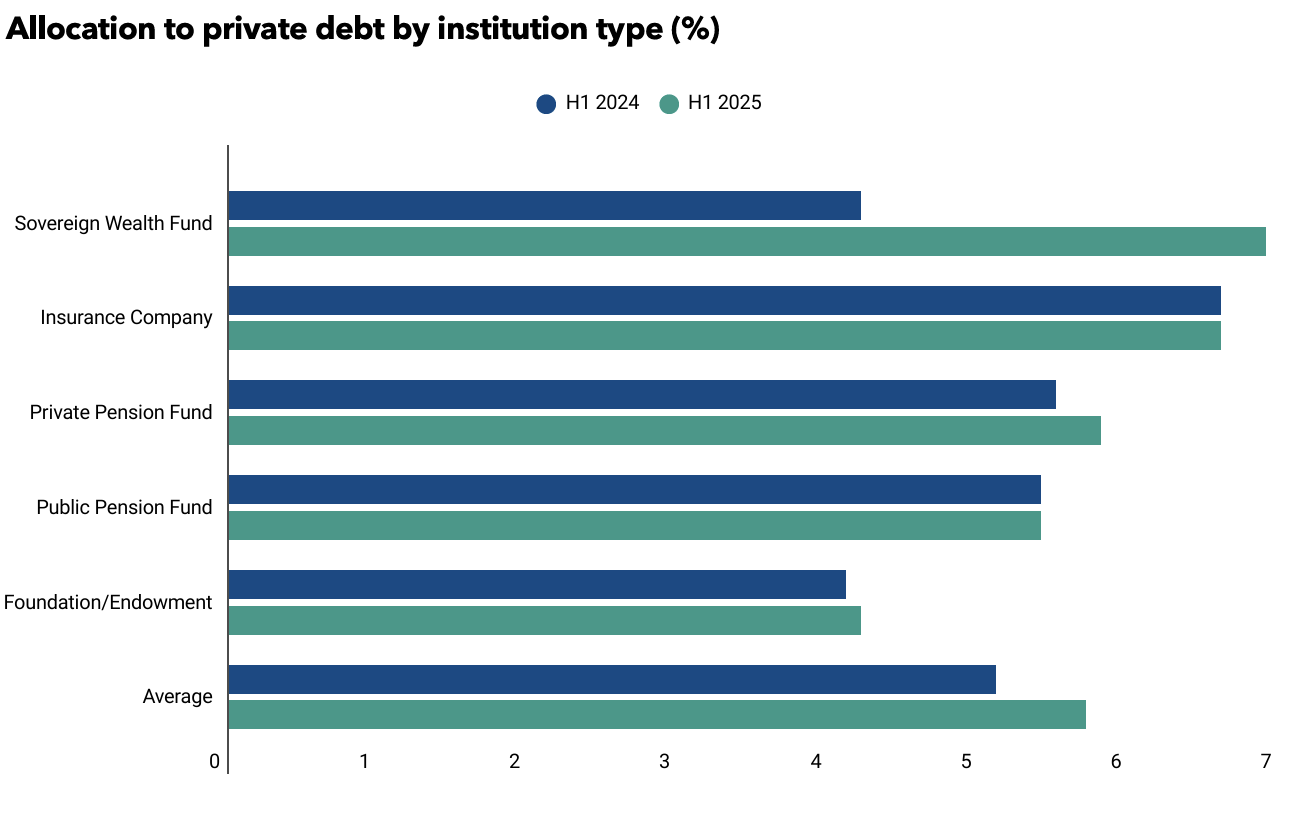
Investors are struggling to get as much invested in private credit as they would like, although there has been a surge in allocations from sovereign wealth funds.
With three quarters of institutions under-allocated to private credit – according to Private Debt Investor’s H1 2025 Investor Report – there is a huge potential pool of capital waiting to be tapped by managers, though it should be noted that many LPs face challenges elsewhere in their portfolios, which may be slowing down their ability to deploy into private credit.
The accompanying chart highlights the difficulties, with many institution types only managing to maintain their existing allocation to the asset class. Insurance companies are the most stable investors, followed by private pension funds, with most investors keeping their allocations steady. Public pension funds are increasing allocations the quickest of all institutions while many endowments and foundations saw a decrease in allocations during the first six months of the year.
Average allocations increased overall in H1 2025, up from 5.1 percent in H1 2024 to 5.7 percent. This was mainly driven by a surge in interest from sovereign wealth funds, which raised average allocations from 4.2 percent in H1 2024 to 6.9 percent in H1 2025. With the potential for long-term stable capital growth, the asset class has proven attractive to these funds. A number of funds based in the Middle East have significantly increased their private credit holdings in recent years.
As expected, US institutions dominate in terms of individual commitments to private credit. With so many US public pension funds now experienced in private credit investing it’s little surprise to see them so active in the space. However, most commitments in H1 came from the International Finance Corporation, a part of the World Bank which aims to provide finance for developing world countries. Its six commitments were spread across a number of impact and emerging market credit funds where debt investing has become a popular way to support emerging economies.





Latest news

Rate hike expectations ease as term SOFR curve flattens
The CME six-month Term SOFR rate reached a recent high of 3.979% on July 28 before retreating to 3.837% as…
3Q26: New loan assets rise to 44% of total lending, a 3-year high
New loan assets as a proportion of total US loan volume make up 44% of the 3Q26 pipeline to date,…

North American GPs dominant as fundraising accelerates
Our PEI Private Credit 200 ranking also shows capital raising increasing overall – and accelerating especially fast for the largest…