
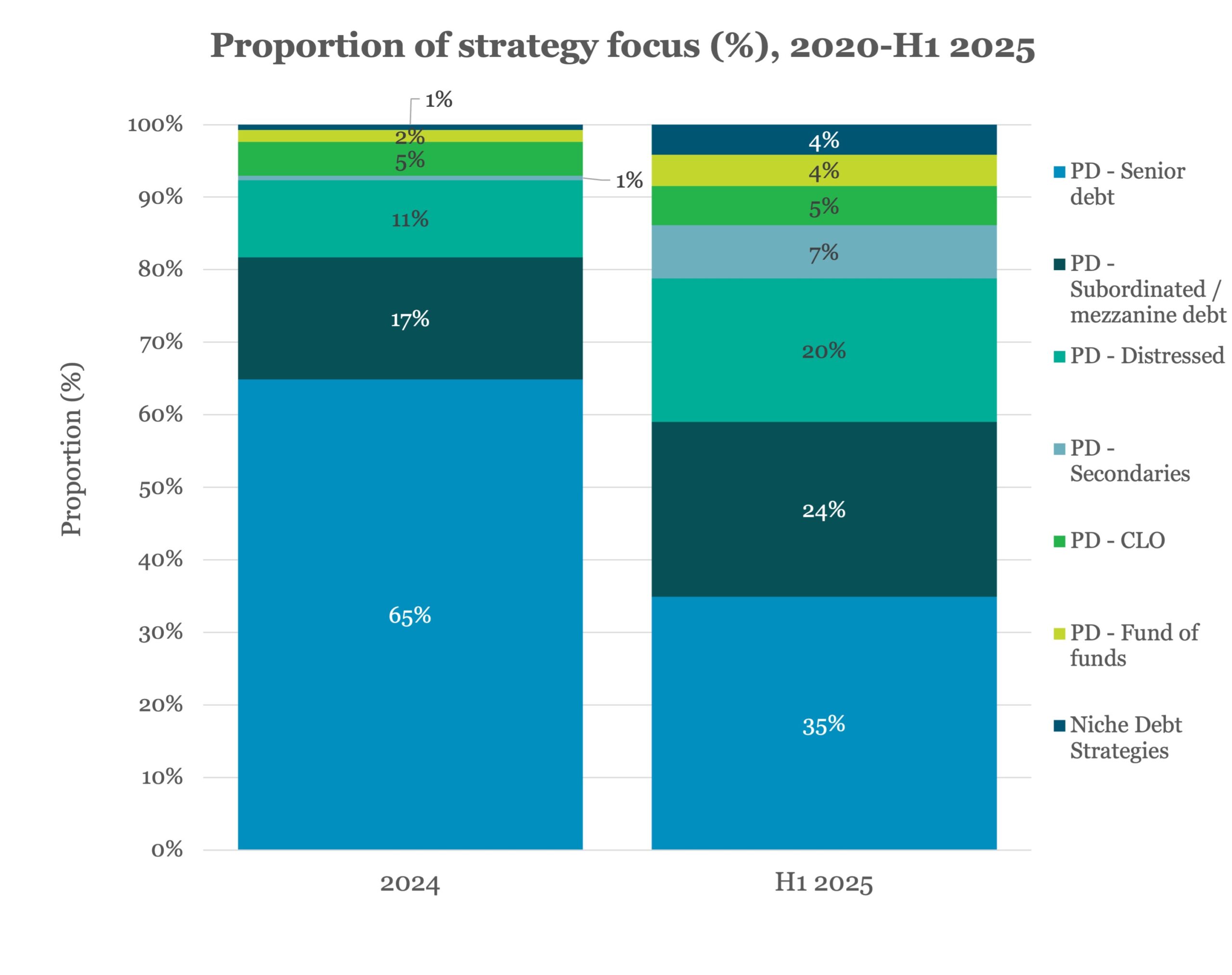
The first half of this year saw investor commitments more widely dispersed in the asset class.
In last week’s column, we examined the first-half global private credit fundraising figures and found that the total raised was consistent with the five-year H1 average, even though consistency was not a word associated with a turbulent period which saw a very strong Q1 followed by an extremely subdued Q2.
Digging deeper into the data, what did it tell us about some of the characteristics of private credit in the first half of the year? One was the apparent emergence of strategic diversification. Last year was one in which senior-debt focused strategies completely dominated – accounting for 65 percent of all capital raised.
In H1 2025, the senior debt share plummeted to 35 percent – the lowest proportion for senior debt in any H1 period since 2020. Close behind were subordinated/mezzanine debt on 24 percent and distressed debt on 20 percent. However, caution should be applied when weighing the prospect of a distressed debt revival as Oaktree’s record-breaking $16 billion fund made an outsized contribution to its share.
While there has been much talk of renewed interest in Europe from LPs, this has not yet translated to the data. North America remained the focus of investor attention in H1, with $61 billion raised by funds targeting the region. Multi-regional funds accounted for nearly $53 billion, with Europe lagging behind on less than $32 billion.
The first half continued to see large average fund sizes, although the $968 million average in H1 was a little down on the almost $1.1 billion recorded in full-year 2024. The average fund size was only just over $600 million in 2020, highlighting how the bulk of investor capital has gravitated to a small, blue-chip group of fund managers.





Latest news

Multiples on PE buyouts
This quarter marks our integration of SPI by StepStone as the primary source for US buyout valuation metrics for the PE Breakdown.

US Leveraged Loan Issuance Slows to $76.5b in July
The US leveraged loan market has continued to slow from the May level of $104.7b, with approximately $76.5b priced in…