



Institutional investors were wary of increasing their private credit exposures in H1.
Given all the ‘noise’ around private credit, albeit mostly focused on the retail space, one might expect institutional investors to be circumspect in terms of their allocations to the asset class. A glance at our provisional soon-to-be-published Investor Report for H1 2026 appears to confirm this.
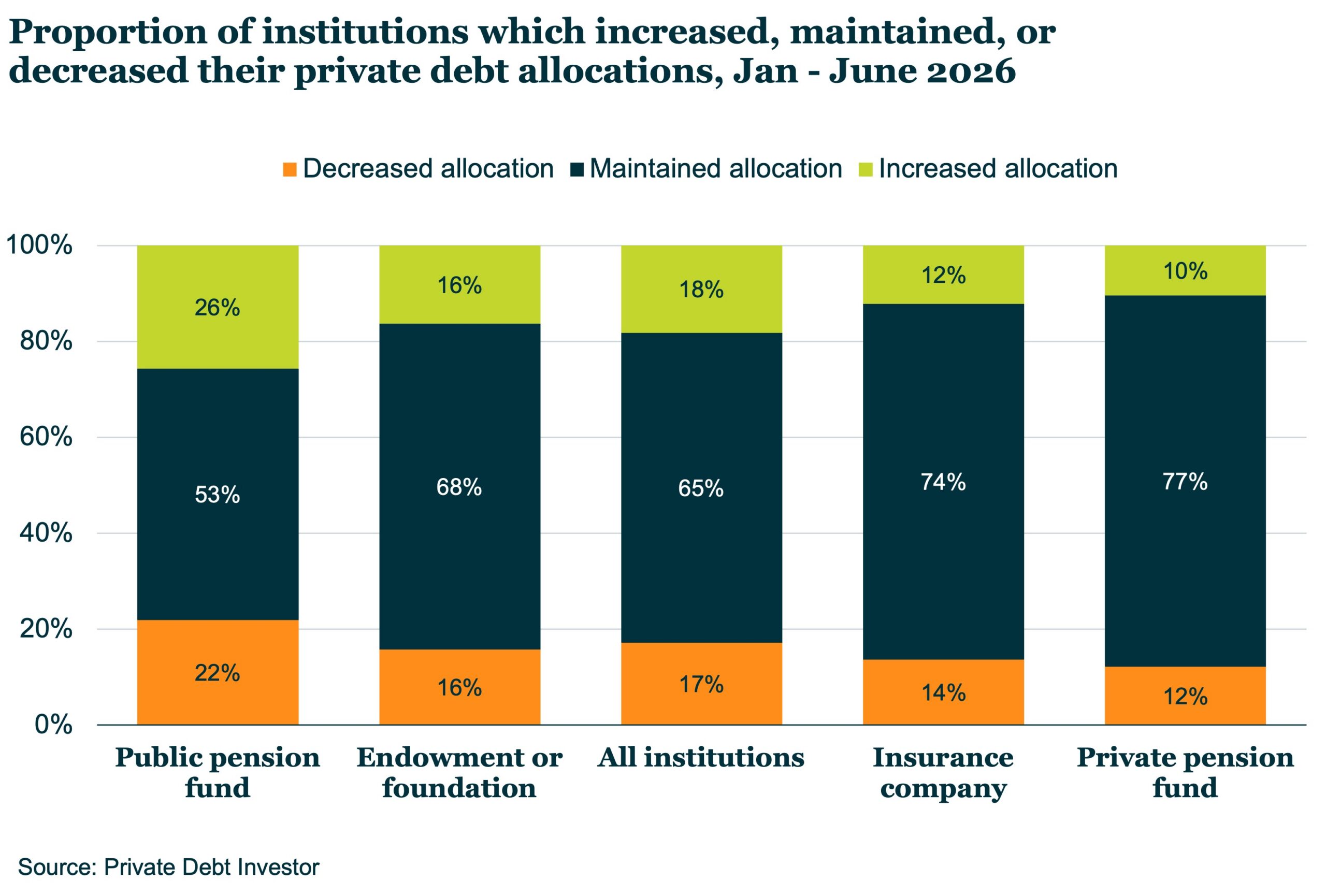
Overall, allocations were more or less static during the six months. Of all the institution types canvassed – covering public pensions, private pensions, endowments/foundations and insurance companies – 65 percent maintained their private credit allocations at the same level in H1, while 18 percent increased their allocations and 17 percent decreased them (see chart).
Insurance companies, making headlines for their array of partnerships with private credit firms, appear to be among the most cautious, with 12 percent increasing their allocations in H1 and 14 percent decreasing them. Operating within a strict regulatory and capital risk environment, it may not be too surprising if the noise has encouraged some of them to press the pause button.
Public pensions demonstrated the biggest support for the asset class during a turbulent H1 – amid concerns over the BDC market, AI disruption and the general economic and political backdrop – with 26 percent increasing allocations. However, at 22 percent, the proportion decreasing their allocations was also high – with those maintaining existing allocations much lower than for other investors at 53 percent.
But while H1 may have been a period when investors chose to sit on current allocations rather than ramping up, the long-term picture remains unchanged – if they want to reach target allocations, LPs will have to dig into their pockets at some point.
Our Investor Report data shows that 63 percent of investors remained under-allocated to private credit on 30 June 2026 – while just 13 percent were over-allocated and 24 percent were at their target allocation.





Latest news

Rate hike expectations ease as term SOFR curve flattens
The CME six-month Term SOFR rate reached a recent high of 3.979% on July 28 before retreating to 3.837% as…
3Q26: New loan assets rise to 44% of total lending, a 3-year high
New loan assets as a proportion of total US loan volume make up 44% of the 3Q26 pipeline to date,…

North American GPs dominant as fundraising accelerates
Our PEI Private Credit 200 ranking also shows capital raising increasing overall – and accelerating especially fast for the largest…