



Our data confirmed the importance of manager selection, given evidence of wide performance dispersion across strategies.
In the second iteration of Private Debt Investor’s quarterly performance reports, we examined performance broken down by strategy to explore in more detail where expectations were being exceeded, met or not delivered.
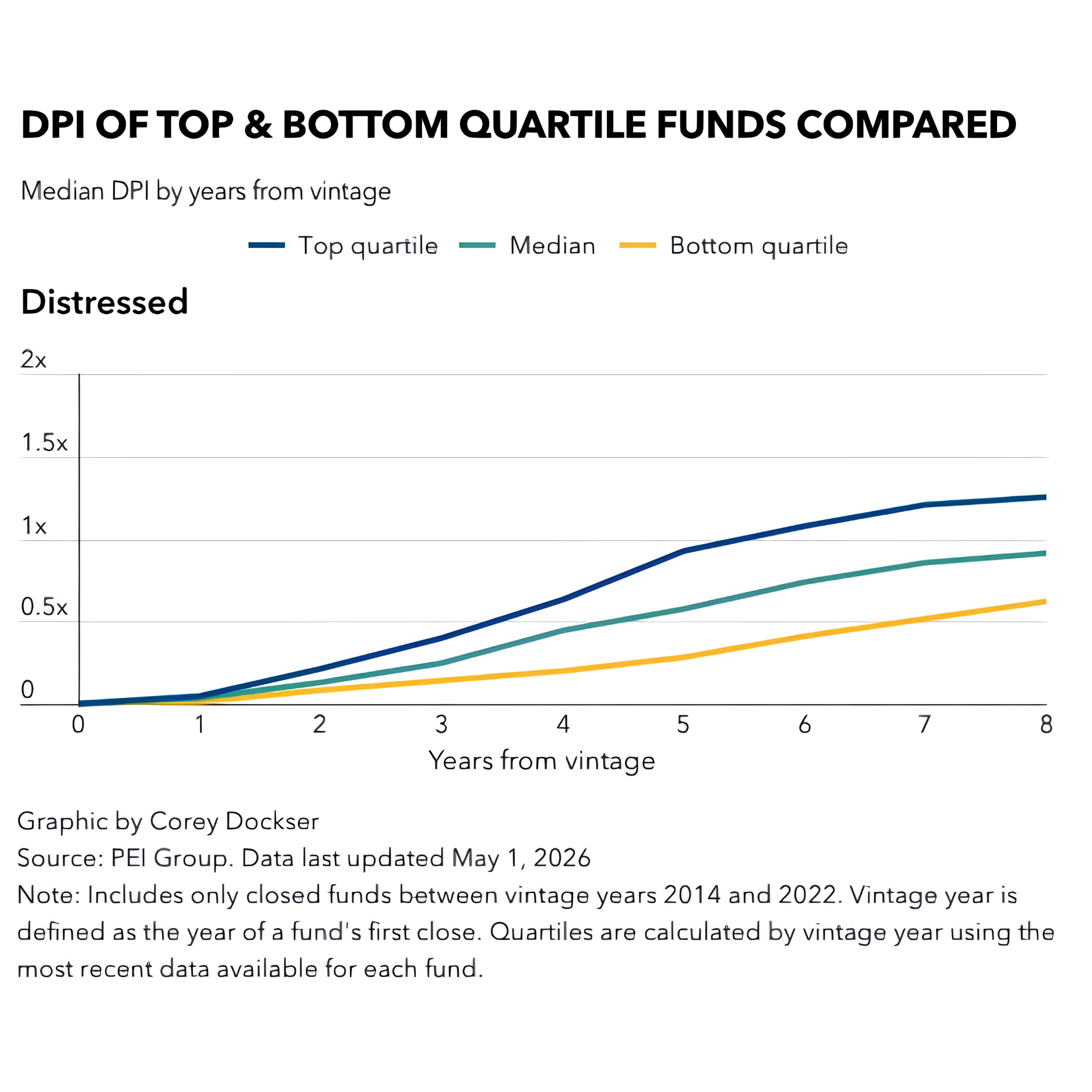
Distressed debt funds might be viewed by some as the roulette wheel of private credit – you place your chips and hope for the best. Some will win big, some will lose big. Our data showing top, median and bottom quartile performance for closed-ended funds ranging in vintage from 2014 to 2022 provided a hint of this – but perhaps with not as dramatic a dispersion as might have been predicted.
What we found was the top quartile funds impressively reaching 1.0x DPI (distribution to paid-in capital) after five years. This represented a marked outperformance compared with median funds, which had not reached 1.0x after eight years, and the bottom quartile which only just crept over 0.5x at the eight-year mark. There was certainly enough evidence to suggest investors need to choose carefully when it comes to distressed debt managers.
However, the trends were not very different to those in senior debt and subordinated and mezzanine debt. In senior debt, the gap between top and median performers was narrower than in distressed debt but the gap between median and bottom was just as wide.
Subordinated and mezzanine debt, meanwhile, showed an even starker dispersion than distressed debt – with the bottom quartile looking similar but the top quartile racing to 1.5x DPI (higher than the other two strategies) after eight years.





Latest news

Rate hike expectations ease as term SOFR curve flattens
The CME six-month Term SOFR rate reached a recent high of 3.979% on July 28 before retreating to 3.837% as…
3Q26: New loan assets rise to 44% of total lending, a 3-year high
New loan assets as a proportion of total US loan volume make up 44% of the 3Q26 pipeline to date,…

North American GPs dominant as fundraising accelerates
Our PEI Private Credit 200 ranking also shows capital raising increasing overall – and accelerating especially fast for the largest…