



Lines of credit from banks to credit vehicles have grown at an exponential rate, warranting regulatory attention.
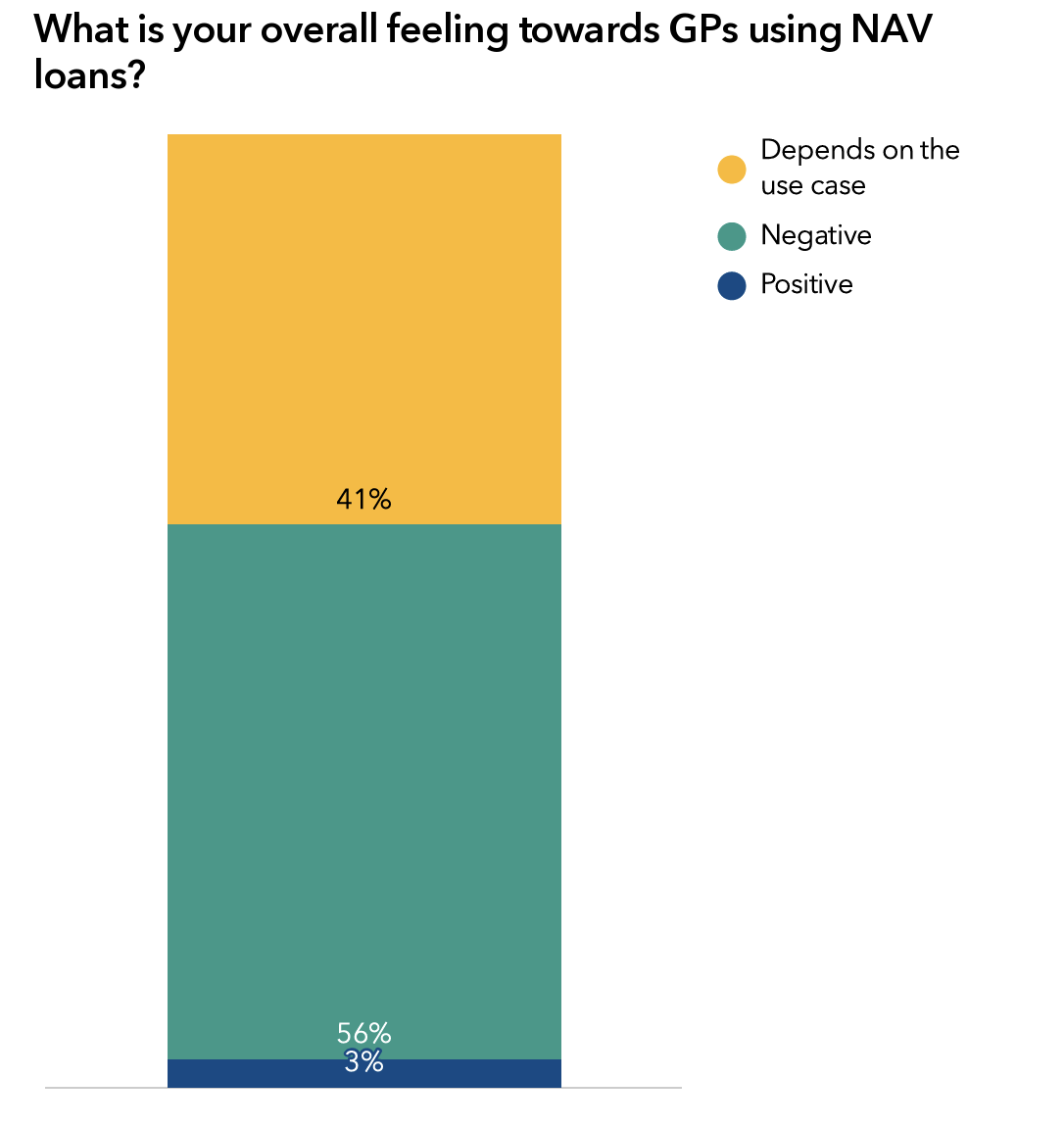
As our most recent LP Perspectives study showed (see chart), the attitude of limited partners towards fund finance is – in more than half of cases – negative. But what do regulators make of this growing field?
Research by the Federal Reserve Bank of Boston and the Federal Reserve’s Board of Governors released in March and May respectively express limited concern with the growing role of bank financing to BDCs and private debt funds, but both regulators committed to increasing oversight, nonetheless.
A 7 May report by the Boston Fed found total lending to private debt and equity funds hit $300 billion at the end of 2023, but a decade prior was just $10 billion – growing 30 times larger in just 10 years.
Utilising data of 31 large US banks, representing $100 billion in assets and subject to the Fed’s 2024 stress tests, there are more than 50,000 commitments made to private funds. While fund-level commitments represent the maximum amount that banks lend, borrowers usually only use a portion.
Credit vehicles typically prefer lines of credit rather than term loans and, as of the fourth quarter of 2024, banks held $79 billion of revolving credit lines and $16 billion in term loans to the sector. Lending to private debt vehicles has grown 145 percent in the past five years.
The worry is that growing lending activity from banks could lead to stress in the sector as credit vehicles draw down large portions of their facilities. The Fed’s researchers ran a simulation assuming debt vehicles drew down all remaining funds from their credit lines, roughly $36 billion: the effect on CET1 capital ratios was minimal and aggregate liquidity coverage ratios would only take a 1 percent hit.
Researchers write that the large US banks are well capitalised and highly liquid – letting them absorb a significant drawdown from credit vehicles.
However, this exercise only involves private credit vehicles. It’s likely that liquidity demand from BDCs and funds would portend liquidity demands from other non-banks, a concerning fact, given they are more dependent on bank credit lines for liquidity now than in the past.
Gaining increased access to liquidity is a good thing for managers and investors alike, but regulators are being prudent by increasing oversight of the growing tie-up between the two.





Latest news

Lack of new issues clouds CLO market
It’s been boom time in the leveraged loan market but now that market has eased off, what are the implications…

Multiples on PE buyouts
This quarter marks our integration of SPI by StepStone as the primary source for US buyout valuation metrics for the PE Breakdown.

US Leveraged Loan Issuance Slows to $76.5b in July
The US leveraged loan market has continued to slow from the May level of $104.7b, with approximately $76.5b priced in…