
After a rocky period for property, investors appear to be regaining confidence – in the debt layer at least.
Real estate debt accounted for nearly a fifth of all private debt fundraising in the first half of 2025, its largest share in five years, according to Private Debt Investor fundraising data.
While fundraising volumes softened slightly in the second and third quarters of the year after a bumper start, real estate accounted for 14 percent of total private credit allocations in the year to September 2025, while the average size of real estate debt-focused funds grew to $595 million – the highest figure on record.
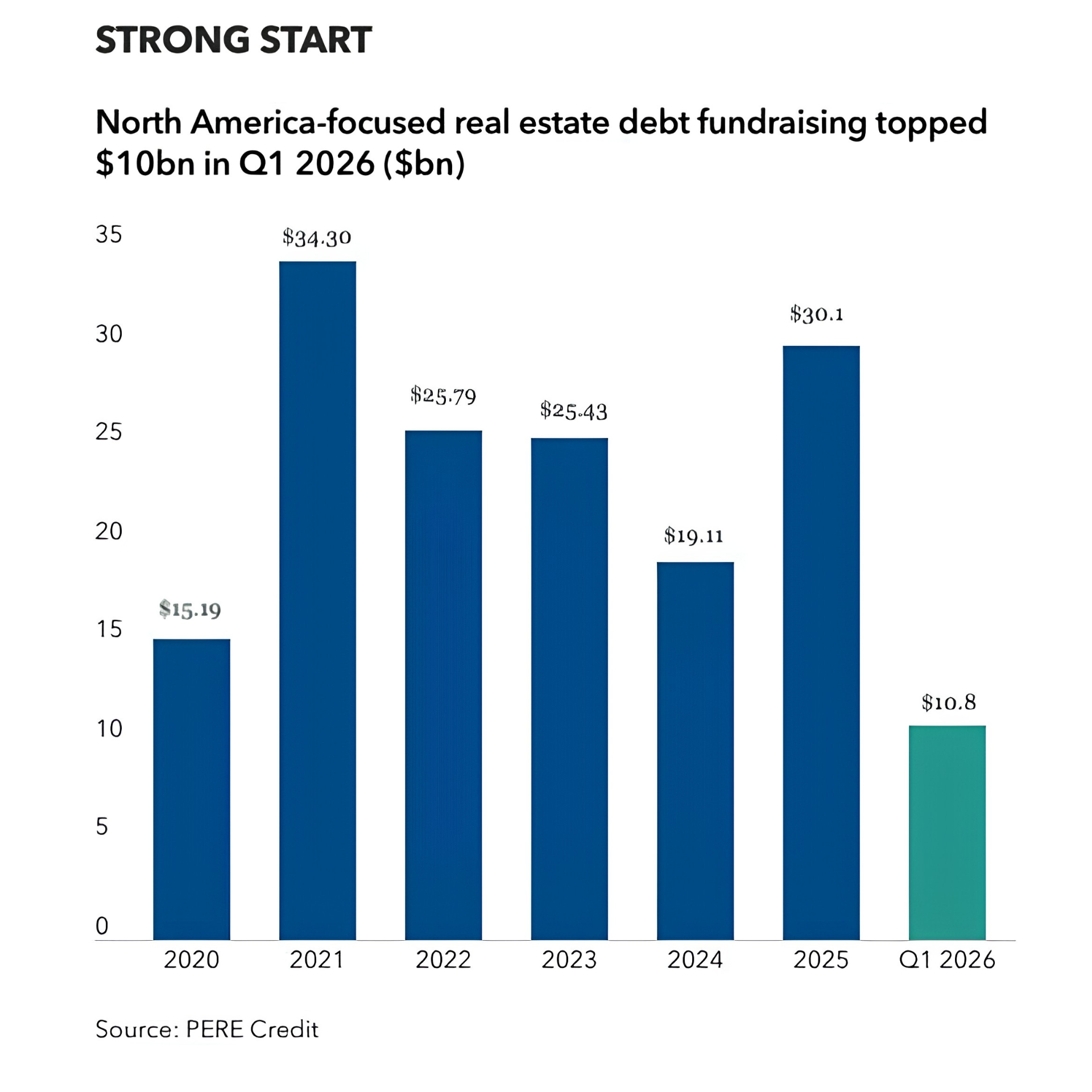
Our latest fundraising figures for the first quarter of this year show continuing momentum (see chart), as capital raised moved past $10 billion. Although it’s early to judge, at this rate of fundraising 2026 would surpass last year by a comfortable margin.
The fundraising figures add weight to a survey of 103 institutional investors by affiliate title PERE Credit, released in December, which showed that nearly one-quarter of respondents planned to boost their allocations to real estate debt in 2026.
Such an uptick in investor interest marks a fairly sharp change in fortunes for an asset class that just a couple of years ago was grappling with the lingering effects of the covid-19 pandemic on office occupancies and high interest rates.
Real estate and credit investors have sharpened their focus on this segment of the market, with many firms looking to real estate debt as a hedge against broader market uncertainty. Indeed, PGIM’s 2026 Real Estate Outlook: Private CRE Credit, published in mid-November, projected elevated yields for commercial real estate private credit income even in the case of declining interest rates.
Pierre-Antoine Godefroy, managing director at placement agent Campbell Lutyens, says that the increased demand for real estate credit is “part of a drive for diversification which is manifesting itself in three ways” – the first, he says, “is a focus on smaller borrowers and loans; the second is higher returning credit strategies with more total return features; and the third is strategies backed by tangible assets which, of course, includes real estate”.




Latest news

US leveraged loans returns turn negative in October
The Bloomberg US Leveraged Loan Index (Ticker: LOAN) has returned -0.26% this month through October 21, reducing its year-to-date return…

M&A activity begins to tick upward
In the third quarter of 2026, acquisition-linked loan volume across North America and Europe reached about $47 billion, up from $30.6 billion in Q2 and $29.5 billion a year ago.