
No one ever got fired for buying IBM
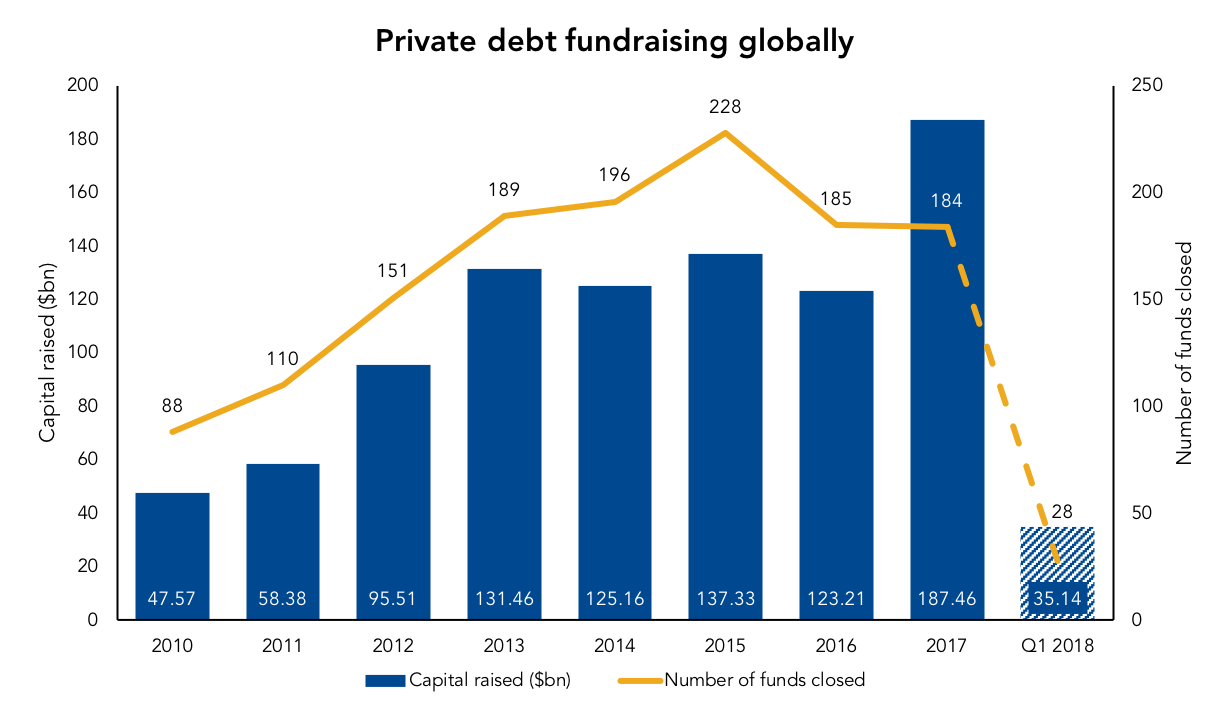
Investors appear to be adopting a ‘safety first’ approach as a decreasing number of managers benefit from continuing appetite for private debt.
Excuse the rudimentary math, but if you take the total number of managers which closed private debt funds in the first quarter (28) and multiply that by four to reach a figure for 2018 as a whole, it comes to 112.
This would be the lowest annual total of managers closing funds since 2011, and less than half the 228 peak number recorded in 2015. Although the 2018 total is a hypothetical projection, it would be in keeping with a decline in managers getting backed from 2015 to 2016 and then a further decline (albeit by a margin of just one) last year.
The notable thing about this is that the quantum of capital raised for private debt has been going gangbusters, with last year’s $187 billion easily surpassing the previous annual record. With first quarters being historically the slowest fundraising period of the year, Q1 2018 appeared to maintain the momentum with $35 billion collected.
So the trend that appears to be emerging is increasing appetite for private debt coinciding with a move to back fewer managers. This concentration of manager relationships is not unique to private debt; it has been witnessed in private equity, for example, for some time. But what does it tell us?
One message is that larger LP investors are now increasingly entering the private debt arena. As they do so, they are committing to a small handful of GP groups which are the only ones with the ability to absorb big-ticket commitments. For LPs with heft, dishing out modest sums to a wide range of firms simply wouldn’t make sense.
A second observation is that LPs – while still keen to chase the yield associated with the asset class – are getting increasingly nervous about the perceived late stage of the credit cycle. They see the bigger platforms as having greater resource to handle a downturn and any difficult situations that may arise from it. In this way, they are seen as a safe bet – today’s equivalent of IBM, perhaps.
Contact: Andy Thomson
andy.t@peimedia.com



Latest news

US leveraged loans returns turn negative in October
The Bloomberg US Leveraged Loan Index (Ticker: LOAN) has returned -0.26% this month through October 21, reducing its year-to-date return…

M&A activity begins to tick upward
In the third quarter of 2026, acquisition-linked loan volume across North America and Europe reached about $47 billion, up from $30.6 billion in Q2 and $29.5 billion a year ago.