



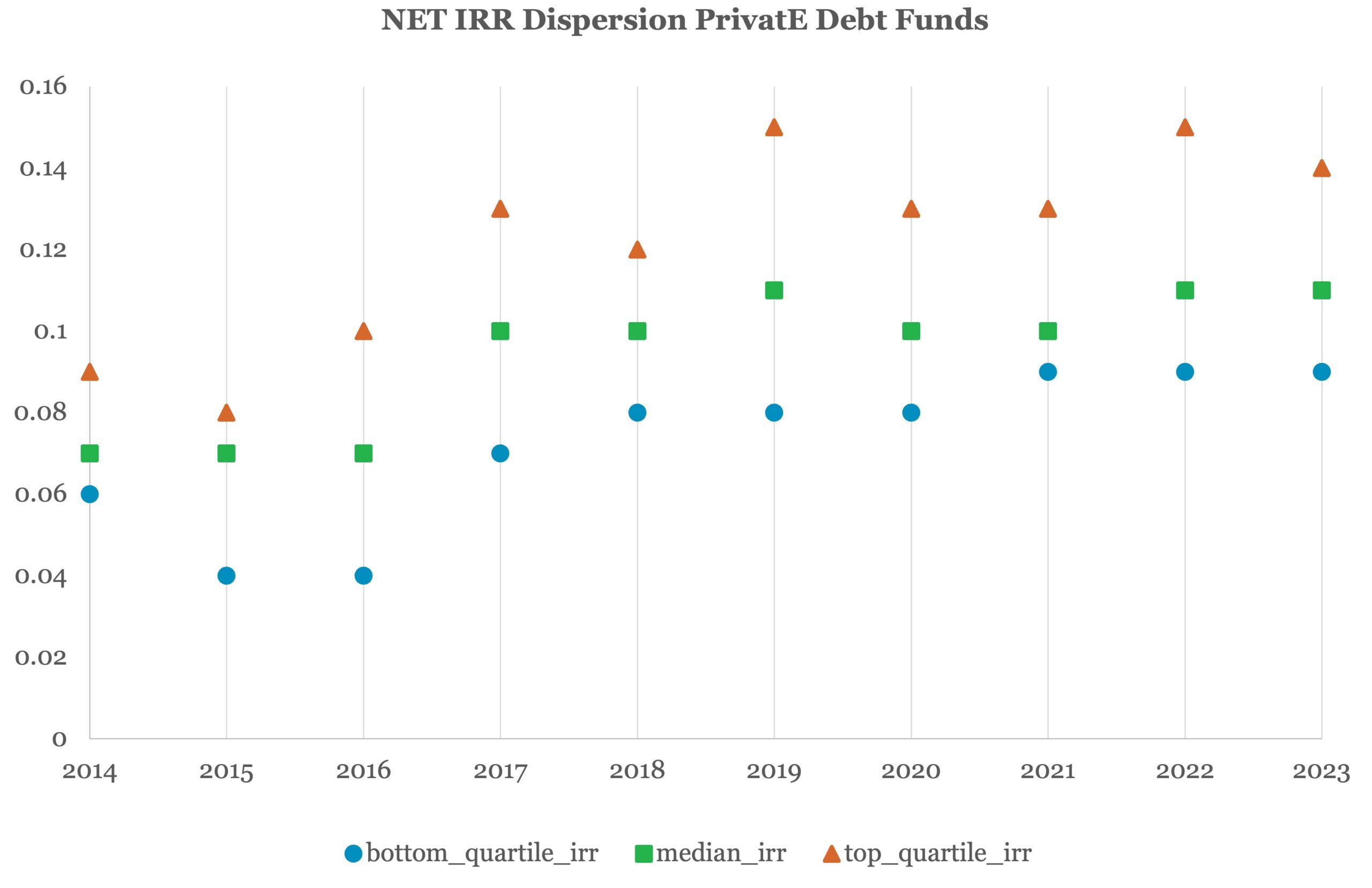
Private Debt Investor’s quarterly performance data shows spikes in internal rates of return – both in an upward and downward direction – in periods of turbulence.
Over the last two weeks, this column has reflected on findings from our new proprietary quarterly performance reports. This week, we explore the topic of return dispersion in private credit, based on top, median and bottom quartile net internal rates of return (IRR).
High dispersion of IRR for a given vintage may be considered more likely in periods of volatility when, in a well-worn phrase beloved of industry participants and observers alike, it’s possible to “sort the wheat from the chaff”.
Funds with a 2019 vintage could not have imagined the turbulence that would lie ahead as first the covid pandemic wreaked havoc and saw interest rates driven down to zero (or even negative rates) before, in response to raging inflation, rates began to be hiked in late 2021.
In this kind of environment, some funds would have found themselves over-exposed to highly impacted sectors and with portfolio companies fighting to stay afloat. Others, with a keen eye for a bargain, would have taken advantage of this “dislocation” opportunity to buy quality assets at low prices. Not surprising then that the 2019 vintages were marked by the biggest difference between the best and worst performers.
In a PDI column in September 2023, we asked “Is this really a golden age?” at a time when the phrase was being widely bandied around – including at that month’s PDI New York Forum.
With fund managers benefitting from lending on a floating-rate basis at a time of rate hikes, there was hope that the asset class was in a higher-returning environment. Comparing recent vintages with those from 2014-16 appears to support the view that performance has indeed been boosted.





Latest news

Rate hike expectations ease as term SOFR curve flattens
The CME six-month Term SOFR rate reached a recent high of 3.979% on July 28 before retreating to 3.837% as…
3Q26: New loan assets rise to 44% of total lending, a 3-year high
New loan assets as a proportion of total US loan volume make up 44% of the 3Q26 pipeline to date,…

North American GPs dominant as fundraising accelerates
Our PEI Private Credit 200 ranking also shows capital raising increasing overall – and accelerating especially fast for the largest…