



Fundraising has been challenging over the last couple of years, but LPs now have the inclination and the ability to commit more capital.
If you’ve been wondering whether private debt can keep its growth momentum going, there’s plenty of room for optimism to be found in our latest LP Perspectives study of investor opinion – which will be published in the February 2025 edition of Private Debt Investor.
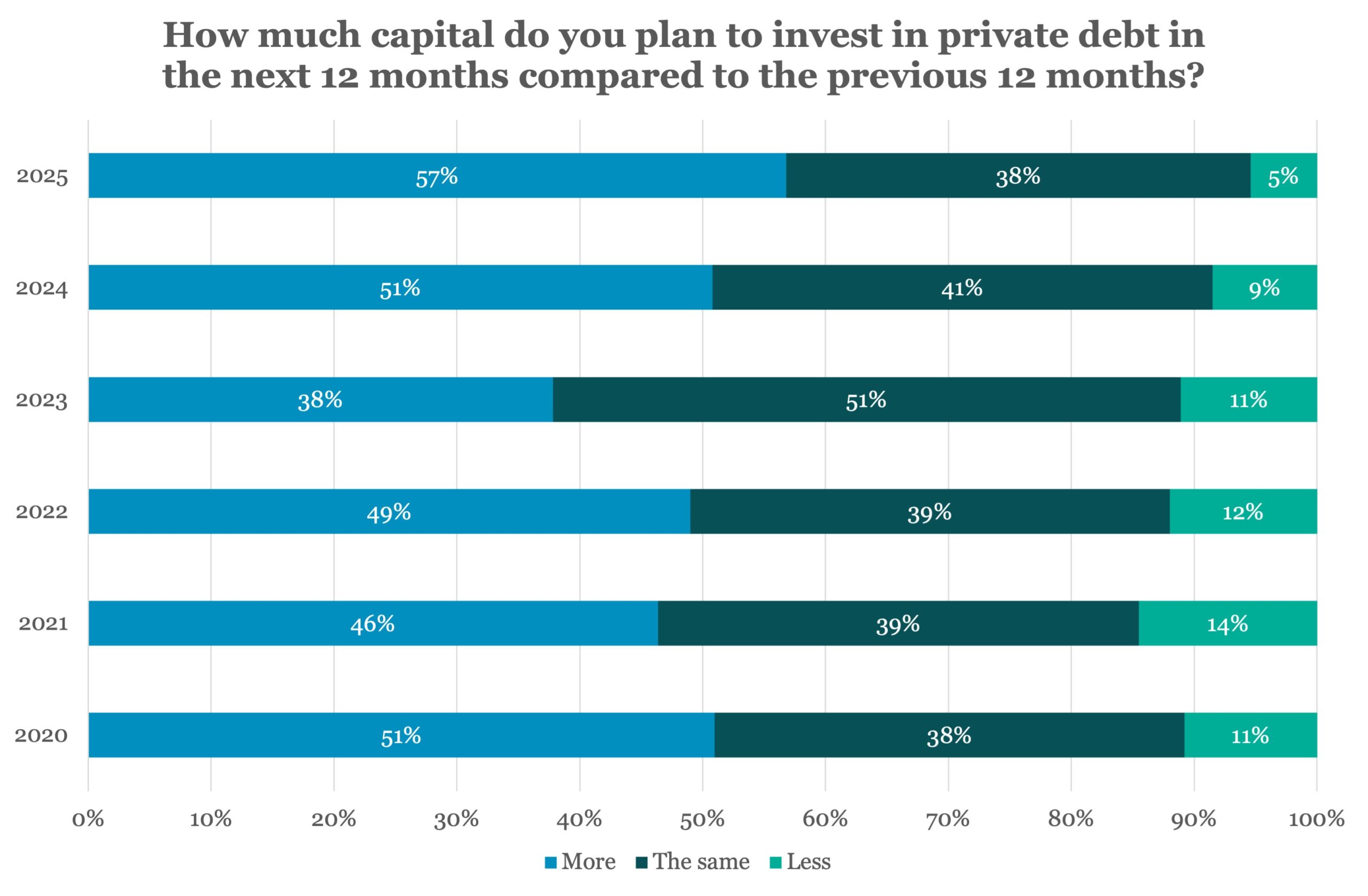
The study found 57 percent of LPs expecting to invest more in the asset class over the next 12 months than they did in the last 12 months. This represents a higher percentage than in any year since 2020. At the same time last year the equivalent figure was 51 percent and two years ago it dipped as low as 38 percent.
Thus, the fundraising lull which has been experienced over the last couple of years might be expected to come to an end in 2025 – indeed, our own fundraising data suggest the tide has already been on the turn in the second half of this year with capital raising beginning to pick up speed.
The private debt figure of 57 percent is also ahead of the figure for private markets as a whole, with 48 percent of LPs expecting to invest more in private markets over the next 12 months than in the last 12.
Partly, this is a reflection of private debt’s relative immaturity and the fact that a large proportion of the investor universe still have only modest private debt allocations. Indeed, none of the respondents to LP Perspectives said they were currently over-allocated to private debt. More than half, 54 percent, said they were at their target allocation while 46 percent said they were currently under-allocated.
Further encouragement for private debt can be taken from there appearing to be few impediments to investors committing capital. Fundraising in recent times has been hampered by the denominator effect and a lack of distributions. However, in our study, 42 percent said their limit on making new commitments was “not much” and 36 percent said “not at all”.





Latest news

Rate hike expectations ease as term SOFR curve flattens
The CME six-month Term SOFR rate reached a recent high of 3.979% on July 28 before retreating to 3.837% as…
3Q26: New loan assets rise to 44% of total lending, a 3-year high
New loan assets as a proportion of total US loan volume make up 44% of the 3Q26 pipeline to date,…

North American GPs dominant as fundraising accelerates
Our PEI Private Credit 200 ranking also shows capital raising increasing overall – and accelerating especially fast for the largest…