
Direct lending has enjoyed years of tailwinds – now it must confront the headwinds.
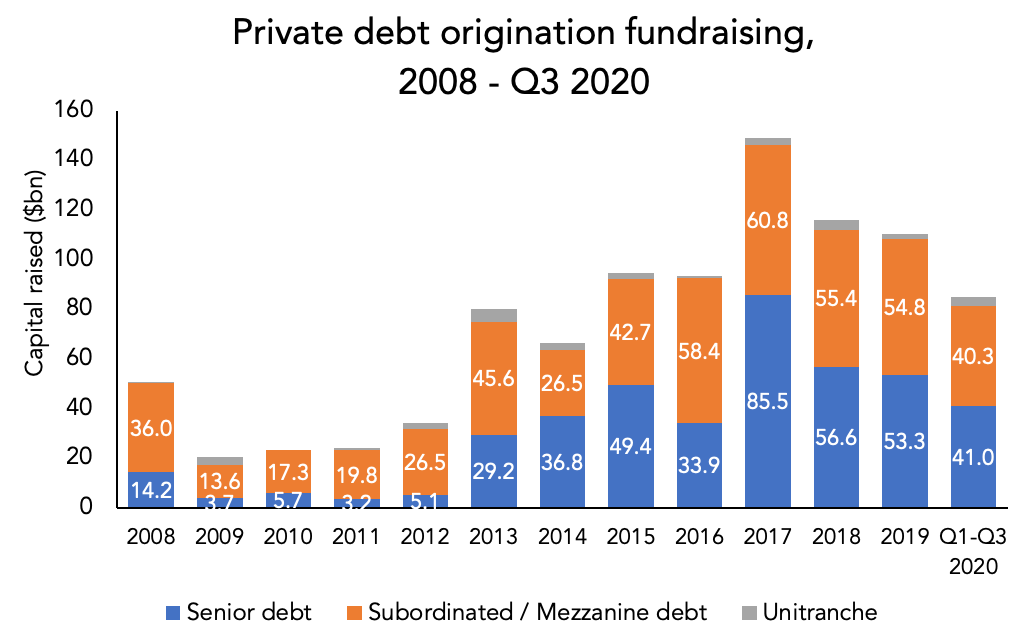
Direct lending has experienced enormous growth since the global financial crisis (see chart showing fundraising for various direct lending-relevant strategies), filling a gap that retrenching banks left behind. It has also been a market driven by tailwinds while constantly bracing itself for an inevitable downturn. Now that one is here, what is the outlook?
One investor we asked found that almost one-quarter of its private debt portfolio companies were subject to high impact from covid-19. Unsurprisingly, many of these were in vulnerable sectors such as retail, hospitality and travel. Eyes are on the operational models that GPs talked about when they raised their funds and whether those models will live up to their billing. Some think this is an environment where the private debt arms of private equity firms may come into their own because of the ability to tap PE colleagues’ operational nous. But there have always been concerns over possible conflicts of interest.
From around 2010-13 a net return of around 8-10 percent was considered par for the course for direct lending. Since then, competition has compressed returns and made that target range more like 6-8 percent. How returns fare in the period ahead depends on the level of defaults – everyone knows they’ll go higher, but no one knows exactly how high.
Since the health crisis emerged, documentation has been getting slightly more favourable for lenders. Some sponsors are recognising that certain EBITDA addbacks cannot be justified in such an uncertain economic environment, and also that cash should not be leaked out of businesses that may need to keep hold of that cash for the next year or two at least. However, there is still a lot of competition for deals in sectors perceived to be covid-resilient and, in these cases, bidders are fighting over the terms as well as the price.
While a lot of capital has been raised for distressed debt by global mega-funds, observers have noted a number of new emerging distressed debt managers in Europe targeting niche opportunities – including the possibility of purchases from direct lenders. This in itself is a sign that all may not be well for everyone.





Latest news

Multiples on PE buyouts
This quarter marks our integration of SPI by StepStone as the primary source for US buyout valuation metrics for the PE Breakdown.

US Leveraged Loan Issuance Slows to $76.5b in July
The US leveraged loan market has continued to slow from the May level of $104.7b, with approximately $76.5b priced in…