



Our latest investor survey shows LPs reluctant to engage with credit secondaries – despite increasing signs of maturity in the market.
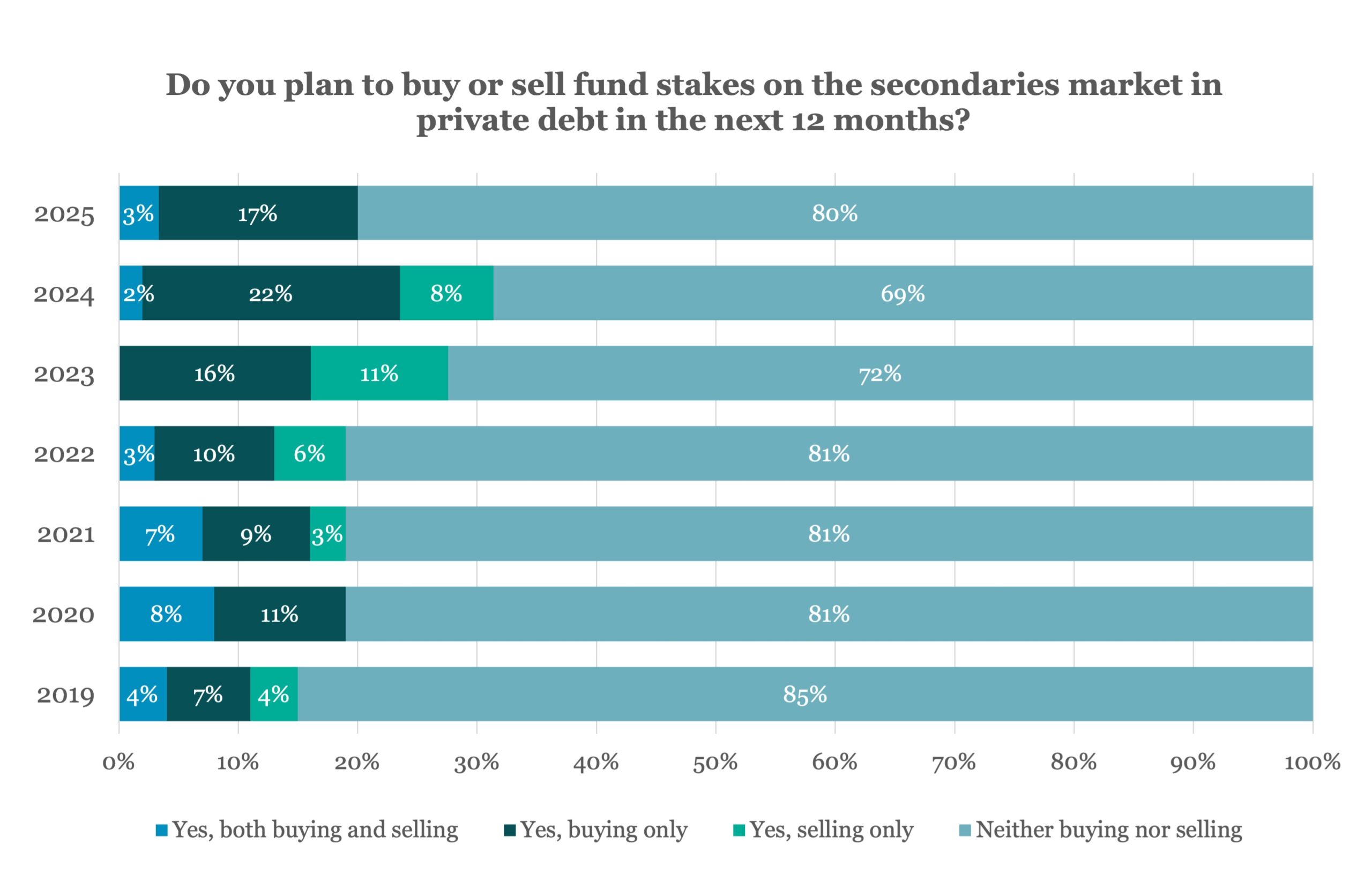
On the face of it, the private credit secondaries market still has a long way to go. In the 2025 version of our Perspectives study, a test of LP opinion, we found only 20 percent of respondents were planning to be active in the secondaries market this year (see chart). This was down on the number planning to do so in 2022 and 2023.
However, current levels of activity appear to present a rosier picture. At the end of last week our colleagues at Secondaries Investor drew attention to what they are calling an “influx of credit-focused secondaries transactions”.
Among these was the offloading of a sizeable private credit portfolio by Florida State Board of Administration, with private debt manager Banner Ridge Partners picking up $2.1 billion of net asset value according to managing partner Anthony Cusano.
The deal “shows the market and institutional investors that large portfolio management changes at scale are possible with illiquid credit assets and not just private equity portfolios”, said Cusano.
As Private Debt Investor referenced in its most recent Friday Letter, last year saw a breakthrough credit continuation vehicle in the form of Abry Partners’ $1.6 billion GP-led transaction, backed by secondaries specialist Coller Capital in a market not just growing fast but also seeing increasing innovation.
We also pondered whether private debt secondaries may go down a more sector-specialist route than its private equity counterpart. Given the distinction between asset-backed and cashflow-based lending, this appears to be a real possibility, according to some in the market.
That distinction is currently a consideration for LPs pondering whether they should have separate cashflow-based and asset-based allocation buckets (given what some see as the potential of ABL to become as large, or even larger, than mid-market corporate lending).
In the secondary market context, GPs are considering whether it would be desirable and/or viable to raise separate vehicles. One source at a leading secondaries firm told us this week they could envisage the advent of specialist asset-based credit secondaries strategies.




Latest news

PE middle-market pooled IRR and TVPI by TEV size bucket
The lower end of the middle market has generated better returns on average and does not come with significantly more left-tail risk


Investors exit retail loan funds in July
Investors in leveraged loans have been pulling money from retail funds in recent weeks, with redemptions outpacing investments by $253.3b…