



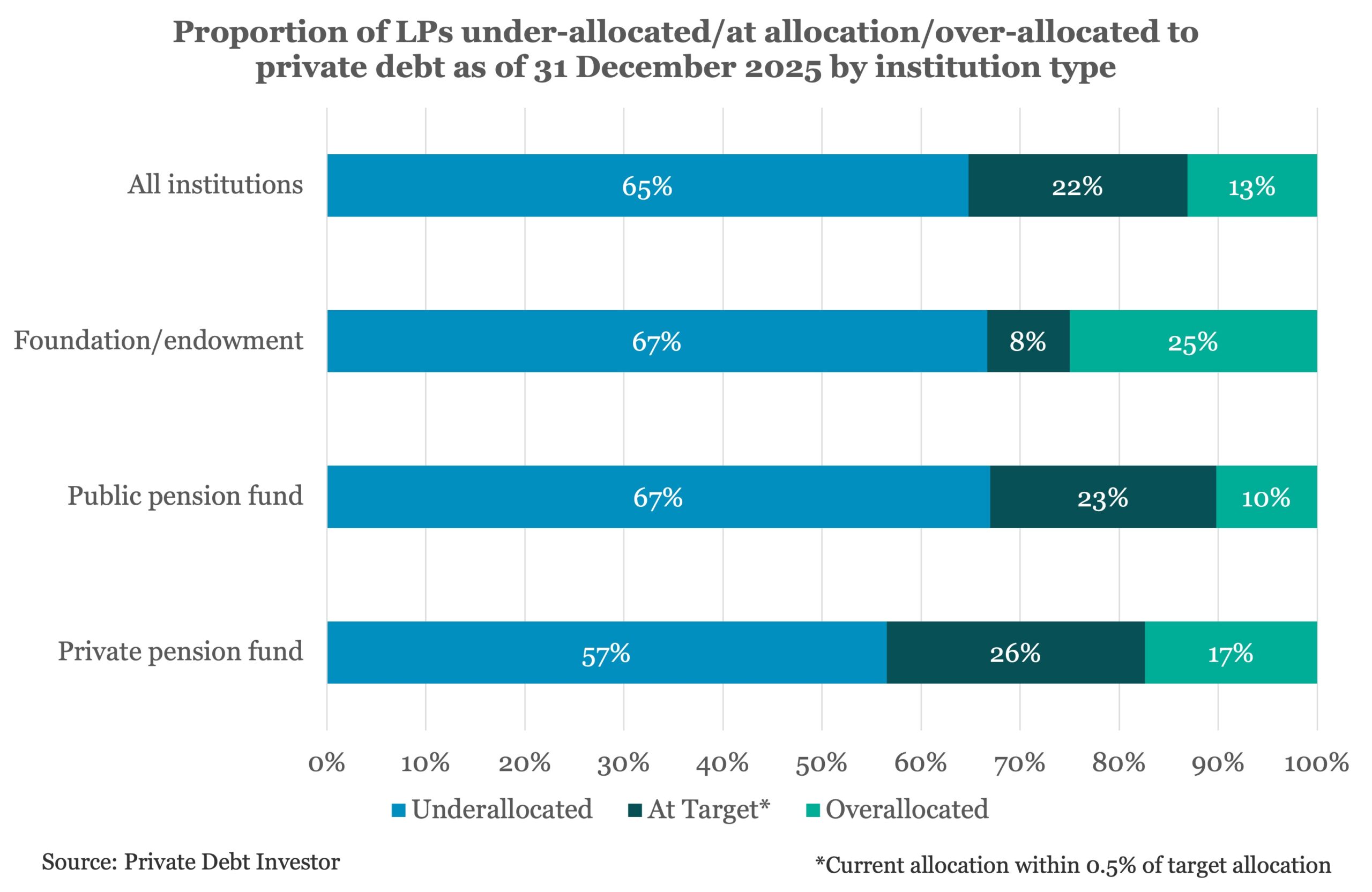
But our Investor Report finds that around two-thirds of institutions consider themselves under-allocated to the asset class.
Public pensions may be the typical investor in private credit – accounting for 46 of the top 75 allocators to the asset class in Private Debt Investor’s annual Global Investor 75 ranking – but insurance companies are the ones apparently prepared to carve out the biggest slices of their portfolios.
PDI’s latest Investor Report shows that – as at 31 December 2025 – insurers made average allocations to private credit (on a weighted average basis) of 7.1 percent. This compared with 6.3 percent for private pension funds, 5.9 percent for public pension funds and 5.2 percent for foundations and endowments.
But while pension funds and insurers have formed the bedrock of private credit fundraising, no one should assume that their appetite is sated. Far from it, in fact. Asked about allocation targets, 65 percent of all institutions canvassed said they were under-allocated to the asset class with just 13 percent over-allocated (see chart). Sixty-seven percent of public pension funds, the keenest supporters on the face of it, consider themselves below target.
The report also identified private credit’s biggest allocators. The prize for top allocator in 2025 went to the International Finance Corporation, with 11 commitments to closed-end funds during the year. Hot on the heels of the IFC, each with 10 commitments, were the European Investment Fund, Los Angeles City Employees’ Retirement System and Texas County and District Retirement System.
When it comes to the biggest individual commitments, we find the top two both accounted for by the California Public Employees’ Retirement System: almost $1.6 billion to Ares Management’s Ares Special Opportunities Fund III and $800 million to Goldman Sachs Asset Management’s West Street Climate Credit SLP fund.





Latest news

Rate hike expectations ease as term SOFR curve flattens
The CME six-month Term SOFR rate reached a recent high of 3.979% on July 28 before retreating to 3.837% as…

3Q26: New loan assets rise to 44% of total lending, a 3-year high
New loan assets as a proportion of total US loan volume make up 44% of the 3Q26 pipeline to date,…

North American GPs dominant as fundraising accelerates
Our PEI Private Credit 200 ranking also shows capital raising increasing overall – and accelerating especially fast for the largest…