


Markit Recap – 4/3/2017

Many names have a certain kind of notoriety in the CDS market. TXU, Hellenic Republic and more recently iHeart – all posed significant challenges to the efficacy of the CDS product.
Another prime example is Novo Banco. The Portuguese name was created as a “good bank” in the restructuring of Banco Espirito Santo in August 2014. This was immediately prior to the introduction of the ISDA 2014 definitions in September of that year. The good bank/bad bank split highlighted some of the flaws in the 2003 definitions: namely senior debt restructurings triggering subordinated CDS and ambiguity around state bail-out of financials.
After infuriating bondholders once again in 2015 – the government transferred additional senior bonds to the bad bank, leaving bondholders out of pocket – Novo Banco is in the news once again. The government has agreed to sell 75% of the bank to US private equity fund Lone Star in return for a capital injection of €1bn. The remaining 25% will the retained by the sole current shareholder, the Portuguese bank resolution fund.
The aforementioned bondholders are seeking an injunction to block the sale of Novo Banco, and the deal still has to be approved by the EU and ECB. Senior bondholders also have to agree to convert €500 million of bonds into higher risk bonds, though the terms and conditions of the exchange have yet to be disclosed.
The bond exchange is voluntary, so if it goes ahead it would be unlikely to trigger CDS. But Moody’s views it as a distressed exchange, hence its downgrade of senior unsecured debt to Caa2.
The reaction in the CDS market? Novo Banco is quoted points upfront, and it saw some credit deterioration after the deal was announced, though it is some way off the levels reached last year. The negotiations with Lone Star had been underway for some time, so it was to some extent expected.
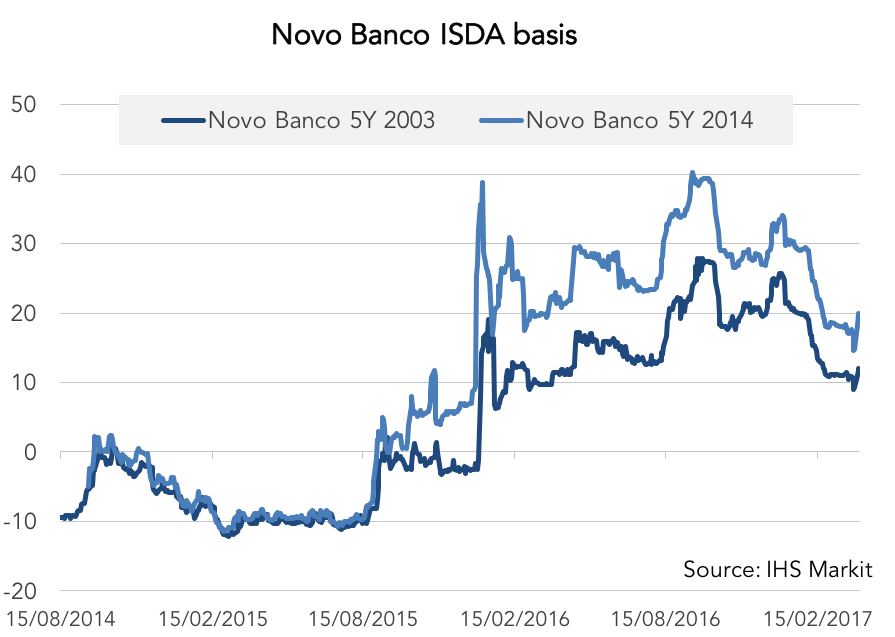
But, given Novo Banco’s history, it is worth examining the relative performance of the 2003 and 2014 contracts, otherwise known as the ISDA basis. Senior 2014 CDS is trading at 20 points upfront compared to 12 points upfront on 2003 contracts. This may seem counterintuitive, as the 2014 senior contract is no longer triggered by subordinated default. But Novo Banco is no ordinary bank, and the basis reflects the governmental intervention credit event embedded in the 2014 contract and the lack of a subordinated capital buffer. The latter fact makes senior debt in line for bail-in if the Lone Star deal doesn’t deliver stability, a risk that is also mentioned in Moody’s decision to place the Caa2 rating on review for downgrade. Novo Banco may not have left its infamy behind, at least to CDS investors.
Contact: Gavan Nolan
Gavan.Nolan@ihsmarkit.com





Latest news

Lack of new issues clouds CLO market
It’s been boom time in the leveraged loan market but now that market has eased off, what are the implications…

Multiples on PE buyouts
This quarter marks our integration of SPI by StepStone as the primary source for US buyout valuation metrics for the PE Breakdown.

US Leveraged Loan Issuance Slows to $76.5b in July
The US leveraged loan market has continued to slow from the May level of $104.7b, with approximately $76.5b priced in…