Markit Recap – 1/12/2015

The precipitous decline in the oil price has taken some of the attention away from Greece, albeit until the elections next week. Less than four months ago the price of WTI crude was more than $100 a barrel; now it is languishing below $50.
A bearish broker report drove the recent decline, but there are clear fundamental reasons behind oil’s fall from grace. Supply remains buoyant, both from shale sources in the US and from OPEC. The latter shows no sign of changing its production policy; indeed, the Gulf states are engaged in a price war to protect market share. On the demand side, the eurozone is stuck in a slump and China is not growing at the rapid pace we have become accustomed to.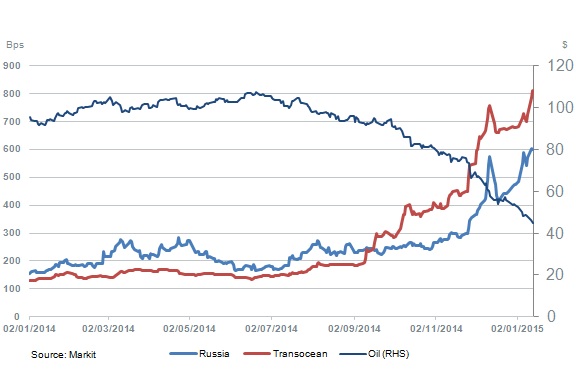
What does a falling oil price mean for the global economy and the credit markets? It results in a transfer of wealth from oil producers to consumers, which should provide a near-term boost to growth (the benefits to consumers are realised quicker than the losses to producers). But that will be of little comfort to oil exporting countries such as Russia and Venezuela. Both countries have seen their CDS spreads widen dramatically in tandem with the declining oil price.
Russia’s spreads exceeded 600bps for the first time since March 2009, and the credit deterioration is all the more evident when one considers that it was trading at 300bps less than two months ago. The sovereign has ample reserves, but the combination of falling revenue from its main export and the impact of US/EU sanctions will impinge heavily on growth this year. Corporate defaults and concomitant bad debts in the banking system could follow, and the government may have to step in and provide capital. The ruble has weakened dramatically, and the CDS market is implying that Russia will struggle to hold on to its investment grade rating (it has Markit Implied Rating of ‘CCC’).
Russia may be in a tight spot, but Venezuela is in an even worse position. It was downgraded two notches to Caa3 by Moody’s, the agency citing the impact of lower oil prices on its already depleted reserves. The sovereign’s CDS reflect its dire predicament – its one-year contract is trading at 54 points upfront, implying a 78% probability of default.
And it is not just government finances that are feeling the pressure from oil. Companies such as Transocean, an oil rig operator, have seen their spreads widen sharply. Transocean is an investment grade credit, but its Baa3 rating is on review for downgrade by Moody’s, and the company’s spreads of 825bps imply that a cut to junk could be forthcoming.
Contact: Gavan Nolan





Latest news

Multiples on PE buyouts
This quarter marks our integration of SPI by StepStone as the primary source for US buyout valuation metrics for the PE Breakdown.

US Leveraged Loan Issuance Slows to $76.5b in July
The US leveraged loan market has continued to slow from the May level of $104.7b, with approximately $76.5b priced in…