


Private credit offers issuers some certainty during uncertain times, although comes with a cost

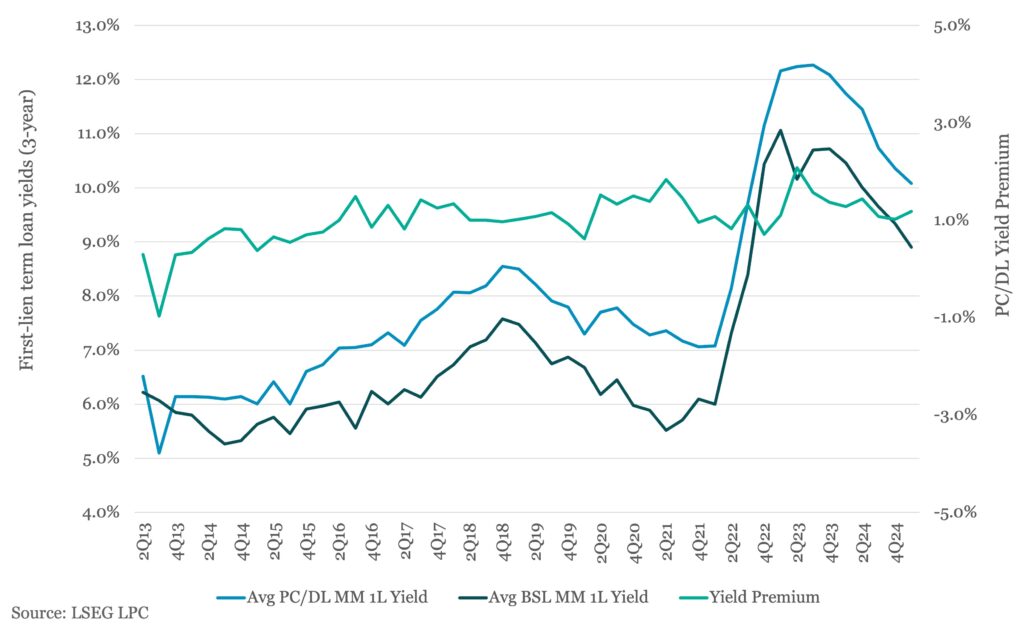
No matter which market borrowers opted to tap, financing conditions seemed more than accommodating as we approached the second quarter. In the middle market, the average yield on a broadly syndicated first-lien term loan tightened 180bp (9% area) since the beginning of ’24, while that on a privately placed term loan eased 200bp (10% area). And while pricing has generally moved in tandem between the two markets, the illiquidity premium for private credit has remained remarkably consistent, bracketing 100-150bp during the same timeframe. That pricing dynamic could change in the months ahead as the BSL market falters while private credit remains open. We may have already seen a glimpse of this play out in 1Q25, where the illiquidity premium widened to 118bp, the steepest delta since 2Q24. So how could a borrower address an M&A opportunity under today’s backdrop? One strategy would be to weigh the tradeoffs of each market and play them off each other. A privately placed financing provides certainty of funds and quicker execution given there’s no ratings requirements, marketing conditions, or flex provisions, which could all be worth the incremental cost of capital. The borrower would also give up some flexibility related to covenants, documentation, and future capital structure changes, although this burden would likely be temporary (if not trivial) given loans are prepayable. The borrower could simply retain the private structure until the call protection steps down or rolls off altogether, then refinance back into the BSL market to potentially recapture that flexibility along with lower pricing once the BSL market reopens, a strategy that numerous issuers have already successfully executed on over the past two quarters.





Latest news

Rate hike expectations ease as term SOFR curve flattens
The CME six-month Term SOFR rate reached a recent high of 3.979% on July 28 before retreating to 3.837% as…
3Q26: New loan assets rise to 44% of total lending, a 3-year high
New loan assets as a proportion of total US loan volume make up 44% of the 3Q26 pipeline to date,…

North American GPs dominant as fundraising accelerates
Our PEI Private Credit 200 ranking also shows capital raising increasing overall – and accelerating especially fast for the largest…