



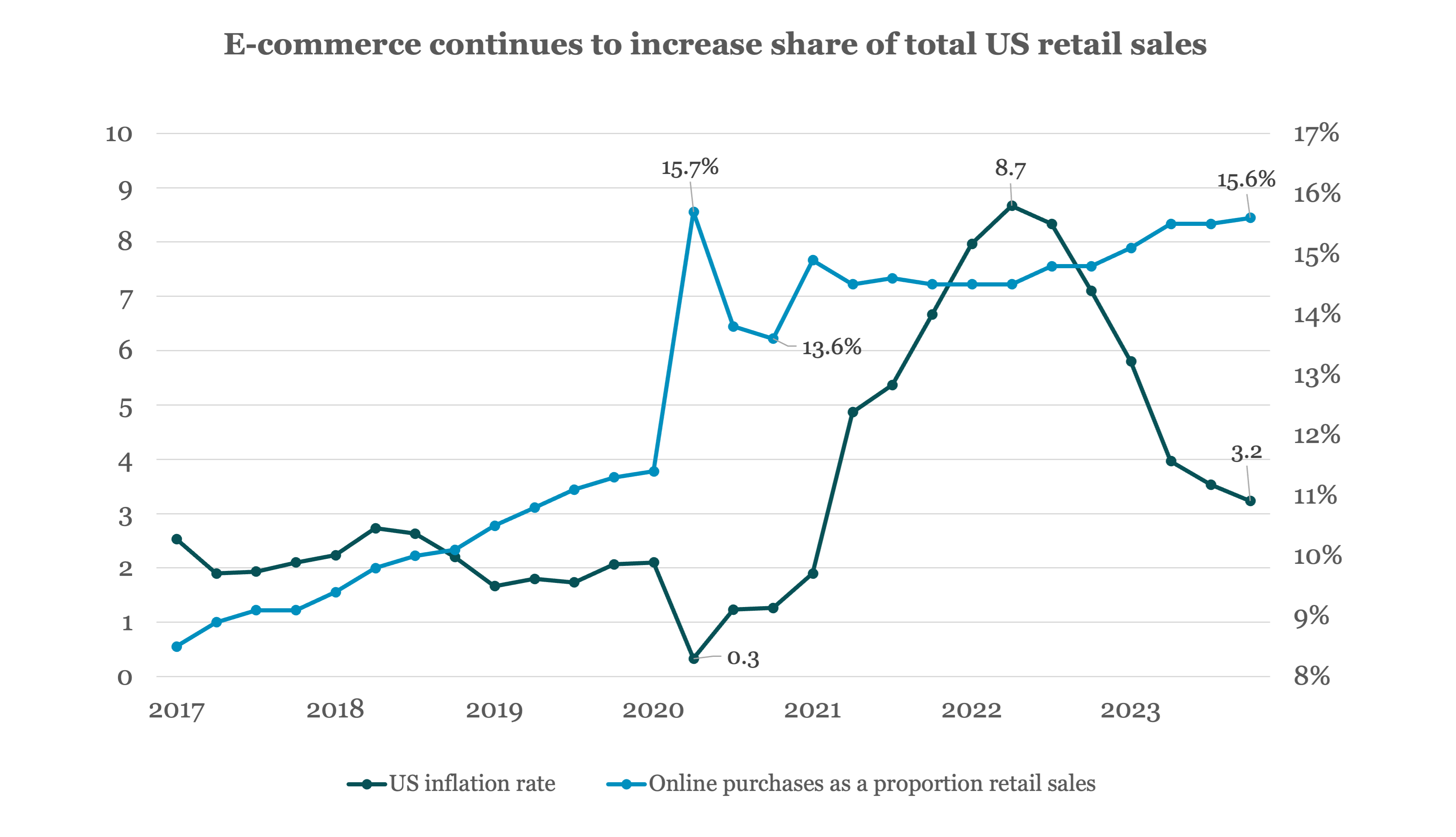
During recent years, the surge in online shopping contributed to the struggles faced by numerous brick-and-mortar retailers. Online purchases spiked to 15.7% of all retail sales during the COVID-19 pandemic, when a lot of retailers had to close their stores. The share of online purchases then stabilized around 14.5% in 2021, before picking up again in 2022 and reaching 15.6% in 2023.
Uncertain future for retailers
Soaring inflation has also weighed heavily on several sectors in recent quarters, contributing to higher operating costs, steeper lease expenses and a greater cost of debt for companies. In addition, it has had a marked effect on consumer behavior, as shoppers have seen their disposable income dwindle, manifesting in a decline in consumer spending.
High key interest rates in response to surging inflation has made the cost of borrowing more expensive and further exacerbated operating challenges for retail companies, and we anticipate more Chapter 11 filings from firms that are currently in our distressed universe. There are presently three companies in the distressed filecycle, scoring over 90 on the Debtwire’s likely-to-distress (LTD) scoring system. A further seven score between 50 and 90, which could potentially tip over to become distressed credits.
We believe there has to be a significant uptick in the broader economy for retailers in our stressed universe to turn the corner and reverse the trajectory of their financial performances. The pressure of high interest rates and leverage causing onerous interest burdens, alongside squeezed liquidity because of decreasing sales, together make for a particularly challenging market for retailers, and this is likely to persist until inflation subsides.
For access to our comprehensive news, analysis and data on the global loan and bond markets, please subscribe to Debtwire.
(Past performance is no guarantee of future results.)





Latest news

Rate hike expectations ease as term SOFR curve flattens
The CME six-month Term SOFR rate reached a recent high of 3.979% on July 28 before retreating to 3.837% as…
3Q26: New loan assets rise to 44% of total lending, a 3-year high
New loan assets as a proportion of total US loan volume make up 44% of the 3Q26 pipeline to date,…

North American GPs dominant as fundraising accelerates
Our PEI Private Credit 200 ranking also shows capital raising increasing overall – and accelerating especially fast for the largest…