



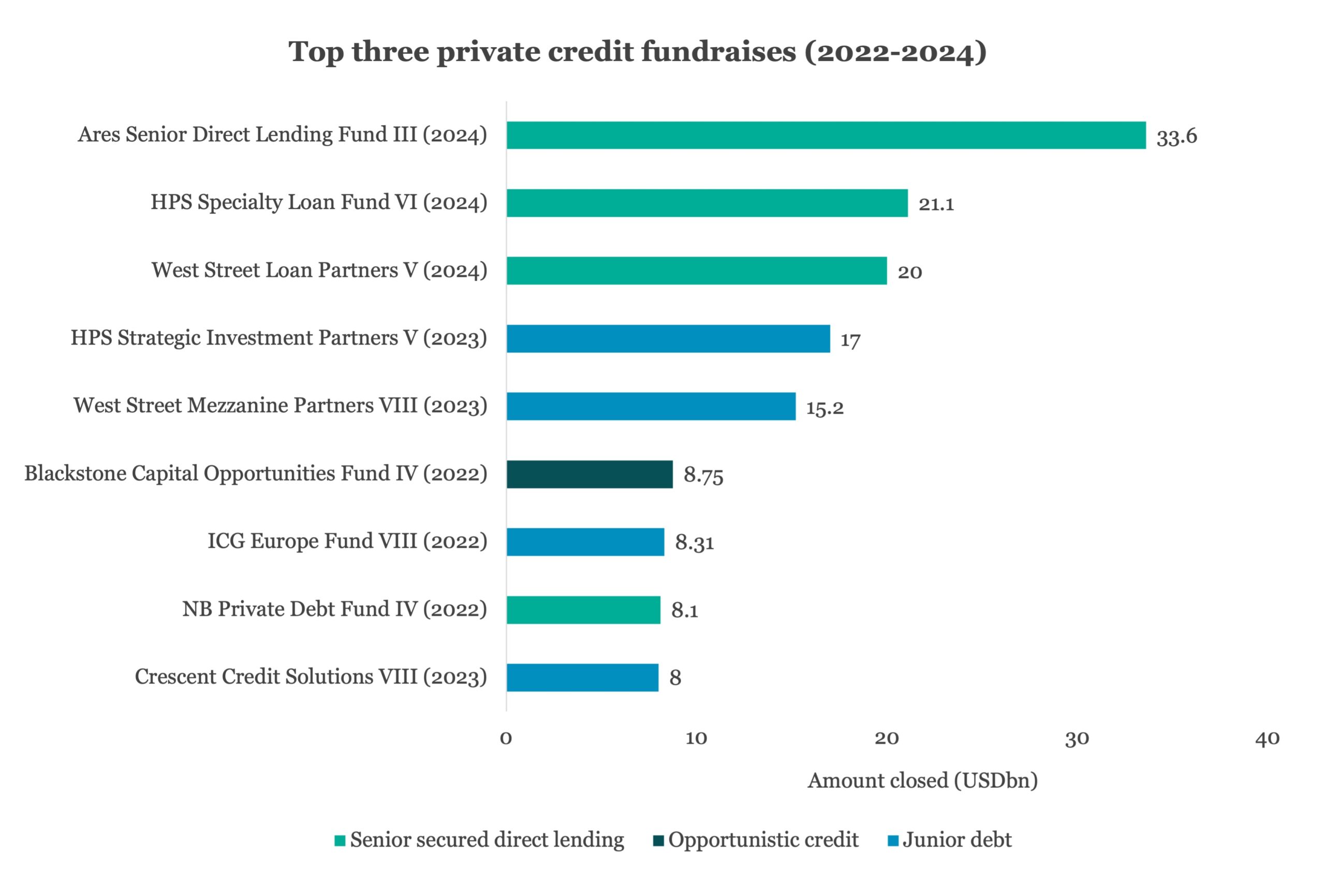
Despite challenging fundraising conditions for private market strategies persisting into 2024, the past year has seen private-credit funds break new ground, smashing fundraising records and solidifying senior direct lending as a leading core strategy.
Ares held a final close for its Senior Direct Lending Fund III, raising USD 33.6bn for the strategy in 2024. The senior secured direct lending fund is the largest closed-end private-credit fund recorded thus far. HPS also pushed the envelope, raising the second-largest fund of the year by securing USD 21.1bn for Specialty Loan Fund VI. Goldman Sachs came in third last year, closing on USD 20bn for West Street Loan Partners V.
It is notable that the top three fundraises in 2024 were the largest recorded over the past three years, according to Creditflux data. Unsurprisingly, these three funds all pursued senior secured direct lending investment strategies, cementing how senior direct lending has come to dominate the world of private credit.
In 2022 and 2023, only one closed-end senior direct lending fund raised enough capital to make the annual top three – Neuberger Berman’s NB Private Debt Fund IV closed in 2022 on USD 8.1bn.
The desire for senior direct lending funds, many of which also have the flexibility to fund unitranche deals, has been intense even as competition in the field increases. The surge in senior direct lending commitments is likely even more dramatic if we include the capital raised by evergreen funds and other vehicles not currently captured by Creditflux data.
Rising interest rates and relatively low default rates over the past few years have influenced investor sentiment. Volatility spikes have made public syndication unattractive, further driving investors toward alternative options. As a result, many institutional investors see senior secured direct lending as a compelling alternative to traditional fixed income especially when managed by a large, reliable asset management brand.
Well-funded pensions can consider senior direct lending strategies, as they offer “risk-controlled return enhancement with a high degree of predictability and strong cash flow characteristics,” investment consultant Cambridge Associates wrote in a 2023 whitepaper. The floating-rate nature of the loan also acts as a natural hedge against interest rates, unlike the liquid fixed-income bond market – which tends to be fixed rate and suffers from the volatility associated with public markets.
This is a real shift from when many investors valued private credit as an asset class for its ability to generate yield through more opportunistic or even distressed strategies. Once upon a time, many investors grouped private credit together with its hedge fund or private-equity allocations. Today, it is much more common for institutional investors to have a designated private-credit allocation consisting mostly of senior direct lending and smaller commitments to opportunistic credit and specialty finance strategies.
Amid the craze for senior direct lending, one might ask whatever happened to ‘junior debt’. In 2023, the three largest funds – HPS Strategic Investment Partners V, Goldman Sachs’ West Street Mezzanine Partners VIII, and Crescent Credit Solutions VIII – all followed some kind of junior debt strategy. In 2022, a junior debt fund the EUR 8.1bn (USD 8.31bn-equivalent) ICG Europe fund VIII – took second place. Yet, the strategy was absent from the top three in 2024.
Junior debt, once used interchangeably with mezzanine debt, has become increasingly difficult to define. The long-term trend has been one in which distinctions between the senior and mezzanine spaces have become less bifurcated, one investment consultant observed.
Traditional mezzanine deals have largely disappeared over the past few years, as private-credit managers readily offered a single solution unitranche loan, replacing the need for a separate senior loan and mezzanine financing.
As a result, junior debt funds appear to be shifting to a wide range of financing deals across the capital structure. Anecdotally, they also appear more willing to source deals with more complexity by backing slightly stressed companies or offering to provide junior debt for a dividend recap. Time will tell whether this category of funds roars back in 2025 to reclaim one of the top spots.
For access to our comprehensive news, analysis and data on the global loan and bond markets, please subscribe to Debtwire.
(Past performance is no guarantee of future results.)





Latest news

Rate hike expectations ease as term SOFR curve flattens
The CME six-month Term SOFR rate reached a recent high of 3.979% on July 28 before retreating to 3.837% as…

3Q26: New loan assets rise to 44% of total lending, a 3-year high
New loan assets as a proportion of total US loan volume make up 44% of the 3Q26 pipeline to date,…

North American GPs dominant as fundraising accelerates
Our PEI Private Credit 200 ranking also shows capital raising increasing overall – and accelerating especially fast for the largest…