


High yield bond issuance surpasses institutional leveraged loan issuance in February

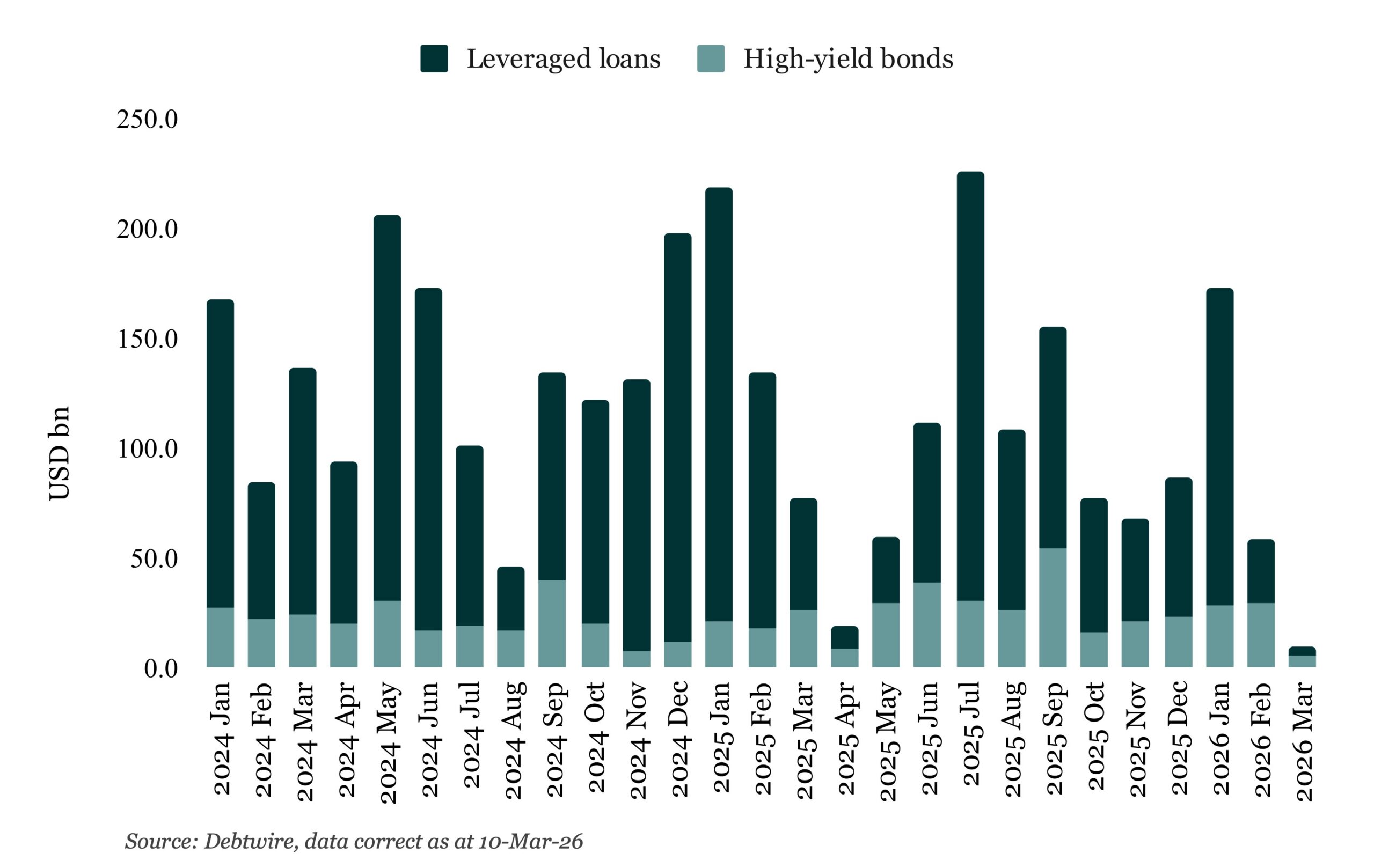
High-yield (HY) bond issuance surpassed institutional leveraged loan issuance in February. HY bond volume reached USD 29.7bn for the month, edging out the USD 28.6bn of institutional leveraged loan issuance recorded over the same period, according to Debtwire data.
“There is a shift towards secured bonds from term loans right now,” a sellsider told Debtwire.
As interest rates are expected to decline, investors are looking to lock in fixed coupons through bonds while the rates are still high, according to the sellsider and a buysider.
Investors are expected to continue to favor bonds over the floating-rate loan market in the short term, the sources continued.
The last time leveraged loan and HY bond volumes were this close was in April and May 2025, following the US government’s “Liberation Day” tariff announcement that disrupted markets.
Leveraged loans had entered this year with strong momentum, with January issuance surging 126% to USD 144.6bn, from USD 64bn in December. That strength faded quickly, however, with February issuance plunging 80% to just USD 28.6bn.
A key driver of the February slowdown was renewed anxiety around AI after Anthropic released its new Claude AI tool, capable of automating complex legal workflows. The launch contributed to a tech-led selloff in the secondary loan market. The share of all loans trading above par went from 55% in mid-January to below 19% in the first week of February and are still trading below 25% as of 11 March, according to Markit data. That deterioration in secondary performance fed directly into softer primary market demand, ultimately contributing to the muted leveraged loan issuance observed in February.
On the other hand, high-yield bond issuance has been consistently on the rise over the past few months, climbing from USD 21bn in November last year to USD 29.7bn in February this year, which is also a 63% increase in volume versus February 2025.
New money in HY bond issuance has accounted for over 30% of HY volume in the first two months of the year. While AI has been a source of fear, causing a disruption in the software industry, it has simultaneously boosted bond activity as investors funded deals related to building datacenters for AI. These AI-linked financings totaled USD 5.8bn in February.
This includes Tract Capital-backed Fleet Data Centers which issued USD 3.8bn of 5.875% 2031 senior secured notes to fund the construction of a data center to be leased to Nvidia.
Bitcoin mining technology company Cipher Mining issued USD 2bn of 6.125% 2031 senior secured notes to fund construction of a data center for AWS.
Applied Digital issued USD 2.15bn high-yield senior secured bond to fund the construction of a new data center in North Dakota.
Some issuers also prioritized bonds over loans in their debt package amid the change in direction of market demand. For example, arts and crafts retailer Michaels downsized its loan offering to upsize its senior secured notes by USD 300m during syndication while refinancing its capital structure to issue USD 2bn of 8.5% first-lien 2033 senior secured notes and USD 750m of 11% second lien 2034 senior secured notes.
The long settlement times for loans, extending to 1-3 months, have been deterring some investors from participating in the BSL market, a second buysider told Debtwire.
Looking ahead
Following the recent outbreak of conflict in the Middle East, signs of slowing activity have persisted in early March. Leveraged loan issuance remained muted in the first week of the month, with only USD 4.4bn as of 10 March. By contrast, HY bond issuance was USD 5.4bn over the same period.
“The market is favoring bonds rather than loans. It’s a different moment for the HY and BSL markets,” said a restructuring attorney, noting that CLOs – traditionally playing a big role in the BSL market – have been reevaluating exposures amid both the software selloff and controversy around two fraudulent situations ending up in bankruptcy last year.
For access to our comprehensive news, analysis and data on the global loan and bond markets, please subscribe to Debtwire.
(Past performance is no guarantee of future results.)
Contacts:
Jayjeet Sharma
jayjeet.sharma@iongroup.com
Ayse Kelce
ayse.kelce@iongroup.com




Latest news

Rate hike expectations ease as term SOFR curve flattens
The CME six-month Term SOFR rate reached a recent high of 3.979% on July 28 before retreating to 3.837% as…
3Q26: New loan assets rise to 44% of total lending, a 3-year high
New loan assets as a proportion of total US loan volume make up 44% of the 3Q26 pipeline to date,…

North American GPs dominant as fundraising accelerates
Our PEI Private Credit 200 ranking also shows capital raising increasing overall – and accelerating especially fast for the largest…