



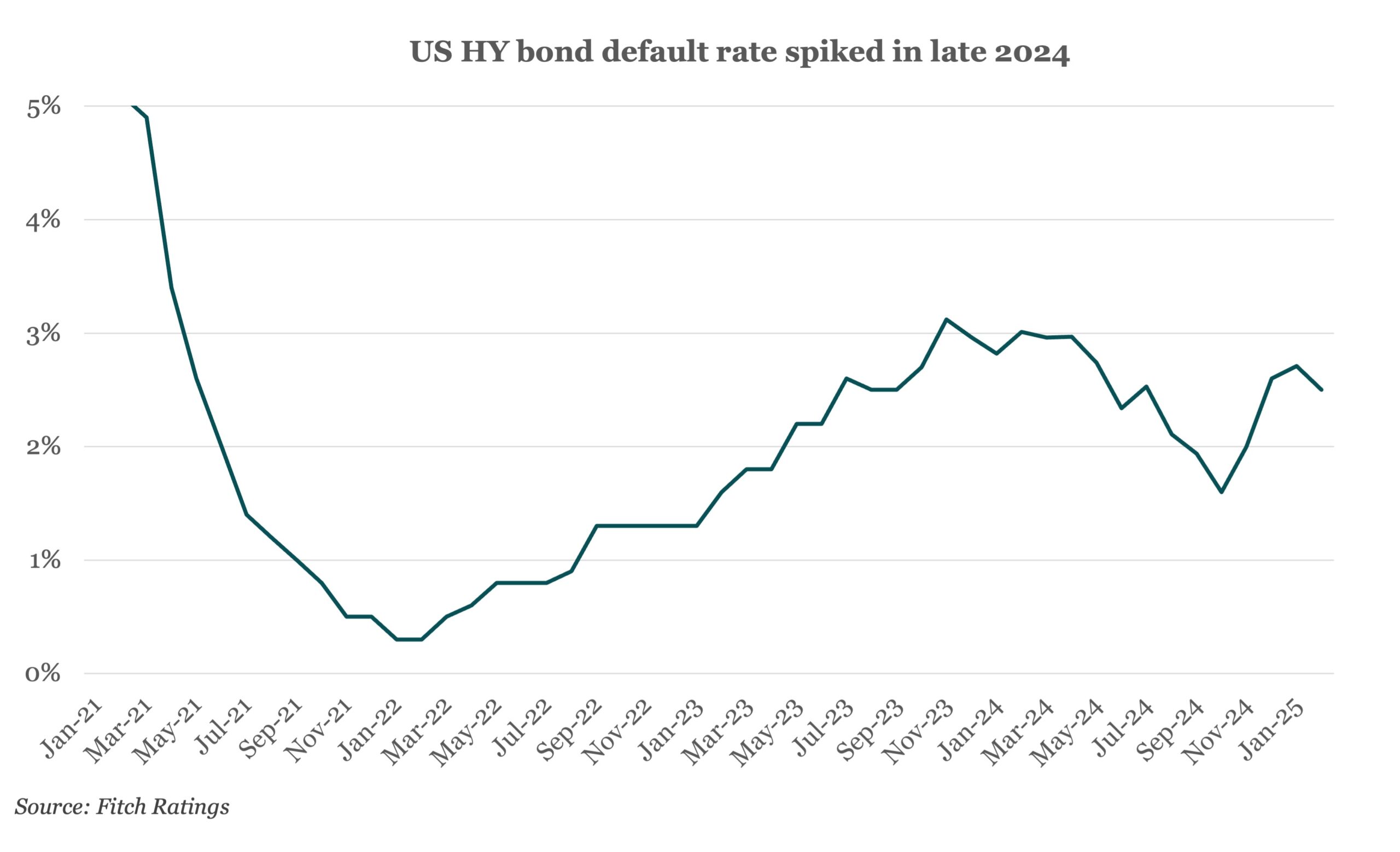
The trailing 12-month (TTM) US high-yield (HY) bond default rate has spiked in recent months following a steady decline through most of 2024. According to Fitch Ratings, the TTM HY bond default rate reached 2.5% in February, up from a low of 1.6% in October 2024.
After retreating throughout most of 2024, the HY bond default rate first started to spike in November last year, climbing to 2%. Four issuers defaulted during the month, with total monthly volume reaching USD 7.3bn, including two distressed debt exchanges (DDE) and two Chapter 11 bankruptcies. Dish DBS Corp’s USD 4.9bn distressed debt exchange last November was the second-largest DDE in the past 12 months, following Lumen Technologies’ USD 7.2bn DDE in March 2024.
November 2024 also saw Spirit Airlines file for Chapter 11 bankruptcy, with USD 3.6bn of prepetition funded debt, making it the third-largest bankruptcy in terms of prepetition debt for the year, according to Debtwire’s restructuring database. The company cited the highly competitive airline industry, shifting consumer demand, inflation, and other macroeconomic headwinds as the cause of its downfall.
The TTM HY bond default rate further increased to 2.6% in December, driven by iHeartCommunications’ USD 3bn distressed exchange, which was the third-largest DDE for bonds in 2024. DDEs have been the primary driver of HY bond defaults, accounting for 28 transactions or 74% of total defaults over the past 12 months. Chapter 11 bankruptcies followed, contributing 24% of the total, while missed payments accounted for only 2% of defaults.
Over the past six months, the broadcasting & media and cable industries have been at the forefront of the rise in HY bond defaults, accounting for 26% of defaults and 47% of total default volume. The rise of streaming services and the evolution of consumer preferences have significantly redirected advertising budgets towards digital platforms and social media. This shift has had a profound impact on the revenue models of broadcasting networks, media companies, and traditional cable providers. As advertisers increasingly focus on online engagement and precision targeting, these traditional media entities are compelled to innovate and diversify their offerings to sustain financial stability and remain competitive in a predominantly digital marketplace.
Meanwhile, the TTM US leveraged loan default rate has been steadily rising over the past year, reaching 5.2% in February this year, up from 3.5% in January 2024, according to Fitch Ratings. Similar to bonds, DDEs accounted for the majority of loan defaults during the past year, making up 69% of total defaults. DDEs have become the preferred option for companies, as they allow businesses to retain more value compared with restructuring through Chapter 11 bankruptcy. Average creditor recoveries for DDEs last year ranged between 78.5% and 92.6%, much higher than average weighted first-lien bankruptcy recoveries, which were around 39.5%.
Recently announced 10% across-the-board tariffs on all US imports, and reciprocal tariffs varying by country, could drive higher default rates for both US leveraged loans and HY bonds this year. Rising import costs and supply-chain disruptions may erode profitability, making it harder for highly leveraged firms to service their debt. Companies unable to pass these costs on to consumers could see declining cash flows, further increasing default risks. Export-reliant businesses may struggle with retaliatory tariffs, weakening their global competitiveness, while domestically-focused companies could benefit from reduced foreign competition as imports become more expensive.
Adding to these challenges, USD 280bn of HY bond debt is set to mature by 2026, creating potential refinancing pressure on issuers. In an increasingly uncertain economic environment, this looming debt burden signals a heightened risk of a further rise in defaults.
For access to our comprehensive news, analysis and data on the global loan and bond markets, please subscribe to Debtwire.
(Past performance is no guarantee of future results.)





Latest news

Rate hike expectations ease as term SOFR curve flattens
The CME six-month Term SOFR rate reached a recent high of 3.979% on July 28 before retreating to 3.837% as…
3Q26: New loan assets rise to 44% of total lending, a 3-year high
New loan assets as a proportion of total US loan volume make up 44% of the 3Q26 pipeline to date,…

North American GPs dominant as fundraising accelerates
Our PEI Private Credit 200 ranking also shows capital raising increasing overall – and accelerating especially fast for the largest…