



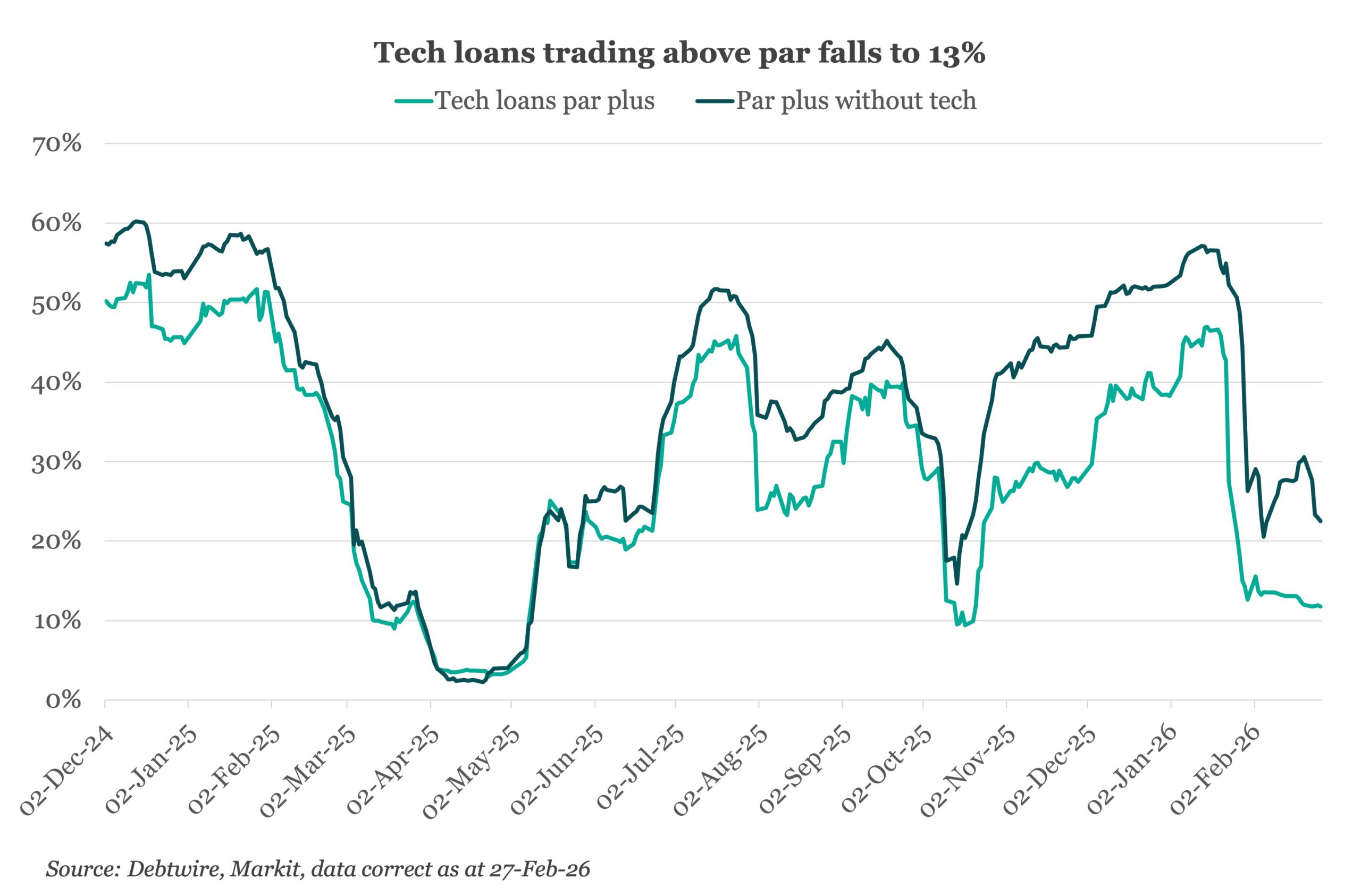
The percentage of tech loans trading above par in the secondary loan market plummeted from a high of 47% on 14 January to just 13% on 30 January, according to Markit data compiled by Debtwire. While the rest of the market initially rebounded nearly 10% after the drop in mid-February before falling again towards the end of the month, tech loans have flatlined since falling and are still hovering around 12%.
The tech sector selloff that began in the last week of January and continued into the early weeks of February was catalyzed by renewed AI-related concerns following Anthropic’s launch of its new CoWork platform, which can automate complex legal workflows. The move was immediately seen in the secondary loan market, with a number of AI-impacted software firms dropping in price.
Investor anxiety is growing over the extent to which AI could disrupt the software industry, a sector that has served as a reliable safe haven in the debt markets for the past decade and has consistently accounted for over 20% of total institutional leveraged loan issuance.
The tech-sector selloff has also weighed on the broader secondary loan market. The share of non-tech loans trading above par dropped sharply, from a peak of 52% on 1 January to just 21% on 5 February. While non-tech loans showed a modest rebound by going up to 31% on 20 February, then falling back to 23% as of 26 February, tech loans remained under significant pressure, with only about 12% trading above par as of 26 February.
The last time secondary tech loan prices moved this dramatically was in late September 2025, following First Brands’ Chapter 11 filing, when the leading global aftermarket auto parts supplier sent shockwaves across the market.
A similar shift also occurred after the US government’s “Liberation Day” tariff announcement in April 2025, when the percentage of tech loans trading above par briefly approached zero.
AI fears have prompted investors to reevaluate their investments and be wary of software companies whose business model is most vulnerable to AI disruption. Some of the software companies have experienced outsized swings in recent weeks.
Cloudera’s USD 1.86bn first lien 2028 term loan went from trading at 96 on 1 January, down to 86.3 on 30 January, before recovering slightly to 88 as of 25 February, based on Markit data. Similarly, QlikTech’s USD 2bn first lien term loan due 2030 dropped from 99.75 on 2 January to 82.75 by 25 February.
Primary market also takes a toll
The tech sell-off has also weighed heavily on primary market activity, with overall issuance falling from USD 142.6bn in January to USD 20.8bn as of 24 February. This year’s February issuance so far is much lower than the USD 116.5bn recorded for the entire month of February 2025.
Some tech loans have also shown signs of stress in syndication. For example, revenue lifecycle software provider Conga, backed by Thoma Bravo, struggled to syndicate its USD 1.2bn loan to fund Conga’s purchase of a subsidiary from PROS Holdings. Investors raised concerns about the new AI tools, which in turn left lead-arranger Deutsche Bank to provide a USD 625m term loan by itself.
Looking ahead
Macroeconomic uncertainty has further compounded the tech sector’s challenges. Recent developments such as the US Supreme court’s decision to strike down a portion of the Liberation Day tariffs and the Trump administration’s subsequent imposition of new 15% global tariff on all trading partners under different sections of trade law, adds to the challenges already faced by the tech sector along with the AI disruption. Also, USD 176bn of outstanding leveraged tech loan debt is set to mature by 2028, which puts pressure on the tech issuers to refinance their maturing debt.
For access to our comprehensive news, analysis and data on the global loan and bond markets, please subscribe to Debtwire.
(Past performance is no guarantee of future results.)





Latest news

Rate hike expectations ease as term SOFR curve flattens
The CME six-month Term SOFR rate reached a recent high of 3.979% on July 28 before retreating to 3.837% as…
3Q26: New loan assets rise to 44% of total lending, a 3-year high
New loan assets as a proportion of total US loan volume make up 44% of the 3Q26 pipeline to date,…

North American GPs dominant as fundraising accelerates
Our PEI Private Credit 200 ranking also shows capital raising increasing overall – and accelerating especially fast for the largest…