



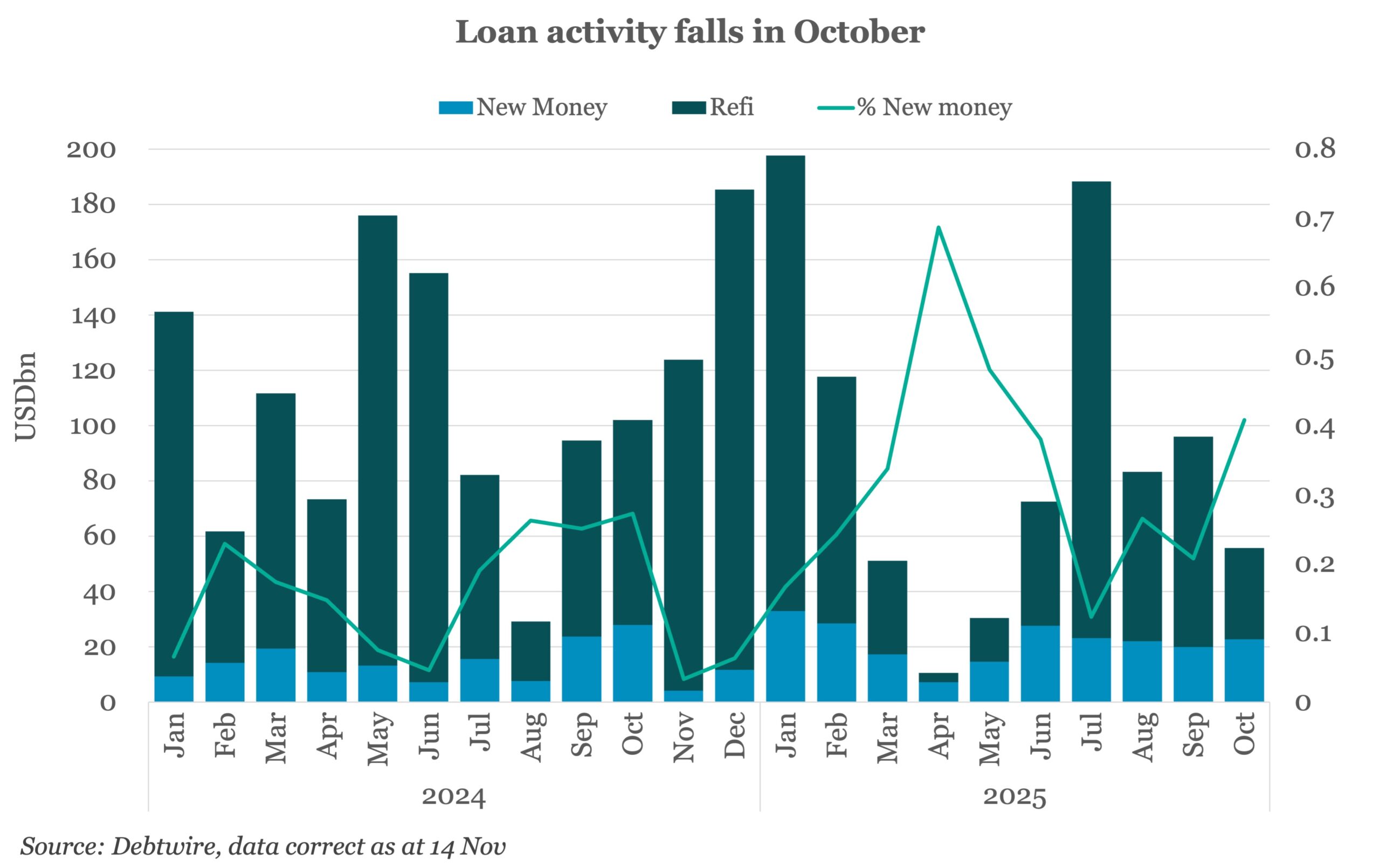
Institutional leveraged loan issuance dropped to USD 55bn in October, down 42% from USD 96bn in September. This decline followed a period of strong activity in the third quarter that marked a rebound from a subdued 2Q25 caused by US tariff announcements in April.
A strong start in July drove 3Q25 activity, with institutional loan volumes climbing to USD 188bn, driven primarily by refinancing deals, which accounted for USD 165bn of that volume. August, typically a quiet month, saw record issuance of USD 83bn, according to Debtwire data.
“Spreads are near all-time lows, rates are coming down, and lots of issuers who couldn’t refinance easily before are able to do so,” said a buysider. “At the same time, we’re seeing increasing dispersion across loans where investors are experiencing a sell-first mentality in highly levered issuers, loans have weaker credit quality lately, and we are seeing more and more loan transactions struggling to syndicate.”
Refinancing slows, new money holds steady
The struggle in syndication has led to a drop in refinancing activity, which had accounted for over 88% of overall volume as recently as July. Refinancings dropped to 59% of total issuance in October.
Despite the sharp decline in overall issuance, new money deals represented 41% of October’s volume, or USD 22.7bn. New money issuance has remained steady since June, consistently exceeding USD 20bn per month.
Dividend recaps are back
One area providing a consistent flow of new money activity is shareholder dividends. Monthly totals have exceeded USD 4.5bn since the start of 3Q25 and reached USD 5.2bn in October.
“The market is starved for new deals; there’s just not a lot of loan deals, and CLOs have cash to put to work,” said a second buysider. “When these incremental dividend recap deals hit the market, there’s new paper and demand is there, even if it’s not the best use of proceeds. We don’t love dividend deals, but they give us a chance to invest and put money to work.”
Dividend recaps have totaled USD 37.2bn this year through 30 November, surpassing the full-year 2024’s USD 25.1bn but still trailing 2021’s USD 51.3bn, which remains the highest level in the past decade, according to Debtwire data.
Why are companies turning to dividend recaps?
Companies have been conducting dividend recaps as they delay capital spending plans. Additionally, PE firms are waiting to get a better picture of the macroeconomic landscape and a better grasp on what some of these targeted companies would look like once the uncertainty clears.
“If they can’t buy assets, they’re leaving money on the table that may have otherwise been deployed this year. If they can’t put money to work to earn a return, they can take out their existing investments and do a dividend recap,” the second buysider said.
Recent prominent dividend recapitalizations include: Aircraft components producer and supplier TransDigm’s USD 2.5bn leveraged loan and USD 2.5bn senior secured notes to fund a USD 4.3bn dividend to shareholders in August; Thoma Bravo-backed, intelligence solutions company Ping Identity’s USD 1.8bn loan issuance to pay a USD 1.1bn dividend in October; and Versant Media Group’s issuance of USD 2.75bn in senior secured debt to fund a USD 2.25bn dividend to parent Comcast in October. All three deals have performed relatively well in the secondary market, with Transdigm and Ping Identity’s loans trading above par and Versant Media close to 99.5.
Looking ahead
Despite the recent slowdown, syndication is expected to accelerate in the first two weeks of December. “You either push new deals in the two weeks post-Thanksgiving, or you’re forced all the way into the new calendar year,” said a third buysider.
“Banks are incentivized to make borrowers feel like there’s a gun to their head, but I do think that they’re right this time. All signs point to inflation being sticky next year, and with credit spreads being tight, it might be the right time,” the third buysider said.
For access to our comprehensive news, analysis and data on the global loan and bond markets, please subscribe to Debtwire.
(Past performance is no guarantee of future results.)





Latest news

Rate hike expectations ease as term SOFR curve flattens
The CME six-month Term SOFR rate reached a recent high of 3.979% on July 28 before retreating to 3.837% as…
3Q26: New loan assets rise to 44% of total lending, a 3-year high
New loan assets as a proportion of total US loan volume make up 44% of the 3Q26 pipeline to date,…

North American GPs dominant as fundraising accelerates
Our PEI Private Credit 200 ranking also shows capital raising increasing overall – and accelerating especially fast for the largest…