


Private Debt Intelligence – 10/24/2016

Private Debt Fund Performance by Strategy
Preqin research finds that the performance of the most prominent private debt strategies – direct lending, distressed debt and mezzanine funds – has been robust, although there is clear fluctuation between vehicles of different vintage periods.
Among 2008-2009 vintage private debt funds, it is distressed debt funds that have the highest median net IRR of any strategy, with returns of 14.8%. These funds were making their first investments during and immediately after the Global Financial Crisis (GFC), and therefore were able to capitalise on the economic downturn and market volatility to post outsized returns. The performance of distressed debt funds has varied significantly over different vintage periods, with a median net IRR for 11.4% for 2010-2011 vintages and 8.1% for 2012-2013 vintages. However, these youngest funds will have yet to exit many of their investments, and this gap may close as the vehicles mature.
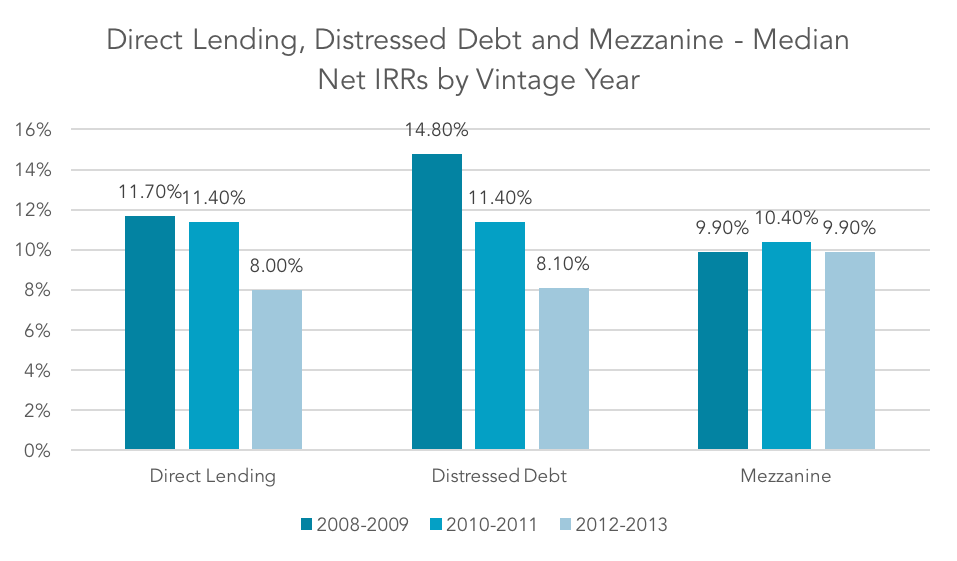
Direct lending has been a central factor in the growth of the private debt industry in recent years, and returns have been correspondingly healthy for 2008-2009 (11.7%) and 2010-2011 (11.4%) vintage vehicles. Although returns for 2012-2013 vintage funds (8.0%) are the lowest of any strategy there is considerable scope for improvement, while competitive forces in the marketplace could also be driving spreads down.
Mezzanine funds typically offer a lower risk profile to institutional investors, and their median net IRRs are testament to this stability. Performance across different vintage year periods has been consistent, with returns remaining between 9.9% (2008-2009 and 2012-2013 vintages) and 10.4% (2010-2011 vintages). Indeed, 9.9% returns among 2012-2013 vintages mark mezzanine funds as the highest performing of the three strategies among most recent funds, and is perhaps a contributing factor in the increasing investor appetite for the mezzanine investment.
On the whole, private debt performance continues to satisfy investors, with 84% of institutional investors surveyed by Preqin in June stating that fund performance had either exceeded (18%) or met (66%) their expectations over the past 12 months. As funds of more recent vintages continue to mature, that continued appetite will rely on this level of performance being maintained.





Latest news


Software, consumer-related direct lending deals fell in H1'26
The software and technology sector, the second-most-active sector in 2025 at 17% of total deal activity, slid to fifth place in the first half of 2026.

Unconquered Territory
With most of the map still unexplored, there’s room for a sequel.