



Insurance companies are some of the biggest allocators to private credit already, but there is still a lot of room for the partnership to grow further.
With insurance regulatory regimes varying between countries – and in the US, between states – and insurers having different needs and restrictions, competing for prized “permanent capital” is no easy task.
But for managers eager to increase their access to capital and management fees amid a somewhat tepid fundraising environment, dealing with complexity is a small price to pay for the $8.5 trillion hoard of cash and invested assets the US insurance industry held at year-end 2023, per the National Association of Insurance Commissioners.
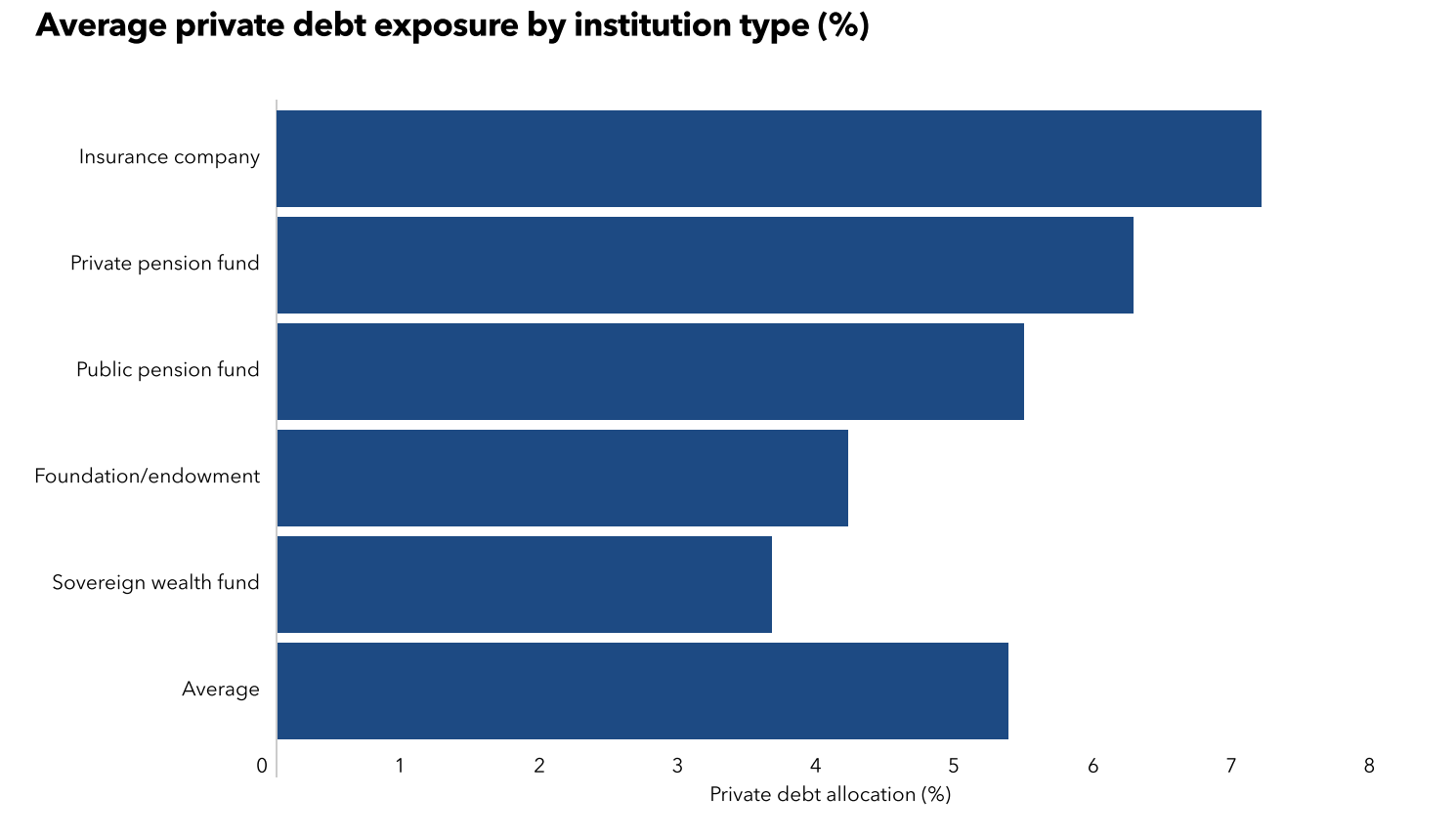
With Moody’s estimating that only about 4 percent of that total is in private credit, there’s a long runway for growth. Although it’s worth noting that, despite that, insurers are still the biggest allocators to private credit today (see chart).
The orientation of insurance companies – particularly life insurers and annuity providers – toward long-dated liabilities, as well as their regulatory imperatives, would seem to align well with private credit’s longer duration and illiquid nature.
But the two businesses “are actually quite distinct in their dynamics”, given that insurance is a balance sheet business, says Himanshu Chaturvedi, partner at consultants Cambridge Associates. He notes that the talent pool, and generally, the time horizon, for the two are very distinct, with life companies entering agreements for multiple decades.
Nevertheless, partnering with asset managers gives insurers potentially higher risk-adjusted yields for their fixed income allocations, greater total return and the kind of diversification that may not be available in public markets.
The hunt for yield characterised by the lengthy period of low interest rates has increasingly pushed insurers into the arms of private credit managers and away from more traditional fixed income products. Indeed, private credit holdings accounted for more than 44 percent of bonds in 2023, climbing from just 27 percent in 2013, according to AM Best, a credit rating agency that specialises in the insurance industry.
A recent Moody’s survey found that insurers had the greatest appetite for asset-based finance and private placements, with 44 percent of respondents expecting to increase long-term allocations. That was followed by mid-market lending, at 39 percent, infrastructure lending on 33 percent and fund finance at 22 percent.
It’s small wonder that the flurry of announced tie-ups between insurers and asset managers that began in earnest several years ago is continuing apace.






Business of Private Credit: Safety, Not Size
Even the best credit managers have loans that go bad. What separates them from everyone else is how they bring history and experience to working those problems out.