



The deal total for the first quarter was well ahead of last year’s equivalent, with the Benelux region particularly active.
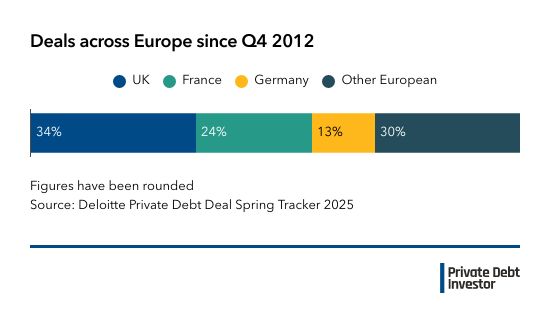
If you look back over the last 12 years (see chart), it’s clear that the European private debt market has been dominated by the UK, France and Germany, which have accounted for around 70 percent of all transactions between them.
Fast forward to the first quarter of 2025 and it’s an unheralded European market leading the deals charge: the Benelux region. Overall, the number of pan-European private equity-sponsored unitranche financings in Q1 fell to 119 – down 21 percent on 150 such financings in Q4 2024, according to Houlihan Lokey’s latest MidCap Monitor analysis.
This decline in deals is not surprising since the total is normally expected to fall between the fourth and first quarters in any given year. But in the Benelux, the number of deals in the period under scrutiny rose by 13 percent. This compared with falls of 8 percent, 35 percent and 39 percent in Germany, the UK and France respectively.
The Benelux market was characterised by the dominance of the Netherlands, accounting for the vast majority of completed deals. It also saw debt funds claim a huge 89 percent share of the overall financing market, with the banks reduced to the periphery.
Despite widely expressed concerns over a lack of dealflow in the sponsor-backed private debt market, the data leaves room for optimism. The Q1 2025 total was 42 percent up on Q1 2024.
Although it has been suggested that the buy-and-build model may be harder to pursue in a higher-rate environment, add-on acquisitions were the biggest single source of financings in Q1 2025, accounting for 42 deals (35 percent of the total), as sponsors continued to pursue buy-and-builds.
Meanwhile, Houlihan Lokey’s European subset of its Private Performing Credit Index showed an all-in yield of 10.17 percent in Q1 2025, above the 9.85 percent recorded in the previous quarter.
Yields for European private credit are now 332 basis points higher than the European Leveraged Loan Index and 41bps lower than the PPCI as a whole, which predominantly comprises US private credit borrowers.





Latest news


Software, consumer-related direct lending deals fell in H1'26
The software and technology sector, the second-most-active sector in 2025 at 17% of total deal activity, slid to fifth place in the first half of 2026.
Unconquered Territory
With most of the map still unexplored, there’s room for a sequel.