
The early signs in 2025 are positive as capital raisers enjoyed a prolific three months and distressed strategies increased market share.
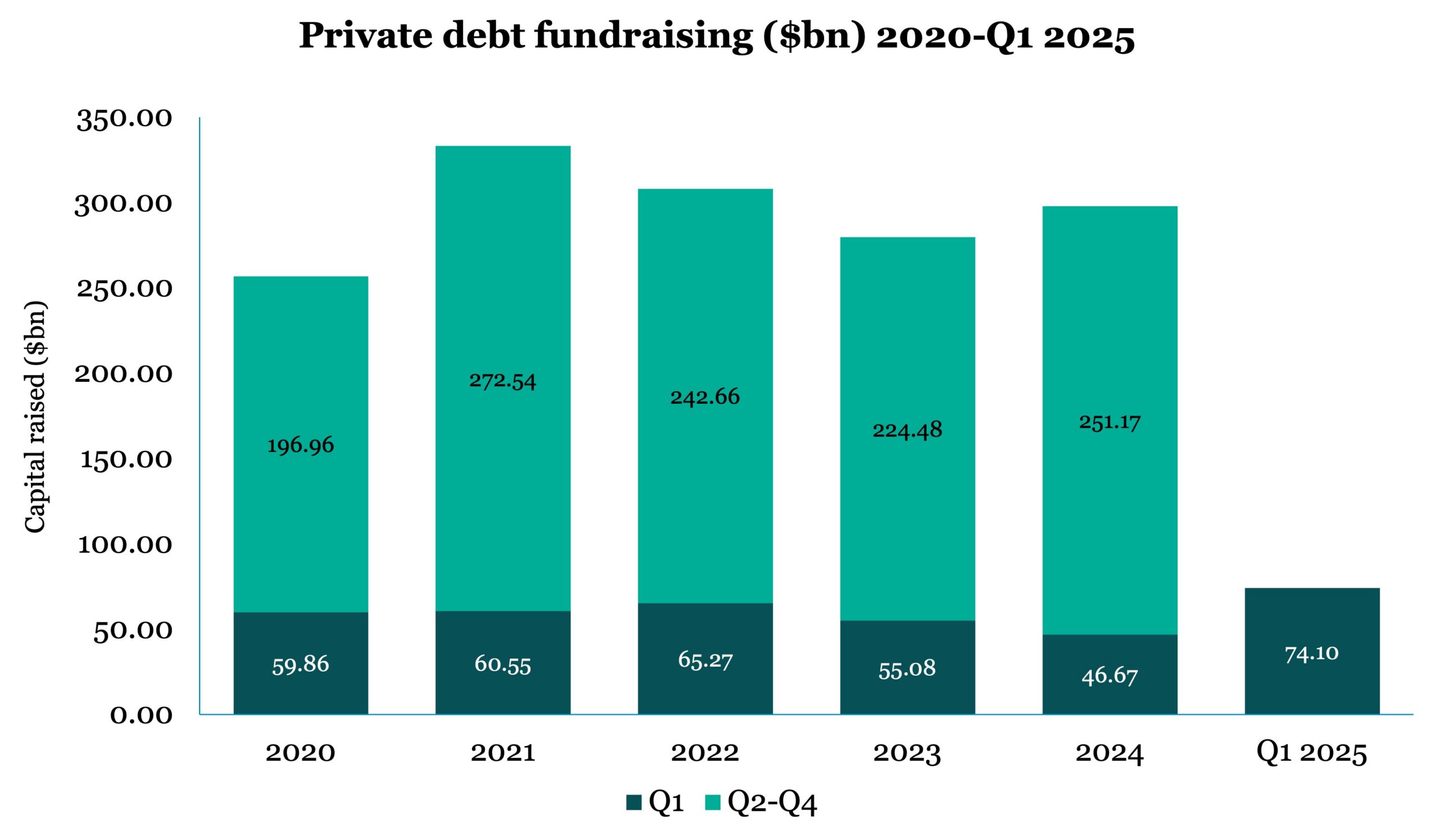
The first quarter of the year was the strongest Q1 on record for private credit fundraising with a huge $74.1 billion raised according to PDI data.
The trend is a marked difference from 2024 which experienced a slow start and some of the lowest fundraising seen in recent years at just $46.7 billion in the equivalent period. This sets 2025 up for the potential to be a record-breaking year if fundraising momentum can be maintained.
Q1 saw a more balanced allocation to strategies than the surge into senior debt seen during 2024 with roughly equal distribution among the three main strategies. Several large distressed debt fundraisings have led to the strategy being the most popular so far, representing 32 percent of all funds raised; however, this is likely to reduce as the data set grows and senior debt activity is expected to pick up.
The size of funds continues to grow as the major players are able to raise ever-larger vehicles in a market where scale has become a significant factor. Having ended 2024 with an average fund size of over $1 billion for the first time, we now see average fund size creep towards $1.1 billion, though this may reduce as the data set grows.
Interestingly, Q1 2025 has seen multi-regional funds dominate activity with $42.1 billion raised, while the usually much larger North American market takes a back seat. Fundraising in Europe continues to lag with the continent struggling to see much fundraising momentum through 2024 and early signs that this may continue in 2025. The rest of the world saw minimal activity in Q1.
As usual, corporate lending remains the dominant sector for private credit funds, making up 75 percent of funds raised. However, the first quarter saw a big bounce-back for real estate debt funds, which have struggled in recent years as real estate equity investment eased off in the wake of the covid-19 crisis.




Latest news

US leveraged loans returns turn negative in October
The Bloomberg US Leveraged Loan Index (Ticker: LOAN) has returned -0.26% this month through October 21, reducing its year-to-date return…

M&A activity begins to tick upward
In the third quarter of 2026, acquisition-linked loan volume across North America and Europe reached about $47 billion, up from $30.6 billion in Q2 and $29.5 billion a year ago.