



Click here to download report.
Do Banks Face Financial Stability Risks from Private Credit (PC) Exposure?
The financial stability risks from banks’ direct exposure to PC are currently limited despite its rapid growth over the last several years. This is largely due to the typical structure of PC lending that involves closed-end funds with committed capital, generally low fund-level leverage, and the banks’ superior position in the capital structure. Further, a downturn in the PC sector is unlikely to pose financial stability risks for the largest banks. Direct exposure represents less than 30% of equity, on average, for large banks although some smaller banking institutions have elevated PC concentrations.
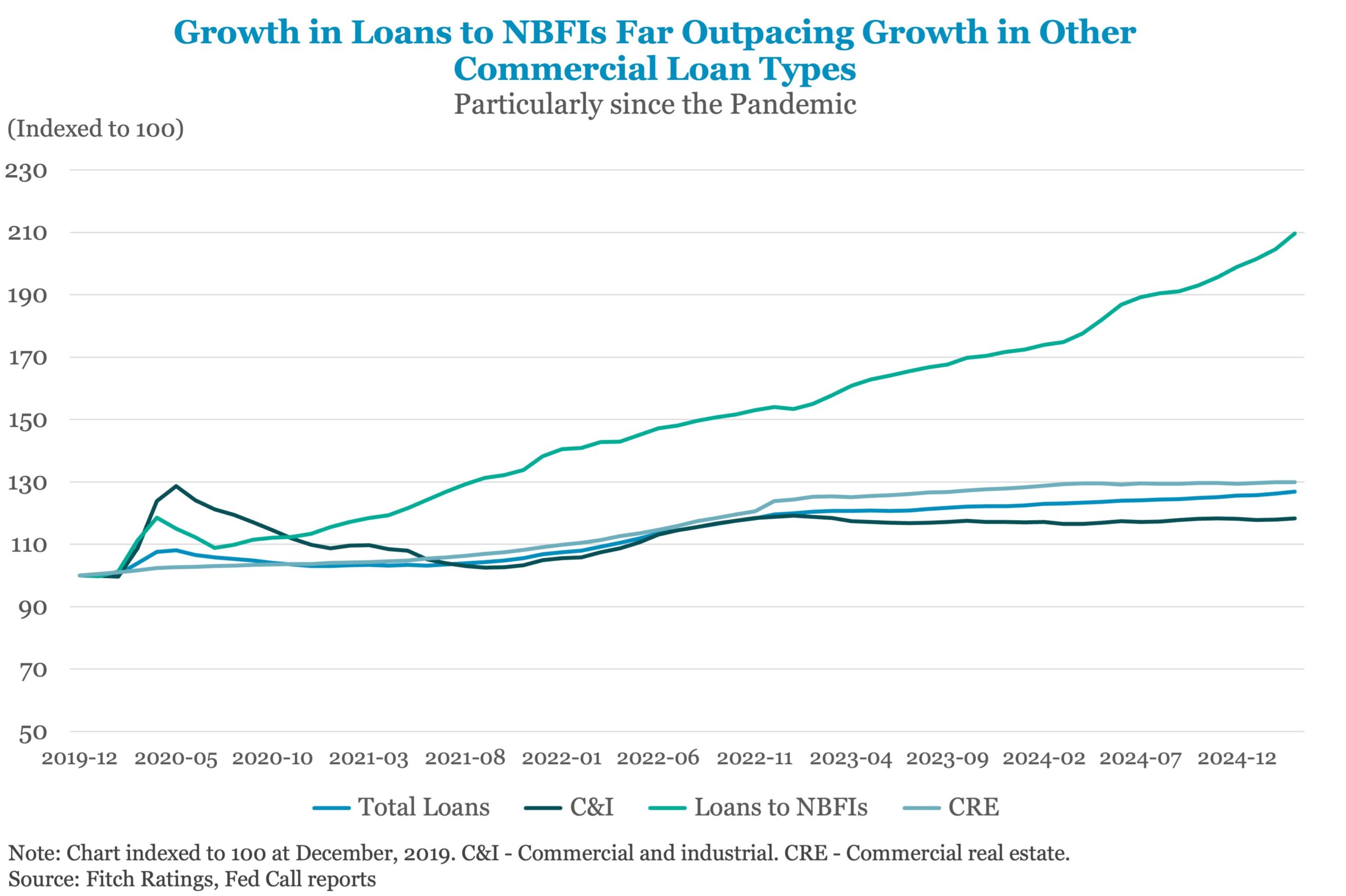
Robust growth in lending to non-bank financial institutions (NBFIs), particularly since the pandemic, has occurred during a time in which companies are increasingly obtaining financing from the non-bank sector, partially at the expense of banks.
U.S. bank lending to NBFIs continues to outpace all other types, with growing exposure driven by loans to PE and PC. Loans to NBFIs were up 20% YoY to approximately $1.2 trillion on March 31, 2025, as compared to commercial loan growth rate of just 1.5% during the same period.
Contact: Brad Hamner
Brad.Hamner@fitchratings.com





Latest news


Software, consumer-related direct lending deals fell in H1'26
The software and technology sector, the second-most-active sector in 2025 at 17% of total deal activity, slid to fifth place in the first half of 2026.

Unconquered Territory
With most of the map still unexplored, there’s room for a sequel.