


Markit Recap – 9/26/2016

We noted last week that Deutsche Bank could soon become the widest name in the Markit iTraxx Europe if its credit deterioration continued. It came to pass perhaps sooner than many expected, with its senior five-year spreads closing at 251bps on September 26, 6bps wider than Glencore.
This is a significant development, and reflects the negative sentiment surrounding the German bank. But the movements in subordinated , rather than CDS are probably more indicative of the wider malaise affecting European banks. The Markit iTraxx Subordinated Financials index hit 247bps on September 29, 60bps wider than level earlier this month. The index is now trading at a multiple of 2.43 to its senior sibling. It has only surpassed this multiple three times since the introduction of the latest ISDA definitions in October 2014. The first was in the days following the change in definitions, the second was in February of this year and the third on the day after Brexit.
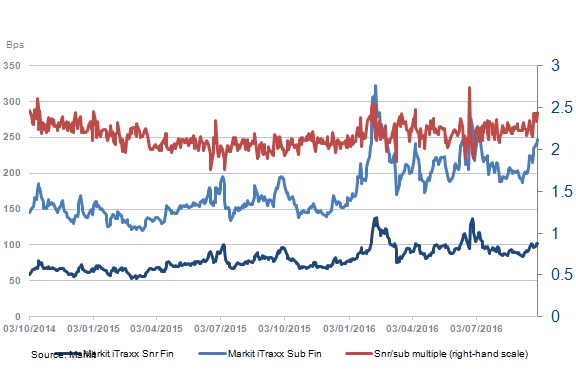
With the exception of Brexit, all of the previous circumstances occurred when the spectre of bail-ins was stalking the market and junior segments of the capital structure were perceived to be at risk. Banco Espirito Santo defaulted in August 2014, leaving subordinated bond holders wary of further cases of government involvement. In February of this year Deutsche Bank’s CoCo bonds were rumoured to be close to triggering, and the same speculation helped push subordinated spreads to their current elevated levels.
The underperformance of subordinated CDS is partly due to their treatment under the 2014 definitions. If a restructuring or governmental intervention credit event occurs on subordinated CDS, it won’t also trigger senior CDS. This is different to the 2003 definitions, where both senior and subordinated would trigger. So if subordinated debt was bailed-in due to government intervention, under 2014 definitions buyers of senior protection would remain intact.
Reports of the German government aiding Deutsche have been strongly denied by the bank and the Merkel administration, though much will depend on the eventual size of the fine from the US Department of Justice. But Deutsche isn’t the only bank that has been linked with state aid. Monte dei Paschi de Siena (MPS) is in a far more delicate position, a fact that is evident in the bank’s subordinated spreads. The five-year traded at 39 points upfront, a considerable increase from the already distressed level of 20 points seen earlier this month. The latest suggestion is that MPS will propose a voluntary debt-for-equity swap. This would be unlikely to trigger CDS, as it is voluntary. But the sharp widening in spreads indicates that the market is doubtful that bondholders would participate, and a restructuring might only be achievable with coercion. Such an outcome would put a credit event back on the table, something the Italian government would rather avoid in the run-up to the referendum later this year.
Contact: Gavan Nolan
Gavan.Nolan@ihsmarkit.com





Latest news


Software, consumer-related direct lending deals fell in H1'26
The software and technology sector, the second-most-active sector in 2025 at 17% of total deal activity, slid to fifth place in the first half of 2026.

Unconquered Territory
With most of the map still unexplored, there’s room for a sequel.