


Markit Recap – 3/30/2015

Lufthansa is one of several airline credits to have seen its CDS spreads tighten in line with the falling oil price. But the tragedy last week has led to investors focusing on the German firm, and the scrutiny is inevitably negative.
At the beginning of March Lufthansa’s five-year spreads were trading at 91bps, a considerable improvement from the 214bps reached last October. However, by April 1 they had gone into reverse and were quoted at 140bps. Its closest peers – British Airways and Air France – were more or less unchanged in recent weeks, highlighting the underperformance of Lufthansa.
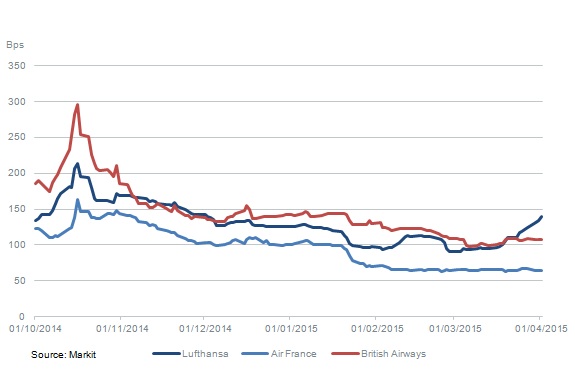
It is easy to see why the markets are worried. There are the direct compensation costs associated with the crash, though much of this should be covered by the company’s insurers. Perhaps of more concern is the potential damage to Lufthansa’s reputation. Safety is obviously paramount to an airline and carriers can little afford customers to have doubts on this front.
The company is already struggling with its industrial relations – a series of strikes led to mass cancellations. But is should be noted that firms affected by disasters often see their spreads recover. Carnival Corp owned the Costa Concordia cruise ship that sank in 2012 with the loss of 32 lives. Its spreads widened significantly following the news. But less than six months later it had recovered all the ground lost and subsequently rallied until the end of the year.
Of course, market conditions and macroeconomic circumstances are quite different now compared to 2012, and Lufthansa’s credit profile is weaker than Carnival’s. Nonetheless, it is worth bearing in mind that the markets can sometimes struggle to price tragic forms of event risk.
Elsewhere, Greece is still weighing on spreads, though its effect on the broader market is contained. The latest headlines suggest that the Greek government would to delay the €450 million payment to the IMF due on April 9 if the next tranche of bailout funds aren’t released. Markets are less susceptible to headline-driven volatility than at the height of the debt crisis, but it is still a reminder that Greece’s position in the eurozone is still far from secure. The sovereign’s illiquid CDS were quoted at 48 points upfront, indicating a high probability of default.
Contact: Gavan Nolan
Gavan.Nolan@markit.com



Latest news

US Leveraged Loan Launch Activity Moderates in July
The US leveraged loan market has recorded $14.01b of new launches through Wednesday, July 22, following $20.91b of issuance the…

US Direct Lending Spread Per Turn of Leverage Widens
Wider spreads and slightly lower leverage provided lenders with better risk-adjusted pricing across all deal sizes in the second quarter.

Concentrated Effort
Tech deals favored upper end of market, especially in 2021 when software valuations peaked. Source: KBRA DLD Research