



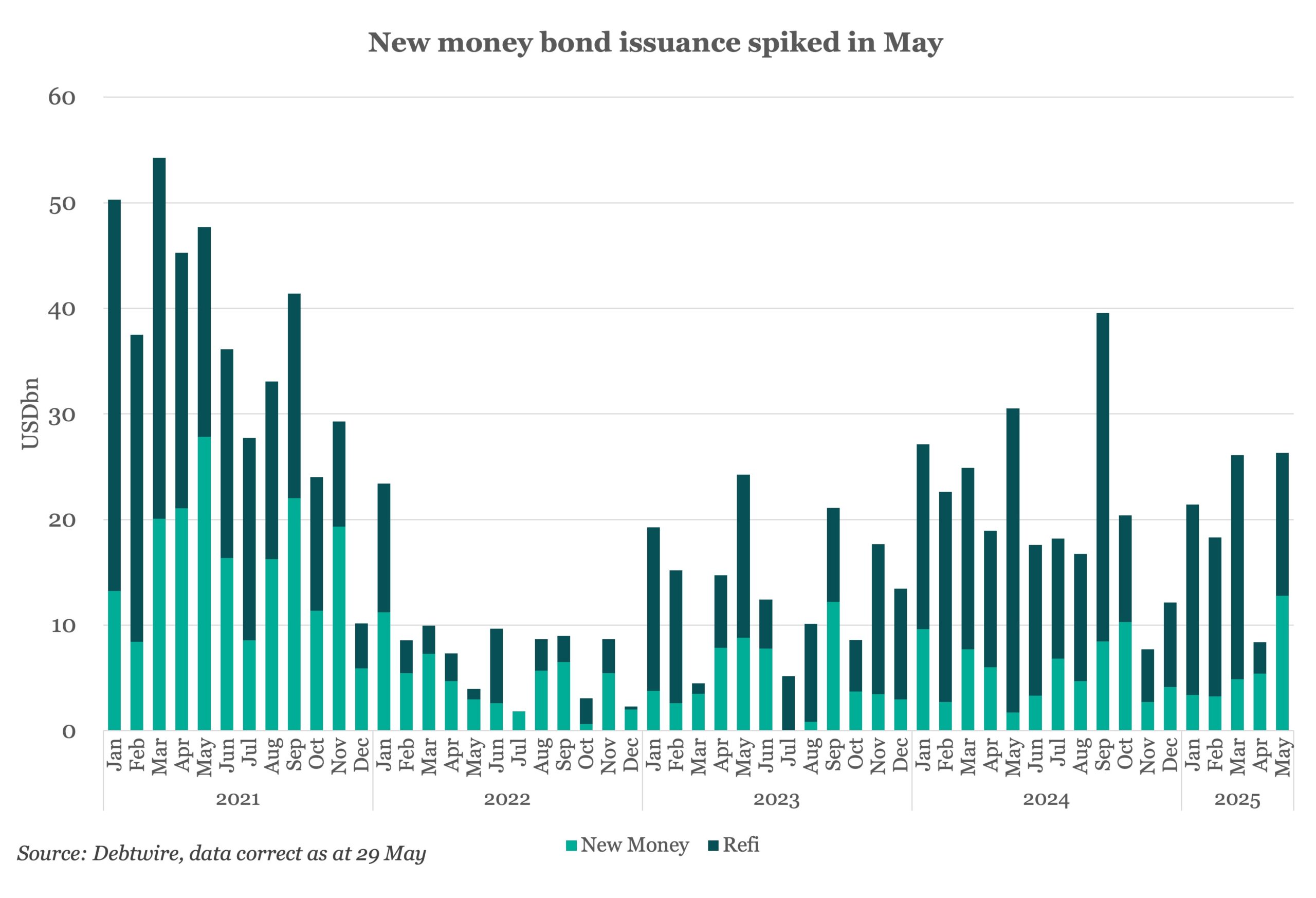
New money high-yield (HY) bond issuance showed signs of a revival in May, following a sluggish period of lower volumes since the start of the year.
New money bond volume surged to USD 12.78bn last month, a hefty rise from the USD 3.40bn recorded in January. May’s new money bond issuance represents the highest monthly volume since November 2021, when it reached USD 19.34bn.
Following April’s depressed levels, triggered by US President Trump’s “Liberation Day” tariff announcement on 2 April, the HY bond market has bounced back faster than the loan market, says Clarke Adams, head of high yield capital markets at SMBC Nikko Securities America.
“Spreads in HY blew out approximately 100 basis points (bps), then steadily tightened back down after about 8 April,” he adds. “Issuers in the bond market took the opportunity to go in May, when the markets recovered and spreads reached attractive levels. It was a lag effect – stuff pushed back in April showed up in May alongside normal May volumes.”
After months of loans dominating new issuance, May’s total bond volume of USD 26.31bn nearly matched loan volume at USD 26.36bn.
The shift has also been driven by changing interest-rate expectations, according to Adams. As previous forecasts of five rate cuts this year dwindled to one or two, fixed-rate bonds became more appealing for issuers hoping to lock in lower yields.
“In an environment with more inflation uncertainty, it makes sense to issue as much longer-tenor fixed-rate debt as possible,” he says, noting that this theme is likely to continue. “The worry in the market is a stagflationary environment, where inflation continues to tick up.”
The rise in new money bond issuance in May was primarily driven by technology, professional services, and chemical industries, which together made up USD 9.3bn, or 73% of the total.
Notable transactions contributing to new money bond issuance include a USD 1.85bn senior secured note launched by Voyager Parent to fund a USD 6.7bn merger of Everi and International Game Technology’s gaming unit. In addition, Toucan FinCo printed USD 1.33bn senior secured notes to fund the merger of IPL Plastics with Schoeller Allibert.
Herc Holdings Escrow issued USD 2.75bn senior unsecured notes for the takeover of H&E Equipment Services, Inc., while Shift4 Payments printed USD 1.32bn of senior unsecured notes to fund its buyout of Global Blue. Moreover, technology firm CoreWeave issued USD 2bn of senior notes for general corporate purposes.
On the loan side, volume was subdued and took longer to recover. The decline in leveraged loan volume can be attributed to tariff announcements and slower M&A activity.
“M&A processes slowed quite a bit in April,” says Adams. “Sponsors in particular favor the loan product to finance acquisitions because it gives them more flexibility around how they present numbers and lower pre-payment costs.”
Institutional leveraged loan volume in May was still down 86% from its peak of USD 191.64bn in January, indicating a slow recovery from the tariff impact. In contrast, the bond market, while also hit by tariffs, climbed 23% during the month to USD 26.31bn, up from USD 21.4bn in January, and April’s trough of USD 8.40bn.
“Once M&A volumes recover, you will start to see more traditional issuance,” explains Adams, noting that this is not a structural shift away from loans. “Sponsors still prefer loans for flexibility. If they are raising real size, they will go to the bond market to access different investor bases and get maximum capacity.”
Looking ahead, the bond market will remain dynamic and volatile as it continues to digest tariff-related volatility.
“Right now, the market is taking a constructive approach to pricing risk,” adds Adams. “The June-through-early-August window looks attractive for accessing the HY market.”
For access to our comprehensive news, analysis and data on the global loan and bond markets, please subscribe to Debtwire.
(Past performance is no guarantee of future results.)






Business of Private Credit: Coming Home
Much attention has been paid to the suitability of Matt Damon in the lead role as the wily Odysseus in this summer’s Christopher Nolan blockbuster.