



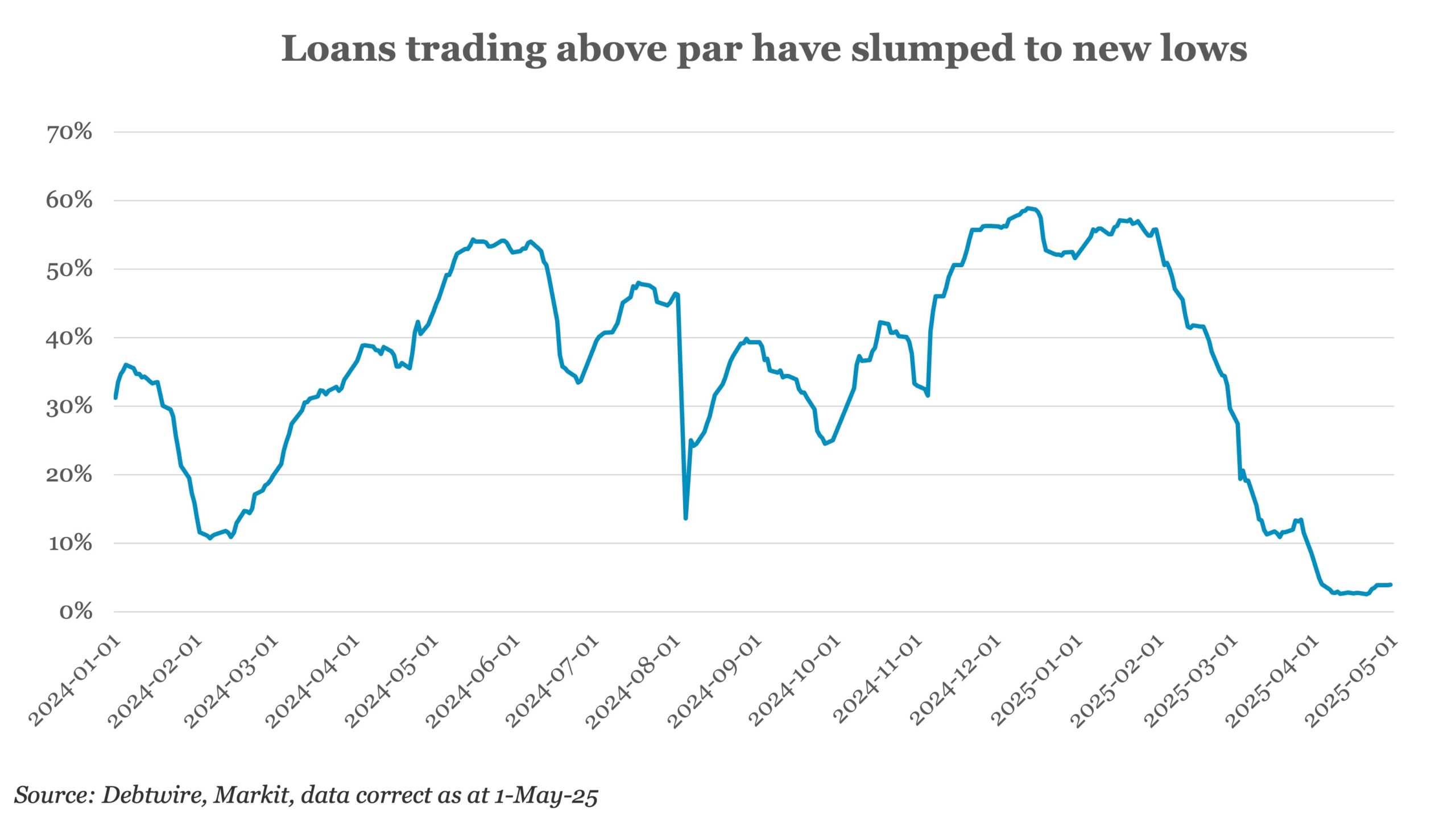
The wave of repricing deals seen at the start of the year is not expected to return until the percentage of loans trading above par in the secondary market bounces back.
Investors have been selling off their loans on concerns over companies’ ability to service debt against an increasingly challenging economic backdrop. This has manifested downward pricing pressure in the secondary market, raising yields on outstanding paper and making it more expensive for borrowers to issue primary debt.
“There is no real impetus to come and refinance or reprice paper because it is all trading at a discount. This means if you were to do it in the primary [market], it is going to be wide,” says Brian Bejile, CEO at loan trading platform, Octaura.
“When over 50% of loans are trading above par, the market is telling us there is an opportunity to do something in the primary market,” Bejile continues. He emphasizes that it only makes sense for companies to reprice a deal if conditions are tighter than they were when the loan was first issued.
Loan prices have been moving in a direction that is not constructive for repricing deals. The decline has been particularly sharp following US President Donald Trump’s “Liberation Day” announcement on 2 April launched a barrage of international trade tariffs. The percentage of loans trading above par plummeted to only 3.9% as at 30 April from a high of 56% on 6 January, according to Markit data compiled by Debtwire.
Repricing activity in the primary market ran high, while most loans traded above par in the secondary. That activity has been on a steady decline since January, when the percentage of loans trading above par reached its peak.
Data over the past five years shows just how close the correlation is between refinancing activity in primary and the percentage of loans trading above par in secondary.
Since January, leveraged loan issuance has fallen rapidly every month. A total of USD 180bn was secured in January, but this evaporated to USD 5.9bn in April.
This remarkable fall-off in activity speaks to continuing stability in the M&A market. Prior to the US tariff announcement in early April, new money activity accounted for a relatively steady USD 20bn each month.
With some stability returning to the market in May, new money activity is expected to return thanks to a robust 1Q25 for the M&A market resulting in strong demand for new paper.
However, the same cannot be said for refinancing activity as yet. The percentage of leveraged loans above par has increased in recent weeks, signaling a thawing of the market.
“The levels of loans trading above par doubled between 29 April and 6 May. It is exactly the development we want to see,” says a banker. “We still have ways to go [to get] back to where we were, but this is exactly the development we want to see.”
Increased appetite from investors for loans in the secondary market would be a welcome sight for borrowers eager to return to the tight spreads seen at the start of the year.
The percentage continued to surge following President Trump’s announcement on 12 May that the US would reduce 145% levies on most Chinese imports to 30%, while Chinese tariffs of 125% on US goods would decrease to 10%.
“I would not be surprised if the levels are above 30% today, up from slightly above 10% last week,” said a buysider.
For access to our comprehensive news, analysis and data on the global loan and bond markets, please subscribe to Debtwire.
(Past performance is no guarantee of future results.)







Business of Private Credit: Coming Home
Much attention has been paid to the suitability of Matt Damon in the lead role as the wily Odysseus in this summer’s Christopher Nolan blockbuster.