
Chart
Download Data
[wpdm_package id=’76143′]
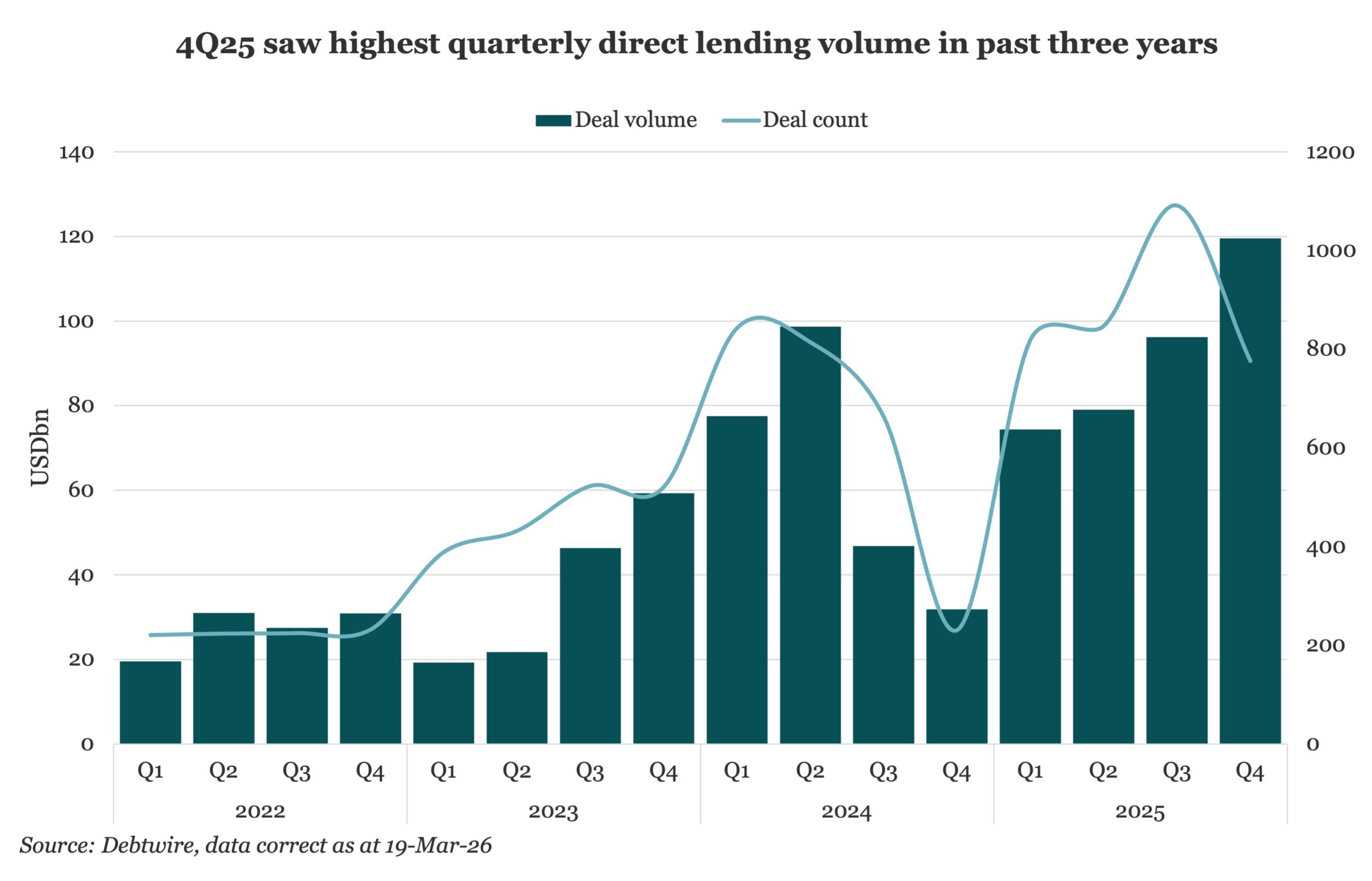
Direct lending volumes surged 24% quarter-on-quarter (QoQ) to USD 119.5bn in 4Q25, compared with USD 96.2bn in 3Q25. The volume in 4Q25 is also the highest quarterly total recorded for direct lending in the past three years, according to Debtwire data, beating 2Q24’s USD 98.7bn.
“We believe 4Q25 reflected a combination of easing financing conditions, improving sponsor confidence and a heavier refinancing calendar, with borrowers still valuing direct lenders for speed, certainty and flexible structures,” said Vishal Rana, Managing Partner at Sarva Capital. “The volume was driven by larger financings rather than board reopening across industries and sectors.”
While direct lending volumes went up, leveraged loan volumes plummeted 54% to USD 172bn in 4Q25, compared with USD 376bn in 3Q25 – the highest quarterly volume for leveraged loans in 2025.
Dividend recaps and M&A activity pick up in 4Q25
Direct lending volume for dividend recaps more than tripled in 4Q25, reaching USD 10.1bn compared with an average of roughly USD 3bn per quarter during the rest of 2025.
“PE hold periods have extended meaningfully, so sponsors are under real pressure to create liquidity while exits remain slow. Lower base rates and better financing windows made recaps more doable in 4Q25, but it is not a reflection of better credit quality,” Rana said.
“We reviewed a number of opportunities and were comfortable with recaps where the business is de-risked and leverage stays sensible,” he added.
Notable deals in 4Q25 included USD 1.02bn of credit facilities issued by PANTHERx Rare (Puma Buyer), an operator of specialty pharmacies, to fund a dividend to its financial sponsors, Nautic Partners, General Atlantic, and Vistria Group. Articulate Global, an online learning platform provider, also finalized a USD 550m deal to finance dividend payments to its shareholders.
M&A direct lending volume doubled QoQ in 4Q25, increasing to USD 24.9bn from USD 12.5bn in the previous quarter. The 4Q25 total was the highest quarterly M&A direct lending volume in the past three years, and it also surpassed M&A volume in the institutional leveraged loan market, which was just USD 19.6bn in the same period.
“We view the increase in M&A-related financing as the healthier signal because it points to narrowing valuation gaps and improving sponsor willingness to transact,” Rana added.
LBO volumes rise as refinancing remains stable in 4Q25
LBO-related direct lending activity also marked a 50% QoQ increase in 4Q25, with volumes rising to USD 36.4bn from USD 24.2bn in 3Q25. Refinancing activity remained relatively flat, moving down slightly to USD 35.7bn in 4Q25 from USD 37.7bn in 3Q25. Despite remaining flat in 4Q25, refinancing accounted for 35% of overall direct lending issuance in 2025, followed by LBO financing with 28% of overall volumes for the year.
Looking ahead
Despite record-breaking 4Q25, 2026 had a tough start for direct lending, with the recent tech selloff – driven by heightened investor concerns over the impact of AI on software‑focused business models – prompting many retail investors to withdraw capital from large funds, amplifying volatility across the sector. With technology accounting for roughly 34% of total direct lending issuance in 2025, the industry remains highly exposed to software credits.
“Looking into 2026, we remain constructive on direct lending, but the market will be more selective and more bifurcated. The recent tech selloff matters because software is a meaningful part of the US loan market and is concentrated in lower-rated, sponsor-backed credits, so underwriting around AI exposure and business-model durability needs to get tighter,” Rana said.
“Overall, 2026 still looks good for senior secured, sponsor-backed, cash-flow lending, especially in the core middle market,” he concluded.
For access to our comprehensive news, analysis and data on the global loan and bond markets, please subscribe to Debtwire.
(Past performance is no guarantee of future results.)



Latest news

US leveraged loans returns turn negative in October
The Bloomberg US Leveraged Loan Index (Ticker: LOAN) has returned -0.26% this month through October 21, reducing its year-to-date return…

M&A activity begins to tick upward
In the third quarter of 2026, acquisition-linked loan volume across North America and Europe reached about $47 billion, up from $30.6 billion in Q2 and $29.5 billion a year ago.