



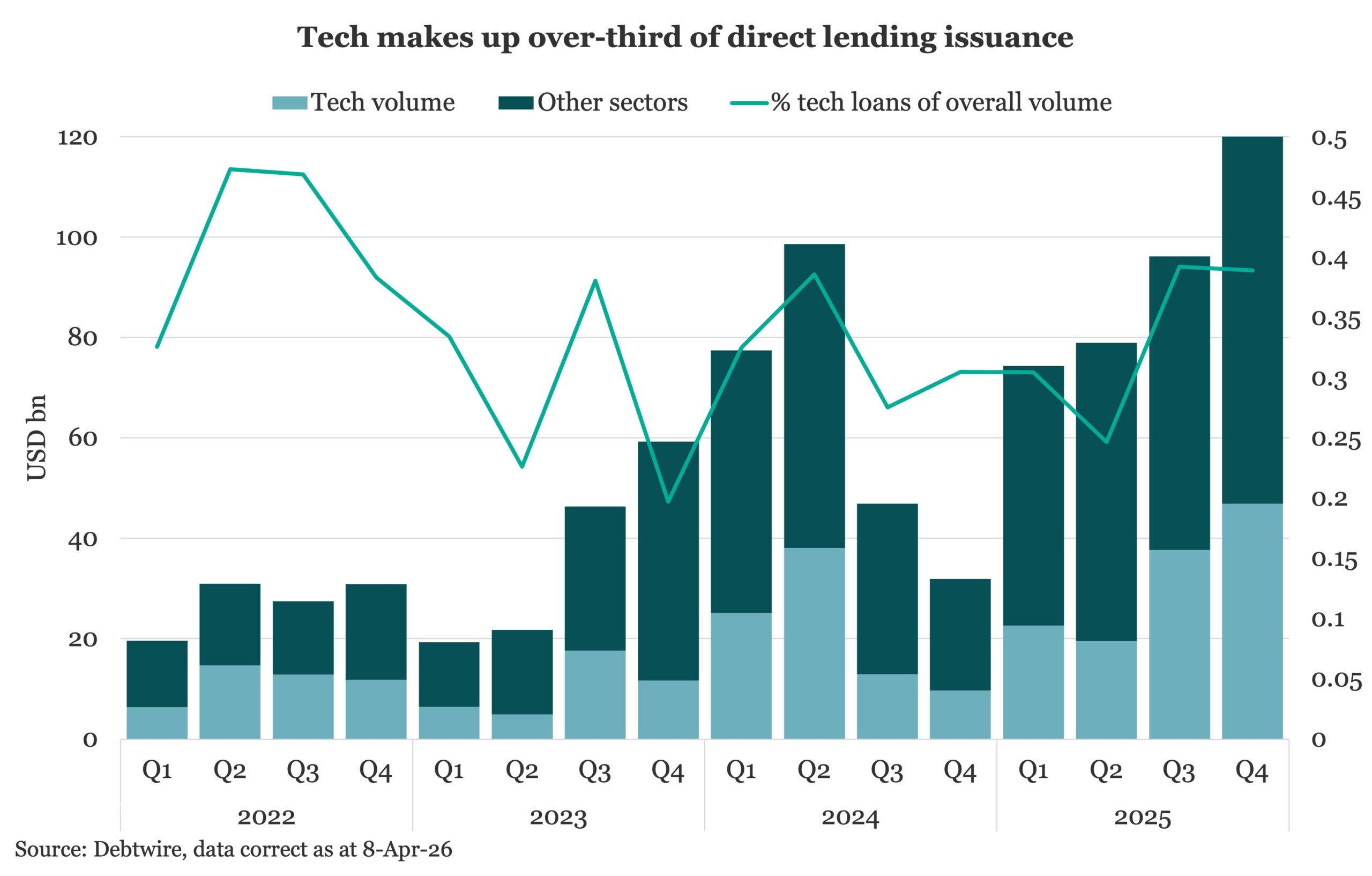
Technology companies have consistently accounted for more than one-third of direct lending issuance over the past three years. In 2025 alone, the sector raised USD 127bn out of USD 370bn in total issuance. Healthcare ranked a distant second, accounting for just 13% of volume, or USD 47.1bn, underscoring technology’s dominant position in the direct lending market.
The recent tech sell-off, instigated earlier this year by the launch of Anthropic’s Claude Cowork tool, which can analyze data and manage complex legal workflows, has raised investor anxiety around the long-term viability of traditional SaaS business models. These concerns have disrupted both the syndicated loan and direct lending markets as technology firms have comprised a significant share of activity across both financing routes in recent years.
The percentage of leveraged loans issued by tech companies trading above par in the secondary market declined sharply, from 43% on 22 January to just 13% by month-end, according to Markit data compiled by Debtwire. These shockwaves also spread through the private credit market, weighing on shares of major private credit lenders and prompting nervous retail investors to initiate early withdrawals from leading direct lending funds.
AI fears put tech‑heavy credit exposure under scrutiny
While much of the recent rhetoric surrounding the sector has focused on elevated risk and declining valuations, the industry encompasses companies both positively and negatively affected by the rapidly evolving AI wave.
“Technology is very broad and there is a lot of demand, companies are pivoting to AI, and the demand for financing is going to accelerate at a rapid pace,” said Matt Schwartz, US Finance Practice Group Leader at DLA Piper.
Within the tech sector, software has been the most prominent subsector for direct lending issuance, making up 88% of USD 111bn in volume in 2025 of overall tech issuance and made USD 75.4bn or 87.5% of total direct lending issuance of USD 86bn in 2024.
As a result, direct lending carries meaningful concentration risk in the software industry, which represents an even larger share of total issuance than in the syndicated loan market. In both 2024 and 2025, software accounted for approximately 20% of total leveraged loan issuance, compared with around 30% of total direct lending issuance in each year, according to Debtwire data.
Software direct lending allocation
Direct lenders have played a central role in financing the software sector, supporting significant leveraged buyout and refinancing activity.
Software borrowers fit a profile well suited to private debt financing. Many issuers trade at high valuations relative to book value, exhibit idiosyncratic risks with limited comparable companies, and many require smaller initial investment sizes. This favors an investor base with a higher risk tolerance and the ability to deploy capital into story-driven credits.
Direct lenders have materially outpaced the syndicated loan market in financing software-related buyouts. Direct lending-backed software LBO volumes reached USD 42bn in 2025, compared with USD 18.5bn of software LBO financing in the leveraged loan market.
In 4Q25, LBOs represented half of software direct lending issuance, totaling USD 21bn out of USD 40.7bn for the quarter. For the full year, buyouts accounted for 38% of total software direct lending issuance, while refinancings made up 34%.
Looking ahead
Despite the recent software-driven volatility, direct lenders and their advisors have shown optimism for direct lending in 2026. Fundraising trends support this outlook. Debtwire tracked USD 139.7bn in US-focused direct lending fundraising in 2025, with an additional USD 41.6bn raised in 1Q26, allowing for continued deployment.
“There are still a lot of investors who want to be invested in the space. It will be a very good year for technology”, said Schwartz.





Latest news

Rate hike expectations ease as term SOFR curve flattens
The CME six-month Term SOFR rate reached a recent high of 3.979% on July 28 before retreating to 3.837% as…
3Q26: New loan assets rise to 44% of total lending, a 3-year high
New loan assets as a proportion of total US loan volume make up 44% of the 3Q26 pipeline to date,…

North American GPs dominant as fundraising accelerates
Our PEI Private Credit 200 ranking also shows capital raising increasing overall – and accelerating especially fast for the largest…