Markit Recap – 2/23/2015

It is a truism that the CDS product garners more headlines when companies default or are close to triggering a credit event. Last week we saw a typical example, and it will surely be the case next week as well.
A credit event auction was held for Caesars Entertainment Operating Co on February 19 after the entity filed for chapter 11 bankruptcy protection in January. Though there were some issues over the timing of the credit event, it was certainly no surprise that Caesars defaulted. The name was trading at over 40 points upfront two years ago and its credit profile has been on a steady decline since. But there was a rapid deterioration in the fourth-quarter of last year, and the upfront level of 84 points implied a near certainty of default.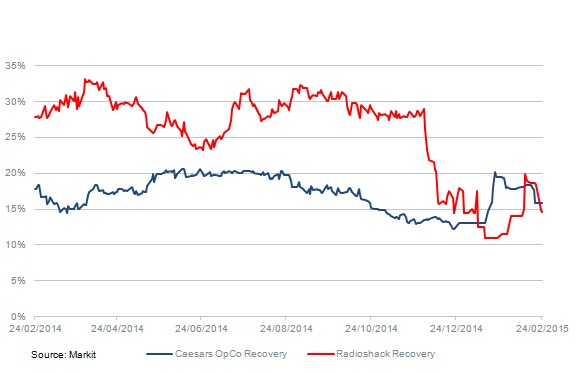
When the auction was eventually held, the final price was 15.89%. This is reasonably low, but investors were well aware of Caesars post-LBO damaged balance sheet and it was to be expected that the recovery rate would be well below the standard 40%. Markit data shows that the consensus recovery rate for Caesars fluctuated between 12% and 20% over the past year, demonstrating the low expectations.
It appears to be a similar story with Radioshack, which filed for Chapter 11 on February 5. It has been on a downward spiral for about the last four years, and there was an inevitability about the credit event given that its CDS have been trading above 50 points upfront for almost 12 months. But we can see from Markit’s data that dealers really started to adjust their recovery rates downward in December, suggesting that it was only recently that the real preparations for default began. The current recovery rate of 15% indicates a similar level to Caesars, though it should be that the final price is determined by an auction and is subject to the technical dynamics of that process.
One name that appears to be less likely to default is Greece. The sovereign’s proposed reforms were approved by eurozone finance ministers, leading to Greece’s CDS levels moving to 35 points upfront (2003 definitions), their best level for over a month.
However, this is by no means the end of the matter. Greece’s credit curve remains steeply inverted, a reflection of the short-term nature of the latest agreement. A long-term solution is still some way off, and investors will stay cautious until Greece’s status within the eurozone is secured.
Contact: Gavan Nolan





Latest news

Multiples on PE buyouts
This quarter marks our integration of SPI by StepStone as the primary source for US buyout valuation metrics for the PE Breakdown.

US Leveraged Loan Issuance Slows to $76.5b in July
The US leveraged loan market has continued to slow from the May level of $104.7b, with approximately $76.5b priced in…