


Markit Recap – 10/3/2016

Numerous press articles in recent years have predicted the death of single name CDS. Onerous capital requirements, costly changes in market structure and alternative hedging tools have all been cited as factors driving the inexorable decline in the product.
No one could deny that CDS activity has dropped sharply from its pre-crisis heyday. But the last few weeks have shown that there is an abundance of life in the CDS market and both traders and investors remain committed to using single name protection.
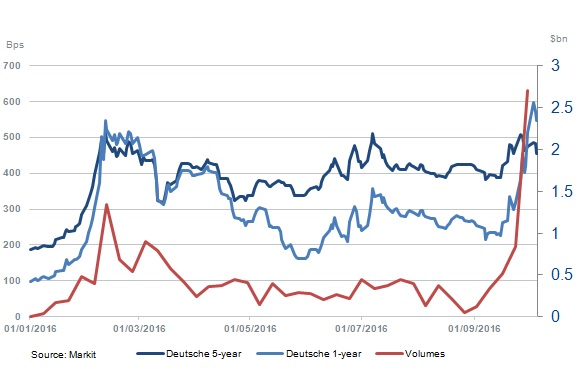
Just over $607bn was traded last week, the highest amount in a non-roll week since the ISDA definition changes in 2014. Deutsche Bank drove the jump in activity, with $2.7bn in notional traded. This was the highest amount since the DTCC started publishing market risk activity in 2010. CDS tends to see volumes rise when negative credit sentiment increases; it is still the most effective way of hedging credit risk and taking short directional views. This is certainly the case with Deutsche, which has struggled to shake off concerns about its capital position and the potential impact on outstanding CoCO bonds.
This week we saw the bank’s credit curve invert, which can be a signal of credit distress. Deutsche’s subordinated one-year spread was trading at 598bps, more than 100bps wider than the five-year level. Curve flattening trades were active at both the short- and long-end, and no doubt contributed to the jump in volumes. If sentiment improves on Deutsche – and there are signs that spreads are tentatively recovering – then profit taking and reversal of curve flatteners will augment volumes in the coming weeks.
Idiosyncratic risk aside, the mounting likelihood of a “hard” Brexit and rumours that the ECB will begin to taper QE next year are counterbalancing the partial recovery in financials. But volatility is relatively low, which could entice investors into long positions. CDS will be the instrument of choice for many, and the product’s naysayers may have to find another asset class to denigrate.
Contact: Gavan Nolan
Gavan.Nolan@ihsmarkit.com





Latest news


Software, consumer-related direct lending deals fell in H1'26
The software and technology sector, the second-most-active sector in 2025 at 17% of total deal activity, slid to fifth place in the first half of 2026.

Unconquered Territory
With most of the map still unexplored, there’s room for a sequel.