



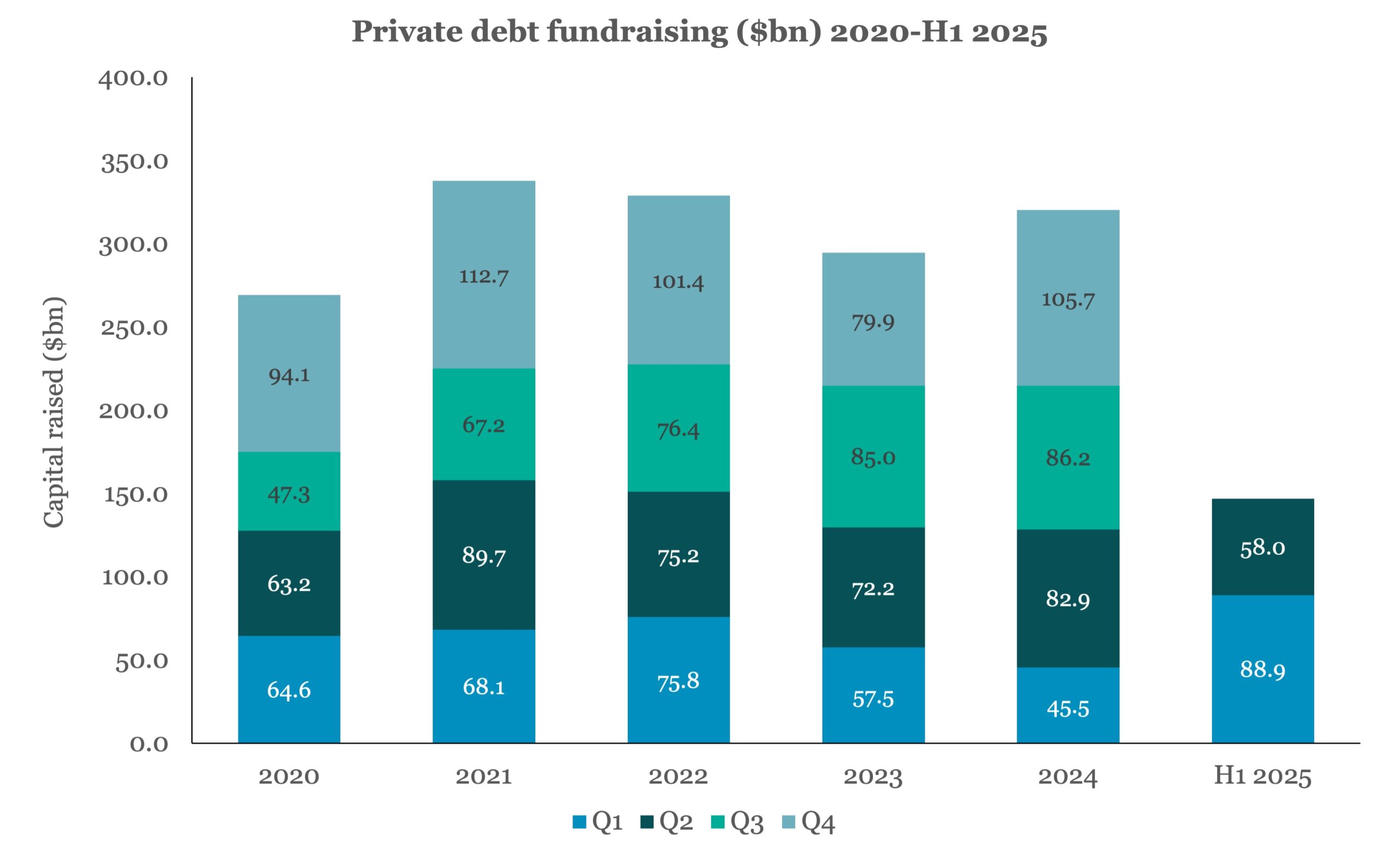
Our data shows the brakes have been slammed by investors after a fast start to the year for those raising fresh capital.
‘Volatile’ is the word frequently being used to describe the economic and political backdrop to investing today. For private debt managers, that same volatility is being seen on the fundraising front.
In the first quarter of this year, almost $89 billion was closed by private debt funds – comfortably beating the previous first-quarter record of almost $76 billion in 2022. While Q1 was boosted by Oaktree’s $16 billion distressed fund, it would still have been a stellar fundraising period even without it.
But in April came “Liberation Day” in the form of the US’s global trade tariffs – a development which has since been followed by renewed bouts of geopolitical instability, notably in the Middle East. Could private debt fundraising withstand these latest blows?
The indications from Q2 appear to be an emphatic ‘no’, with fundraising plummeting to $58 billion – lower than in any second quarter at least since 2020. Combining the two very different quarters so far this year adds up to almost $147 billion for H1 2025 – still fairly healthy compared with recent years, and a comfortable increase on the $128 billion raised in the first half of last year.
The question now is whether fundraising is stuck in a rut as GPs and LPs alike ponder continuing uncertainty with regard to the macro climate, or whether at least some of Q1’s momentum returns as investors recover from the shellshock and decide to put capital to work.
So far, it’s a year which has been far less dominated by senior debt strategies. In full-year 2024, around two-thirds of capital (65 percent) was allocated to senior debt. But in H1 2025, this figure almost halved to 34 percent, with distressed debt (aided, let’s not forget, by Oaktree’s fund) the second-most popular strategy on 24 percent.




Latest news

US Leveraged Loan Launch Activity Moderates in July
The US leveraged loan market has recorded $14.01b of new launches through Wednesday, July 22, following $20.91b of issuance the…

US Direct Lending Spread Per Turn of Leverage Widens
Wider spreads and slightly lower leverage provided lenders with better risk-adjusted pricing across all deal sizes in the second quarter.

Concentrated Effort
Tech deals favored upper end of market, especially in 2021 when software valuations peaked. Source: KBRA DLD Research