
Download PitchBook’s Report here.
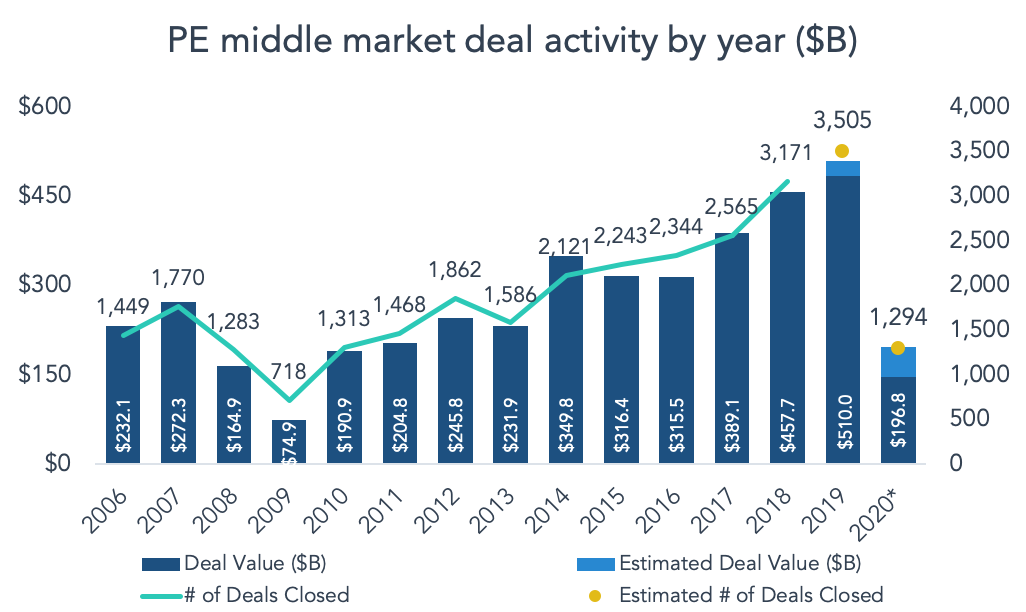
PitchBook’s Q2 US PE Middle Market Report releases today – download your copy here – and the headline numbers largely mirror the broader PE market. Deal volume cratered in Q2, as expected, falling from an estimated 789 deals in Q1 to 504 in Q2, a 36% drop. Combined value declined by the same percentage, from an estimated $120.1B in Q1 to about $76.7B in Q2. COVID’s impact on the lower middle market is more pronounced but also somewhat masked by the data: a July report from Proskauer Rose found that the default rate for the $25M-$50M EBITDA range was about 6.7%, up from a 5.2% default rate in Q1. The $25M and below EBITDA numbers were worse, with a 9.2% default rate compared to 7.0% in Q1.
A separate analysis from PitchBook estimated that about 85% of dry powder is earmarked for 2017, 2018 and 2019 vintages. Among other things, that means older funds have less wherewithal to infuse latent capital into their struggling companies. The good news, relatively speaking, is that fundraising looks healthier in the middle market compared to the whole. H1 fundraising didn’t fall as steeply as the broader PE market, with $44.3 billion raised through June. On paper, that puts 2020 on pace to surpass 2015 levels of $80.5 billion. But the dichotomy in fund sizes is striking—only three closed in the $100M-$250M range through June and totaled less than $500 million altogether. Between 2012 and 2019, at least 35 such funds were raised every year, combining for at least $6 billion each time. For the first half of 2020, LPs preferred funds on the larger side. Middle market funds in the $1B-$5B range made up half of all fund closes through June; they usually account for 20% to 30% in any given year.




Latest news
US Leveraged Loan Issuance Slows to $76.5b in July
The US leveraged loan market has continued to slow from the May level of $104.7b, with approximately $76.5b priced in…