


Private Debt Intelligence – 1/2/2017

Infrastructure Debt Rises in Prominence
Although banks are the primary providers of financing for global infrastructure projects, liquidity and capital requirements can prevent them from fully serving the market. This has led to an opportunity for the unlisted fund management industry to become a significant niche player in the provision of debt financing for infrastructure.
As such, fundraising in the space has risen significantly in recent years. A total of $32.9bn of investor capital has been secured since 2013, more than twice the amount ($14.1bn) that was raised by funds closed in the preceding four years. Demand for infrastructure debt vehicles appeared to slow in 2016 YTD, with just 10 funds raising a combined $4.3bn of commitments, well down on the record $13.1bn secured in 2013. However, this slowdown in fundraising through 2016 YTD should be interpreted in the context of a cool-off in the wider private debt industry.
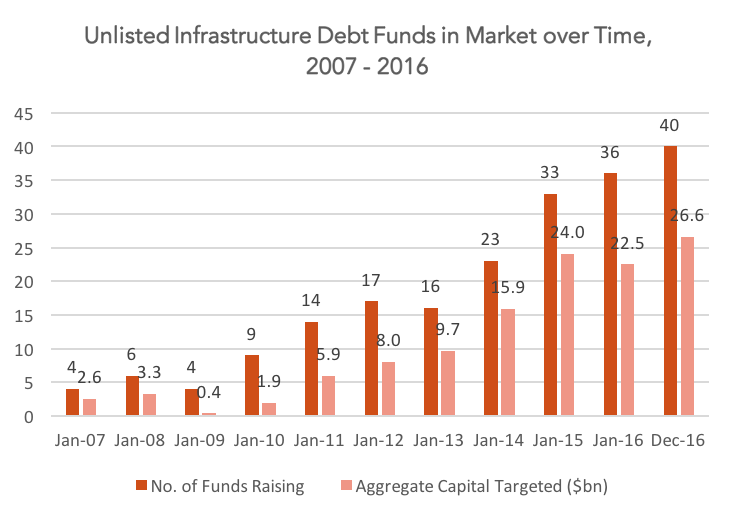
As of December 2016, there were 40 infrastructure debt funds on the road, targeting an aggregate $27bn; this marks an 18% increase in target capital from January 2016, and is substantially up from the 16 funds that were targeting $9.7bn at the start of the record fundraising year in 2013. Furthermore, 18 of the funds in market have already held an interim close, securing $6.4bn in investor capital, which indicates that 2017 could well be a banner year for the space.
IFC Asset Management Company’s, MCPP Infrastructure, the largest infrastructure debt fund on the road, is seeking $5bn in investor commitments. The vehicle is focusing on opportunities in the power, water, transportation, and telecommunications systems sectors in emerging markets.
With the UK government and US President-Elect both pledging significant investment to the infrastructure market, unlisted infrastructure fund managers will hope to stoke further interest in the debt space, as non-traditional financers of these projects. In the longer-term, regulation around the credit industry could drive infrastructure debt into the mainstream as it continues to become an ever-more prominent component of the unlisted infrastructure industry.





Latest news


Software, consumer-related direct lending deals fell in H1'26
The software and technology sector, the second-most-active sector in 2025 at 17% of total deal activity, slid to fifth place in the first half of 2026.

Unconquered Territory
With most of the map still unexplored, there’s room for a sequel.