


Private Debt Intelligence – 11/21/2016

First-Time Private Debt Fundraising
First-time private debt funds are of increasing interest to investors: a recent Preqin study found that the majority of investors across the private capital landscape will now consider investing in emerging funds. However, it appears that this segment of the market has yet to fully develop, and continues to be bound to the fundraising picture at the top end of the industry.
Over the past decade, first-time fundraising has often run counter to the overall private debt fundraising environment. For instance, in the period 2010-2012, when overall fundraising saw annual increases, first-time private debt fundraising saw declining levels of capital raised, not just proportionally but in currency terms. Conversely, between 2015-2016 the total level of private debt fundraising has fallen significantly, but first-time private debt funds have registered a small increase in both the level of capital raised, and the proportion of overall fundraising.
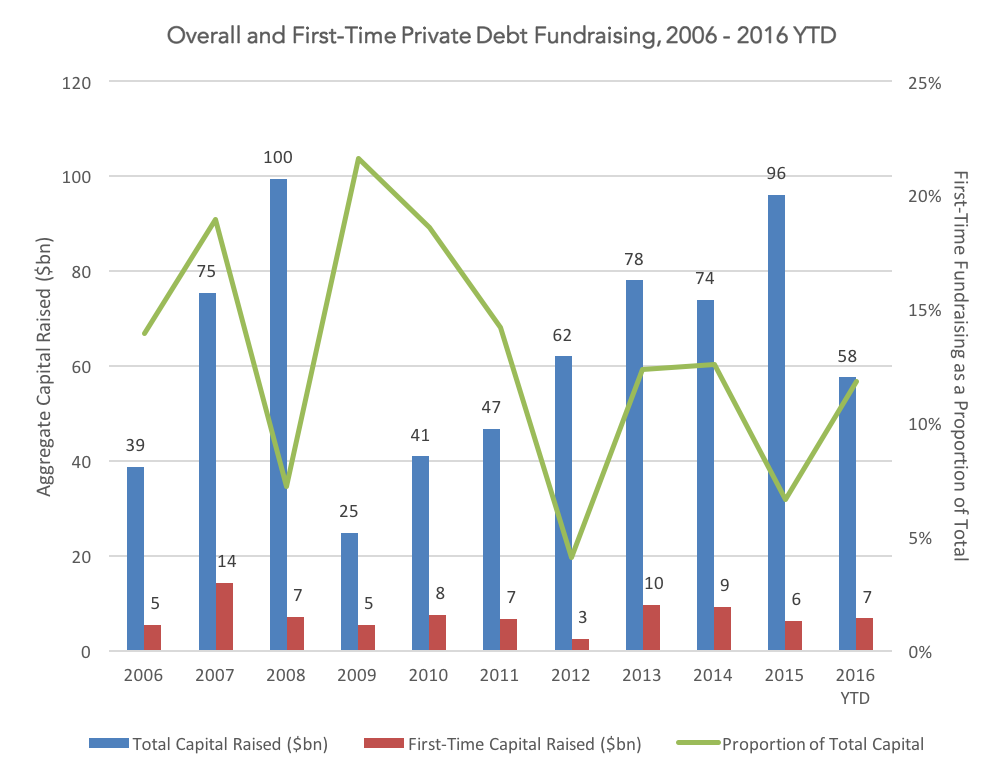
Proportionally, it is perhaps to be expected that in years that have high overall levels of private debt capital raised, the proportion represented by first-time funds will be lower: first-time funds tend to be smaller than average, and are easily dwarfed by the largest flagship funds. However, it would still be expected that first-time fundraising would conform to macro-economic trends that impact the overall fundraising picture. But this is not always apparent – first-time private debt funds saw fundraising decreases in 2008, 2012 and 2015, all of them robust years for the industry as a whole.
This is perhaps indicative that, despite the private debt industry’s growth in size and significance over the past decade, it has yet to reach a ‘critical mass’ at which point it might function as the private equity industry does. The largest private debt funds run by the most experienced managers have seen exponential increases in size, which have not been matched by the industry at large, and certainly not by emerging fund managers. As a result, these funds still accrue the bulk of available investor capital when they are being marketed, and there is less incentive than in private equity for investors to seek out and commit to smaller emerging vehicles. Investor sentiment towards private debt remains on an upward trend, but it will need to rise further before first-time private debt fundraising is not eclipsed by the largest funds.





Latest news


Software, consumer-related direct lending deals fell in H1'26
The software and technology sector, the second-most-active sector in 2025 at 17% of total deal activity, slid to fifth place in the first half of 2026.

Unconquered Territory
With most of the map still unexplored, there’s room for a sequel.