



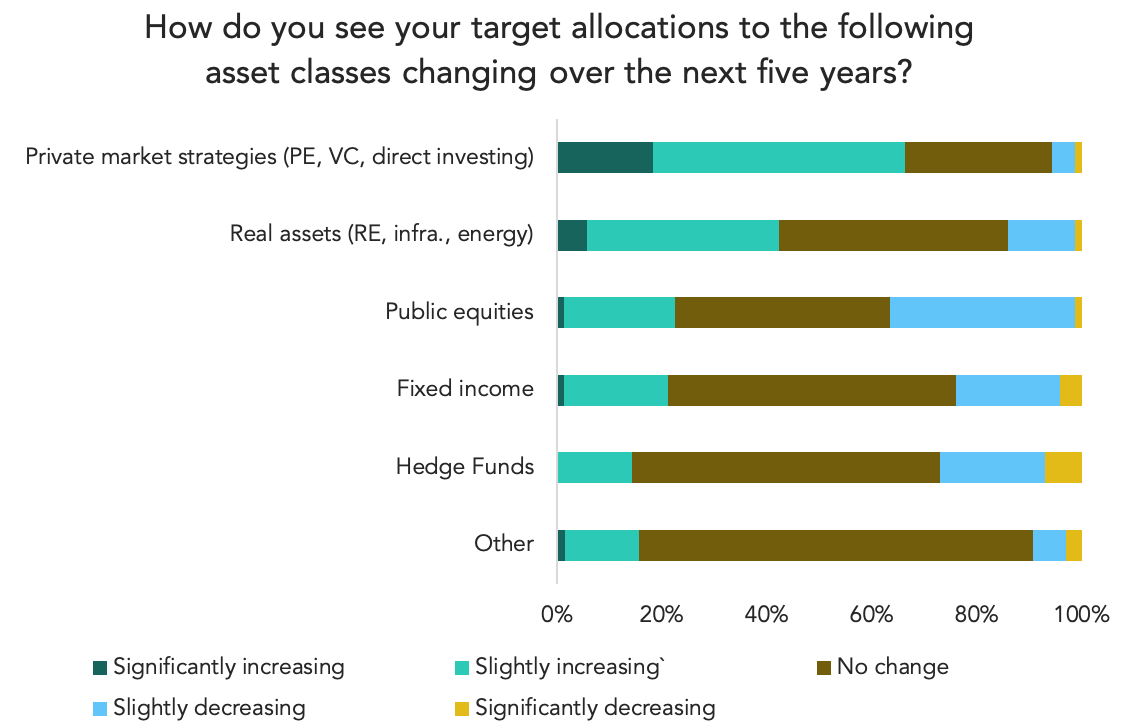
Private market strategies are growing and will continue to grow for the foreseeable future. PitchBook heard from 101 institutional limited partners as part of a new survey report (Private Markets: A Decade of Growth) to see where LPs are allocating their money in the near-term. Two-thirds said they’d be increasing, significantly or slightly, their allocations to the private markets. That percentage far outpaces other asset classes, most of which will stay the same or go down slightly.
It’s worth pausing to note not only how big the private markets have become but how important they’ve become, as well. Private equity was something of a curiosity as recently as the 80s, when many on Wall Street didn’t quite get what LBOs were all about. The biggest buyout shops are now mentioned in the same sentence as the biggest banks and asset managers. PE has revitalized thousands of brands and serve as an important feeder into the multitrillion-dollar M&A market. The same applies to venture, which generates so much energy and value that public companies need to keep in front of trends emanating out of Silicon Valley. Venture is both a threat and a resource for corporate America, which snaps up hundreds of startups every year. In a sense, venture capital (and technology in general) has replaced private equity as the real barbarian at the gate.
Public equity investors are increasingly aware of both: 42% of our respondents listed private market trends as “very” or “extremely” important to keep track of. Less than 20% said they weren’t important at all. Percentage-wise, that’s probably a compliment. Both revitalize the public markets: Between 2009 and 2018, VC- and PE-backed IPOs have contributed $1.4 trillion in IPO value on a pre-money valuation basis, according to PitchBook data. That’s a fraction of the eventual value propelled by the private markets over the years, considering Facebook and Google’s combined market cap this week was about $1.3 trillion.





Latest news

Rate hike expectations ease as term SOFR curve flattens
The CME six-month Term SOFR rate reached a recent high of 3.979% on July 28 before retreating to 3.837% as…
3Q26: New loan assets rise to 44% of total lending, a 3-year high
New loan assets as a proportion of total US loan volume make up 44% of the 3Q26 pipeline to date,…

North American GPs dominant as fundraising accelerates
Our PEI Private Credit 200 ranking also shows capital raising increasing overall – and accelerating especially fast for the largest…